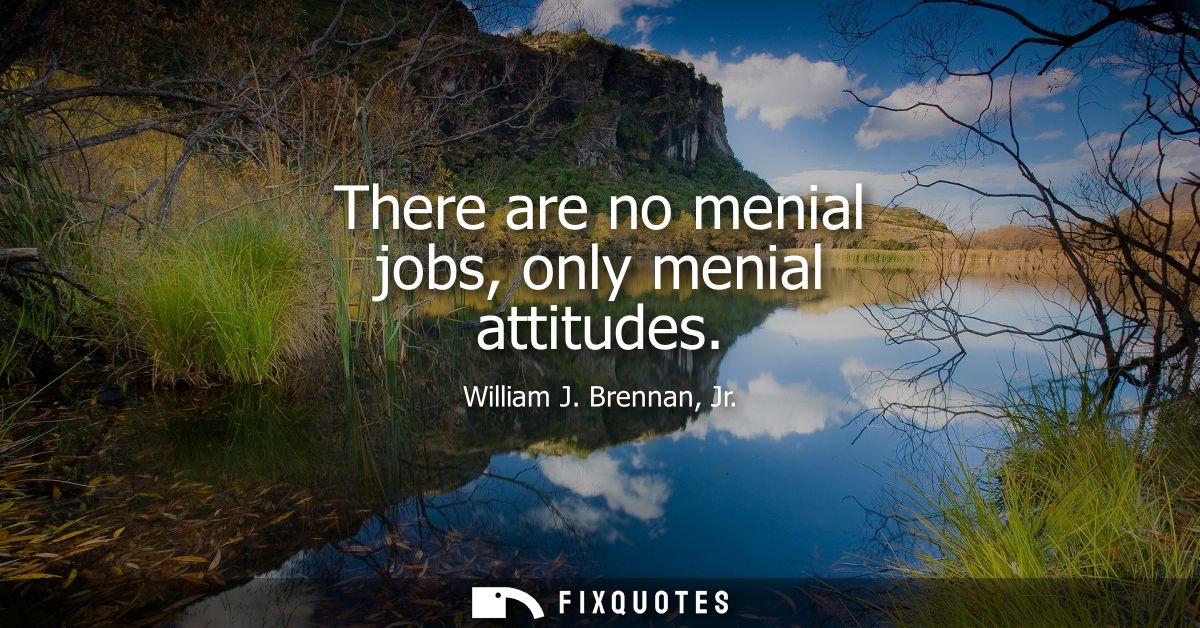
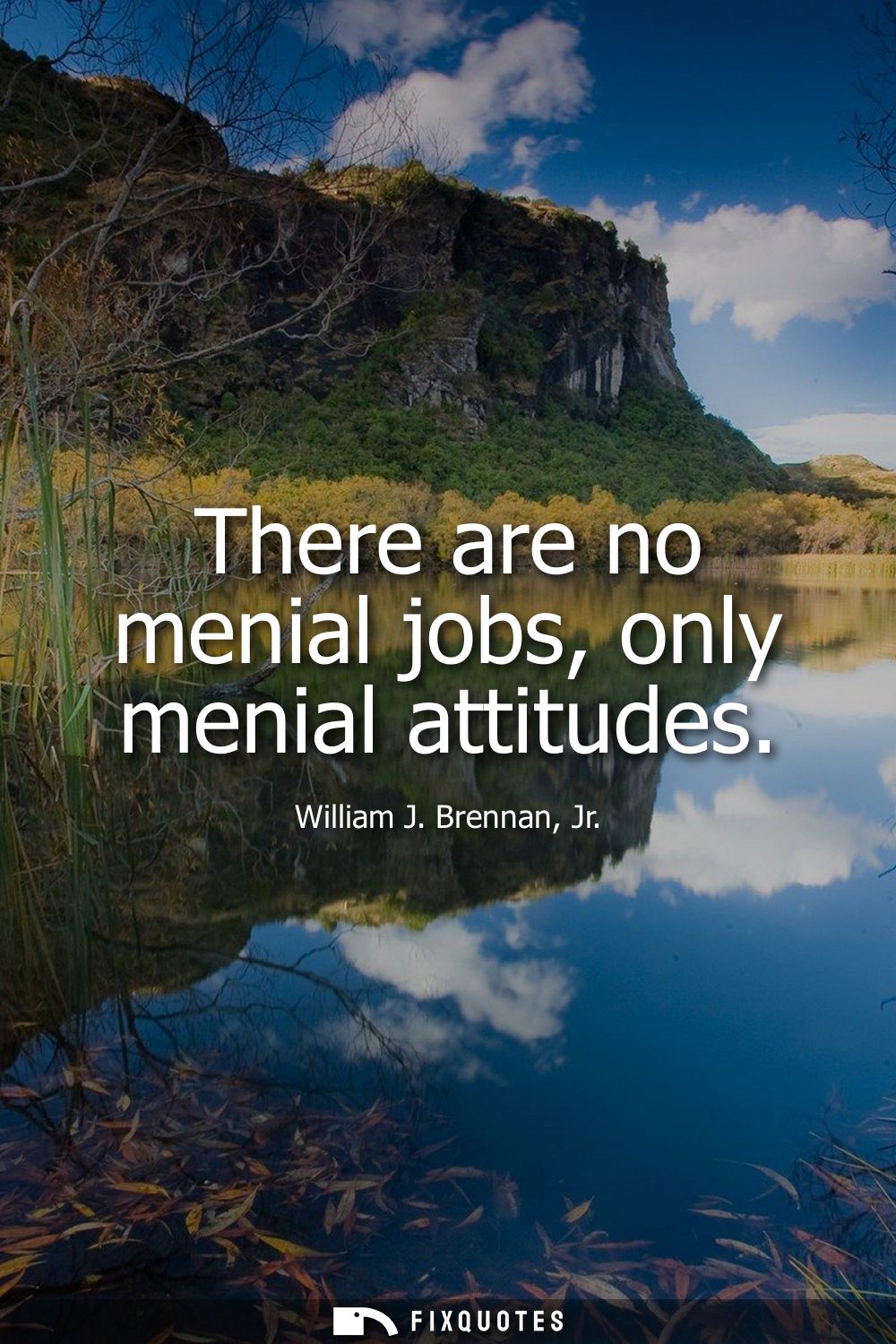
"There are no menial jobs, only menial attitudes"
About this Quote
Brennan’s line lands like a moral bench slap: the insult isn’t in the work, it’s in the way we choose to see the people doing it. Coming from a Supreme Court justice, that distinction matters. Judges live in a hierarchy of titles, rituals, and deference, yet Brennan flips the axis from status to dignity. It’s a compact rebuke to a culture that launders contempt through vocabulary: “unskilled,” “low-end,” “just a” anything. The sentence doesn’t romanticize labor; it targets the spectator’s posture.
The intent is clarifying and corrective. “Menial” is exposed as a social judgment masquerading as a description. By relocating the ugliness from job to attitude, Brennan turns a supposedly neutral classification into an ethical failure. The subtext is that degrading work is often a pretext for degrading workers, which in turn makes it easier to underpay them, ignore their safety, or treat them as interchangeable. If the job is “menial,” the person can be too.
Contextually, Brennan’s jurisprudence leaned toward human dignity and the lived consequences of law over abstract formalism. Read beside that legacy, the quote becomes less motivational poster, more civic standard: a society reveals itself in how it narrates necessary work. It also smuggles in accountability. If contempt is an “attitude,” it’s chosen, not inevitable. Brennan isn’t asking you to applaud every task; he’s asking you to stop using work as an excuse to rank human worth.
The intent is clarifying and corrective. “Menial” is exposed as a social judgment masquerading as a description. By relocating the ugliness from job to attitude, Brennan turns a supposedly neutral classification into an ethical failure. The subtext is that degrading work is often a pretext for degrading workers, which in turn makes it easier to underpay them, ignore their safety, or treat them as interchangeable. If the job is “menial,” the person can be too.
Contextually, Brennan’s jurisprudence leaned toward human dignity and the lived consequences of law over abstract formalism. Read beside that legacy, the quote becomes less motivational poster, more civic standard: a society reveals itself in how it narrates necessary work. It also smuggles in accountability. If contempt is an “attitude,” it’s chosen, not inevitable. Brennan isn’t asking you to applaud every task; he’s asking you to stop using work as an excuse to rank human worth.
Quote Details
| Topic | Work Ethic |
|---|---|
| Source | Later attribution: Beyond Disability Etiquette Matters (Ellen L. Shackelford, 2014) modern compilationISBN: 9781493177080 · ID: k2SFAwAAQBAJ
Evidence:
... There are no menial jobs , only menial attitudes . -William J. Brennan Jr. CHAPTER 3 Disability Etiquette and Sensitivity T HE MATTERS OF. BEYOND DISABILITY ETIQUETTE MATTERS 43. |
| Cite |
Citation Formats
APA Style (7th ed.)
Jr., William J. Brennan,. (2026, March 28). There are no menial jobs, only menial attitudes. FixQuotes. https://fixquotes.com/quotes/there-are-no-menial-jobs-only-menial-attitudes-59289/
Chicago Style
Jr., William J. Brennan,. "There are no menial jobs, only menial attitudes." FixQuotes. March 28, 2026. https://fixquotes.com/quotes/there-are-no-menial-jobs-only-menial-attitudes-59289/.
MLA Style (9th ed.)
"There are no menial jobs, only menial attitudes." FixQuotes, 28 Mar. 2026, https://fixquotes.com/quotes/there-are-no-menial-jobs-only-menial-attitudes-59289/. Accessed 30 Mar. 2026.
More Quotes by William
Add to List