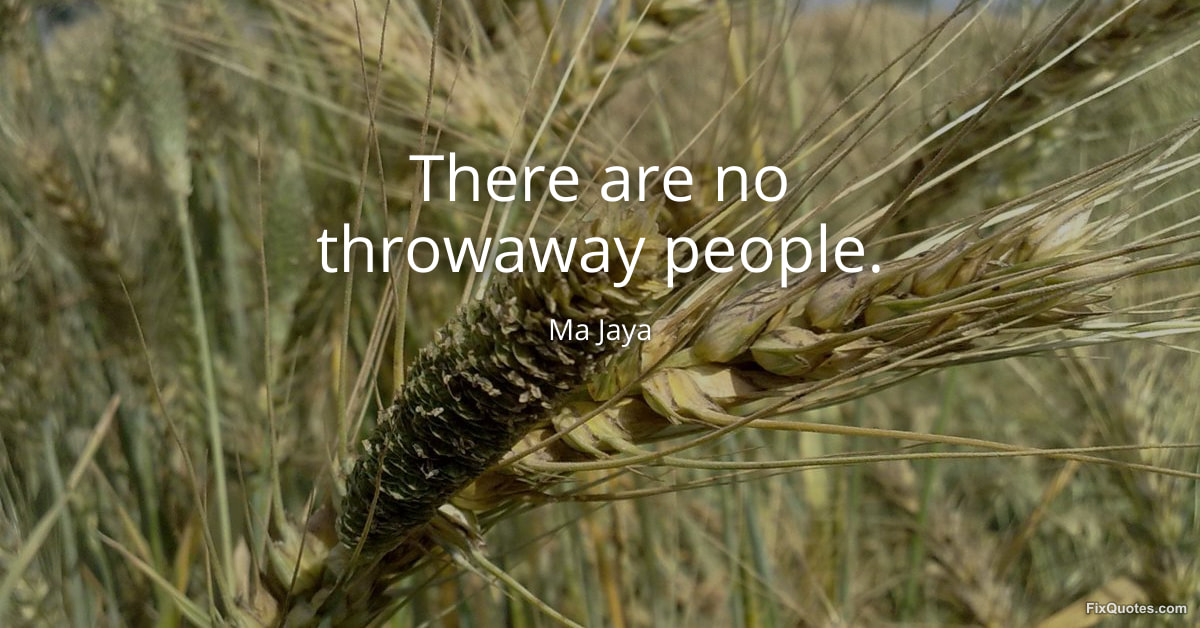
"There are no throwaway people"
About this Quote
In six blunt words, Ma Jaya refuses the most convenient lie modern life runs on: that some people can be written off as excess. “Throwaway” is consumer language, the vocabulary of packaging, planned obsolescence, and trash day. Grafting it onto “people” is meant to sting. It forces the listener to notice how easily human beings get processed the same way we process objects: used, judged, discarded, forgotten.
The line’s intent is moral and practical at once. As a teacher, Ma Jaya isn’t offering a feel-good abstraction; she’s issuing a standard for attention. Classrooms, like societies, are sorting machines. They reward the legible and the compliant and quietly exile the disruptive, the struggling, the inconvenient. “There are no throwaway people” pushes back against that triage. It’s an instruction to keep looking, to stay in relationship when the system nudges you toward labels: lost cause, bad kid, addict, criminal, failure.
The subtext is also accusatory. If no one is “throwaway,” then the act of discarding isn’t neutral; it’s a choice someone makes, and usually a choice backed by power. The phrase implies a whole shadow economy of abandonment: institutions that warehouse people, communities that avert their gaze, families that cut ties to protect their own narrative.
Its power comes from the simplicity. No metaphors, no caveats, no hierarchy of deserving. It’s a small sentence that leaves you fewer places to hide.
The line’s intent is moral and practical at once. As a teacher, Ma Jaya isn’t offering a feel-good abstraction; she’s issuing a standard for attention. Classrooms, like societies, are sorting machines. They reward the legible and the compliant and quietly exile the disruptive, the struggling, the inconvenient. “There are no throwaway people” pushes back against that triage. It’s an instruction to keep looking, to stay in relationship when the system nudges you toward labels: lost cause, bad kid, addict, criminal, failure.
The subtext is also accusatory. If no one is “throwaway,” then the act of discarding isn’t neutral; it’s a choice someone makes, and usually a choice backed by power. The phrase implies a whole shadow economy of abandonment: institutions that warehouse people, communities that avert their gaze, families that cut ties to protect their own narrative.
Its power comes from the simplicity. No metaphors, no caveats, no hierarchy of deserving. It’s a small sentence that leaves you fewer places to hide.
Quote Details
| Topic | Kindness |
|---|
More Quotes by Ma
Add to List