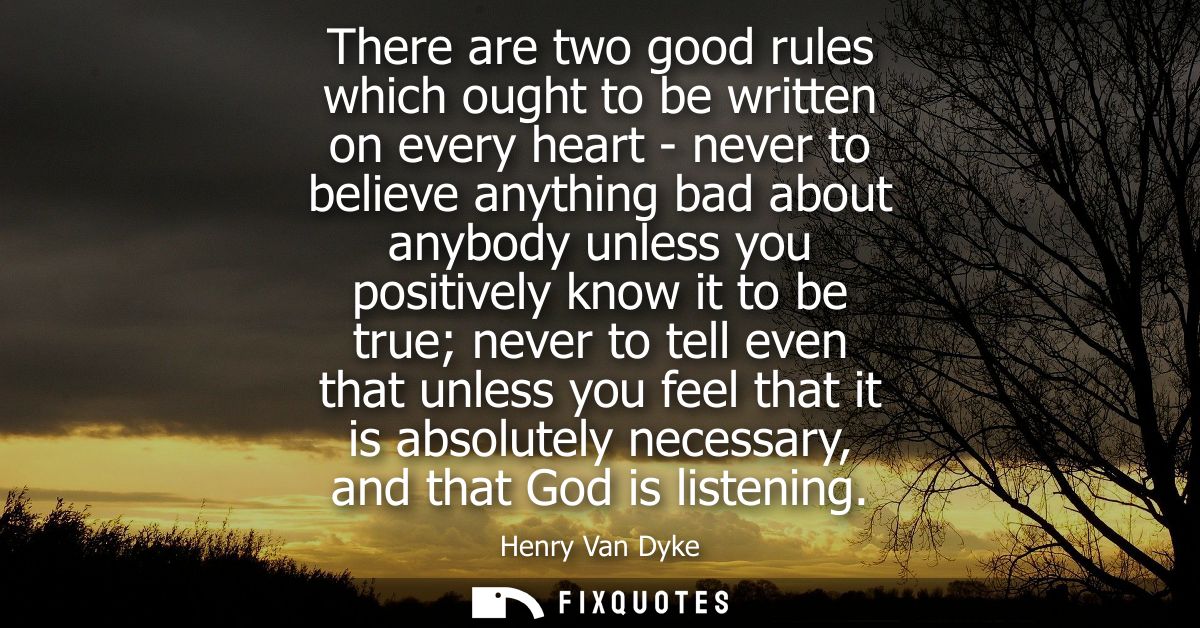
"There are two good rules which ought to be written on every heart - never to believe anything bad about anybody unless you positively know it to be true; never to tell even that unless you feel that it is absolutely necessary, and that God is listening"
About this Quote
Van Dyke builds a moral system out of something most people treat as entertainment: other people’s flaws. The line’s first move is practical, almost journalistic: don’t “believe anything bad” unless you “positively know it to be true.” That word choice matters. “Positively” isn’t a casual hedge; it’s a demand for proof, a rebuke to rumor culture before we had a name for it. He’s not warning against evil so much as against the lazy pleasures of suspicion.
Then he tightens the screws. Even if the negative thing is true, don’t “tell even that” unless it’s “absolutely necessary.” Truth doesn’t automatically earn the right to be repeated. Subtext: gossip often hides behind correctness, using facts as a permission slip for cruelty. Van Dyke splits ethics into two gates - epistemic (is it true?) and moral (is it needed?) - and insists you pass both.
The last clause is the clincher: “and that God is listening.” It’s not pious decoration; it’s a surveillance device for the conscience. By moving the audience from the social world to the divine ear, he shifts the incentive structure. You’re no longer managing your reputation among peers; you’re accountable to an omniscient witness who can’t be impressed by clever phrasing or “just being honest.”
Context helps: a late-19th/early-20th-century Protestant moral imagination, where character is forged in private disciplines and public speech is a moral act. Read now, it lands as an anti-algorithm manifesto: don’t amplify harm because it’s plausible, printable, or shareable.
Then he tightens the screws. Even if the negative thing is true, don’t “tell even that” unless it’s “absolutely necessary.” Truth doesn’t automatically earn the right to be repeated. Subtext: gossip often hides behind correctness, using facts as a permission slip for cruelty. Van Dyke splits ethics into two gates - epistemic (is it true?) and moral (is it needed?) - and insists you pass both.
The last clause is the clincher: “and that God is listening.” It’s not pious decoration; it’s a surveillance device for the conscience. By moving the audience from the social world to the divine ear, he shifts the incentive structure. You’re no longer managing your reputation among peers; you’re accountable to an omniscient witness who can’t be impressed by clever phrasing or “just being honest.”
Context helps: a late-19th/early-20th-century Protestant moral imagination, where character is forged in private disciplines and public speech is a moral act. Read now, it lands as an anti-algorithm manifesto: don’t amplify harm because it’s plausible, printable, or shareable.
Quote Details
| Topic | Kindness |
|---|
More Quotes by Henry
Add to List