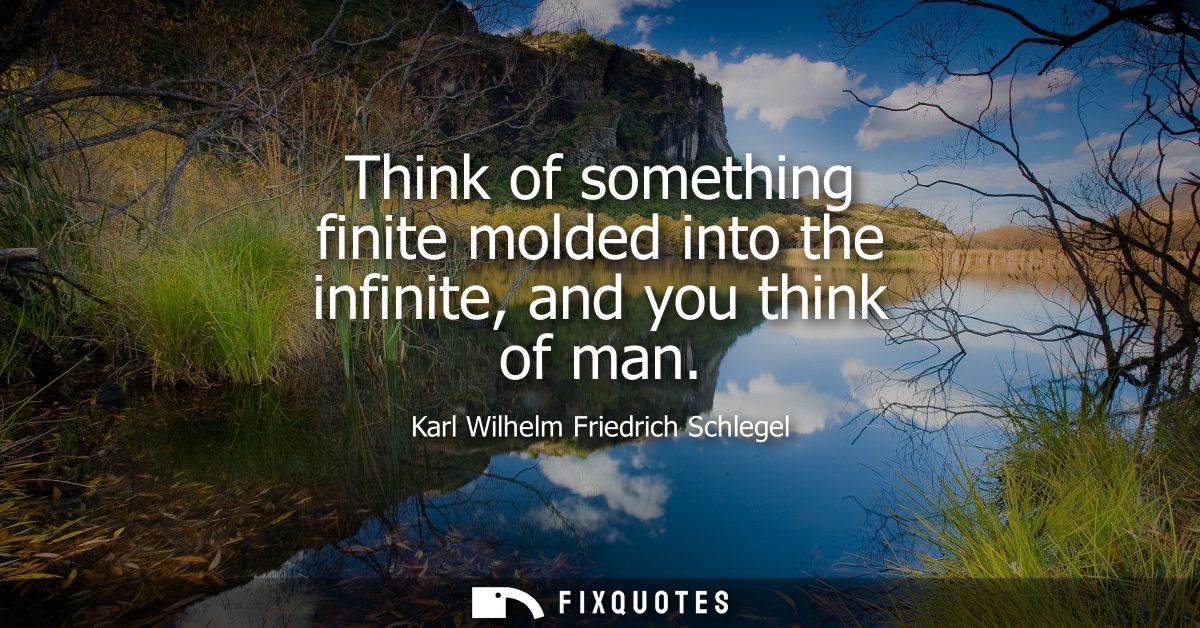
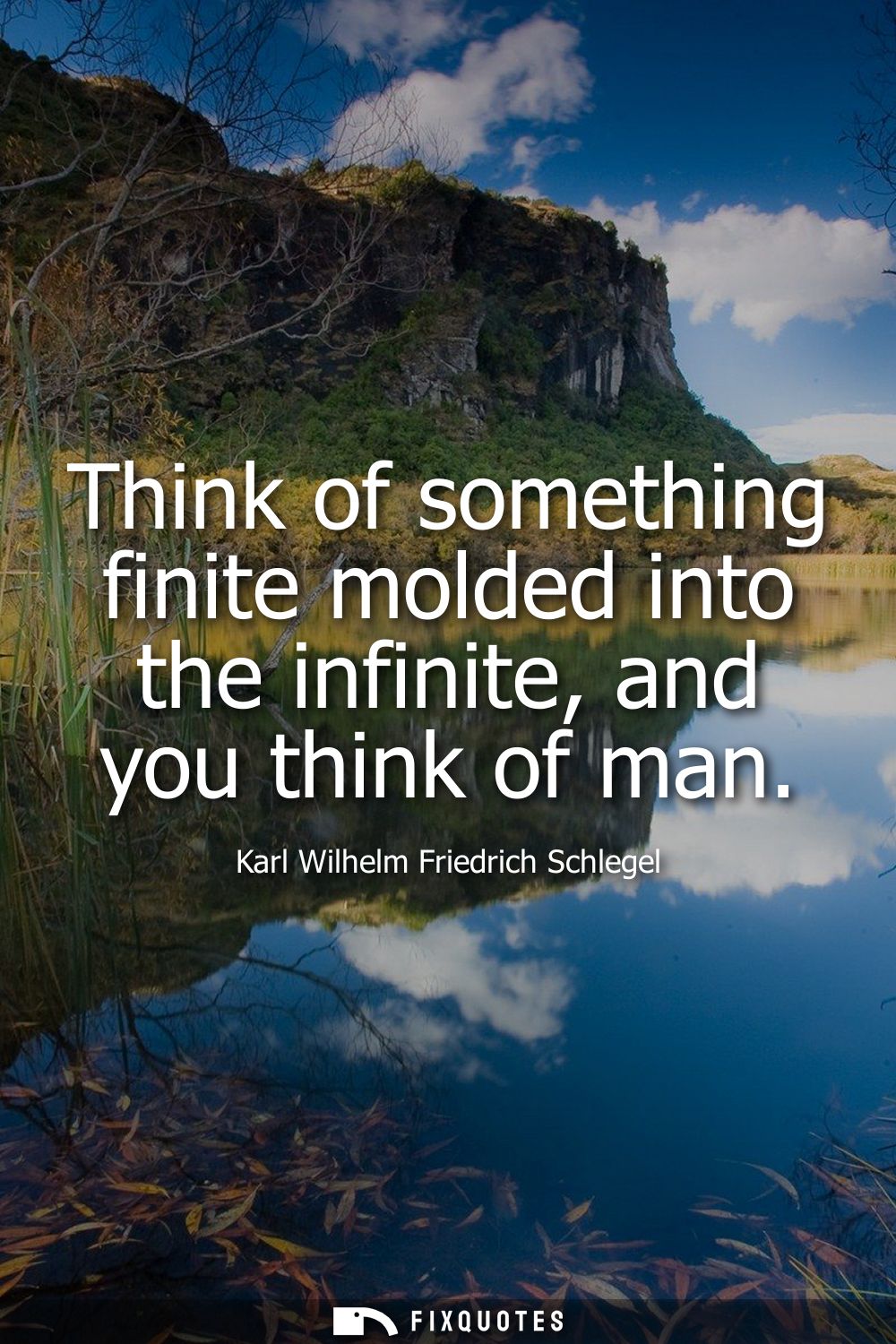
"Think of something finite molded into the infinite, and you think of man"
About this Quote
A single sentence, but it behaves like a whole Romantic manifesto: human beings are the clash point where limits and longing meet. Schlegel’s “finite molded into the infinite” doesn’t flatter humanity as the center of the universe so much as it frames us as a strange medium - a temporary material pressed into shapes that reach past their own lifespan. The verb “molded” matters. It suggests pressure, form-giving, even artifice: the infinite isn’t gently “felt” or “imagined,” it’s worked into us the way a sculptor forces meaning into stone. Man, in this view, is both artwork and raw material.
The subtext is a quiet rebuttal to Enlightenment self-confidence. Reason can measure the finite; it can’t domesticate the infinite. Schlegel, a key architect of German Romanticism, is writing from a cultural moment that distrusts neat systems and hungers for what exceeds them: the sublime in nature, the absolute in philosophy, the sacred after skepticism. Humans become the proof of that excess, because our bodies are bounded but our desires aren’t. We’re the creature that invents eternity, then suffers because we can’t live there.
It also smuggles in a moral psychology: what’s most “human” isn’t our efficiency or our certainty, but our restless reach. The line works because it refuses resolution. “Finite” and “infinite” don’t reconcile; they grind against each other, and that friction is Schlegel’s definition of a person.
The subtext is a quiet rebuttal to Enlightenment self-confidence. Reason can measure the finite; it can’t domesticate the infinite. Schlegel, a key architect of German Romanticism, is writing from a cultural moment that distrusts neat systems and hungers for what exceeds them: the sublime in nature, the absolute in philosophy, the sacred after skepticism. Humans become the proof of that excess, because our bodies are bounded but our desires aren’t. We’re the creature that invents eternity, then suffers because we can’t live there.
It also smuggles in a moral psychology: what’s most “human” isn’t our efficiency or our certainty, but our restless reach. The line works because it refuses resolution. “Finite” and “infinite” don’t reconcile; they grind against each other, and that friction is Schlegel’s definition of a person.
Quote Details
| Topic | Deep |
|---|
More Quotes by Karl
Add to List