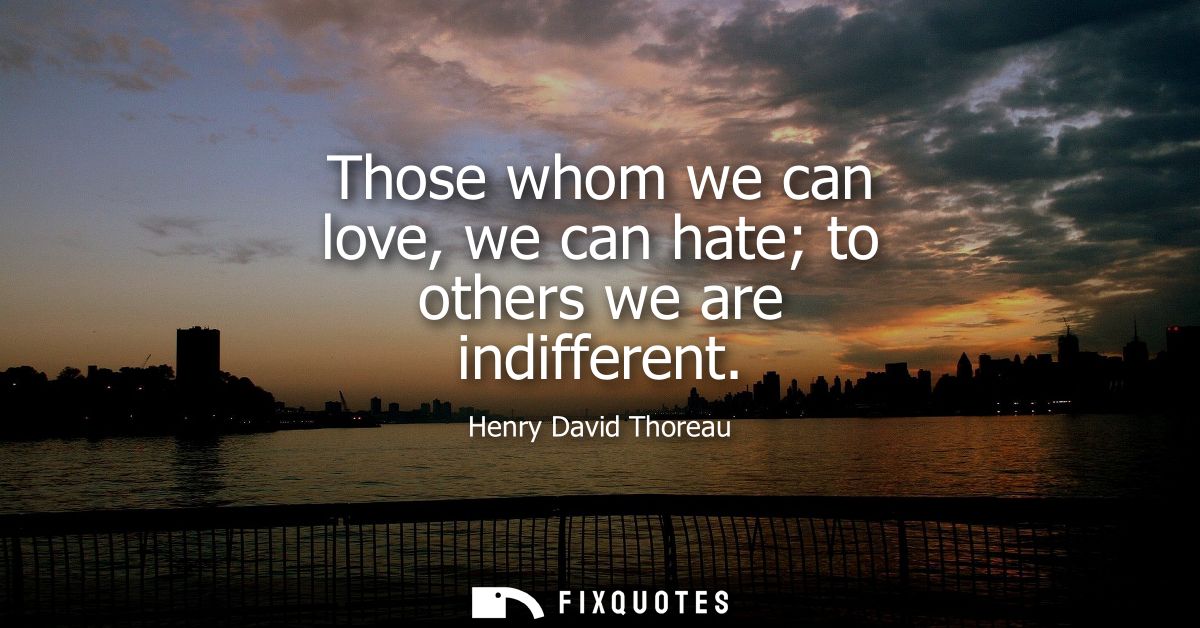
"Those whom we can love, we can hate; to others we are indifferent"
About this Quote
Thoreau’s line cuts against the comforting idea that hatred is the opposite of love. For him, indifference is the true enemy: the emotional null zone reserved for people who never breach the perimeter of the self. Love and hate, in this formulation, are siblings, not opposites. They share a common prerequisite: attention. You can only hate what has mattered to you, what has had access to your hopes, your trust, your imagination. The sting of hate is often just the shadow of disappointed intimacy.
The subtext is both psychological and moral. Psychologically, Thoreau is mapping how attachment works: the more invested you are, the more volatile your feelings become, because the stakes are real. Morally, he’s issuing a quiet indictment of detachment. Indifference looks like neutrality, but it’s a refusal of relation. It’s the posture of the spectator, the person who stays clean by staying uninvolved.
Context matters: Thoreau is a writer of conscience, suspicious of social conformity and emotional laziness. In the orbit of his broader work, feeling is not just private weather; it’s a register of responsibility. To be capable of hate is not a virtue, but it’s proof you’re implicated. Indifference, by contrast, is the luxury of someone who has decided that other lives don’t touch theirs.
The line also exposes a modern discomfort: we prefer tidy binaries, but human bonds don’t cooperate. Love curdles, ideals collapse, friendships fracture. Thoreau’s point isn’t to romanticize hate; it’s to show that the most honest measure of connection is not sweetness, but intensity.
The subtext is both psychological and moral. Psychologically, Thoreau is mapping how attachment works: the more invested you are, the more volatile your feelings become, because the stakes are real. Morally, he’s issuing a quiet indictment of detachment. Indifference looks like neutrality, but it’s a refusal of relation. It’s the posture of the spectator, the person who stays clean by staying uninvolved.
Context matters: Thoreau is a writer of conscience, suspicious of social conformity and emotional laziness. In the orbit of his broader work, feeling is not just private weather; it’s a register of responsibility. To be capable of hate is not a virtue, but it’s proof you’re implicated. Indifference, by contrast, is the luxury of someone who has decided that other lives don’t touch theirs.
The line also exposes a modern discomfort: we prefer tidy binaries, but human bonds don’t cooperate. Love curdles, ideals collapse, friendships fracture. Thoreau’s point isn’t to romanticize hate; it’s to show that the most honest measure of connection is not sweetness, but intensity.
Quote Details
| Topic | Love |
|---|---|
| Source | Help us find the source |
| Cite | Cite this Quote |
Citation Formats
APA Style (7th ed.)
Thoreau, Henry David. (2026, January 17). Those whom we can love, we can hate; to others we are indifferent. FixQuotes. https://fixquotes.com/quotes/those-whom-we-can-love-we-can-hate-to-others-we-28783/
Chicago Style
Thoreau, Henry David. "Those whom we can love, we can hate; to others we are indifferent." FixQuotes. January 17, 2026. https://fixquotes.com/quotes/those-whom-we-can-love-we-can-hate-to-others-we-28783/.
MLA Style (9th ed.)
"Those whom we can love, we can hate; to others we are indifferent." FixQuotes, 17 Jan. 2026, https://fixquotes.com/quotes/those-whom-we-can-love-we-can-hate-to-others-we-28783/. Accessed 4 Feb. 2026.
More Quotes by Henry
Add to List