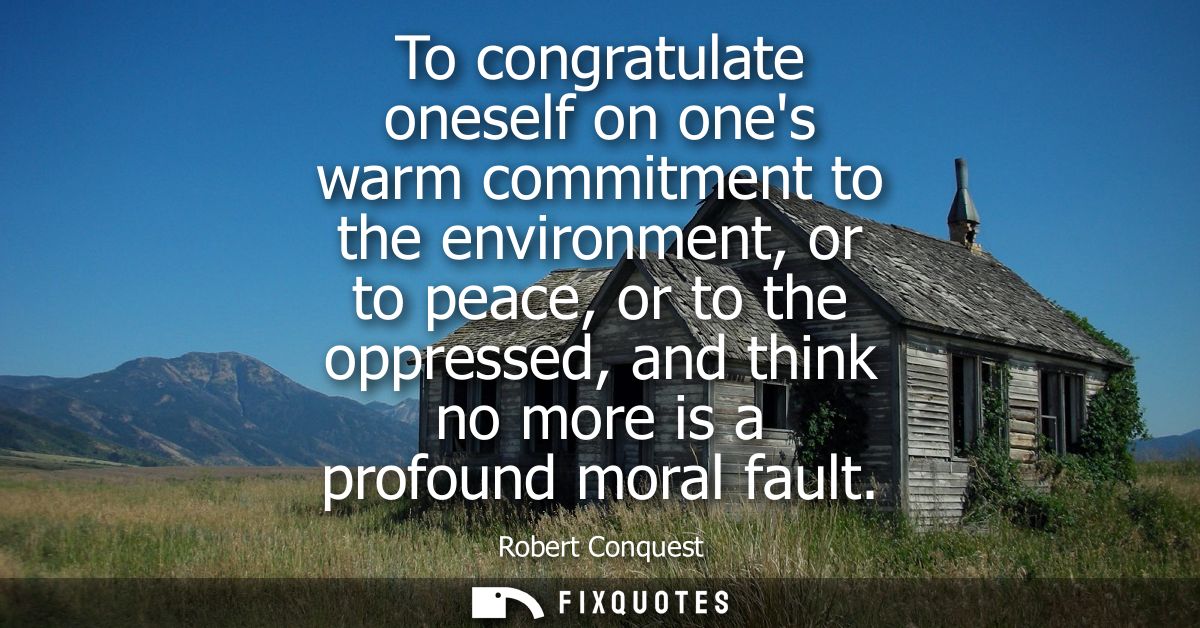
"To congratulate oneself on one's warm commitment to the environment, or to peace, or to the oppressed, and think no more is a profound moral fault"
About this Quote
Robert Conquest warns that warm feeling can masquerade as virtue while leaving reality untouched. To stop at the glow of caring for the environment, for peace, or for the oppressed is, he says, a profound moral fault. The target is not compassion itself but the self-congratulation that treats moral sentiment as an endpoint rather than a summons to hard thinking and costly action.
Conquest earned the right to make that charge. As the historian who exposed the Soviet terror, he watched Western intellectuals elevate noble abstractions over the grim facts of tyranny. They loved humanity in the large and failed particular humans in the small. During the Cold War, parts of the peace movement prized the aura of pacifism while neglecting the consequences of unilateral concessions to an aggressive regime. The posture felt righteous; the likely outcomes were dangerous. For Conquest, that pattern recurs whenever public conscience turns into a performance, detaching intention from responsibility.
Warm commitment is easy because it demands little beyond assent and applause. Real care requires attention to trade-offs, to unintended effects, to institutional constraints, to what actually works. Environmental concern that rejects practical energy transitions, peace advocacy that ignores deterrence, or solidarity with the oppressed that excuses their oppressors if they are ideologically congenial are forms of moral vanity. They invert ethics by treating feeling good as doing good.
The remedy he implies is humility and persistence. Keep thinking after the first rush of empathy. Test policies against evidence, not slogans. Accept that helping often means choosing between imperfect options and accepting costs. Measure success by outcomes for real people, not by the purity of one’s stance. Moral life begins with care, but it continues through discipline, prudence, and accountability. Without that continuation, conscience curdles into self-flattery, and the people we claim to defend remain unserved.
Conquest earned the right to make that charge. As the historian who exposed the Soviet terror, he watched Western intellectuals elevate noble abstractions over the grim facts of tyranny. They loved humanity in the large and failed particular humans in the small. During the Cold War, parts of the peace movement prized the aura of pacifism while neglecting the consequences of unilateral concessions to an aggressive regime. The posture felt righteous; the likely outcomes were dangerous. For Conquest, that pattern recurs whenever public conscience turns into a performance, detaching intention from responsibility.
Warm commitment is easy because it demands little beyond assent and applause. Real care requires attention to trade-offs, to unintended effects, to institutional constraints, to what actually works. Environmental concern that rejects practical energy transitions, peace advocacy that ignores deterrence, or solidarity with the oppressed that excuses their oppressors if they are ideologically congenial are forms of moral vanity. They invert ethics by treating feeling good as doing good.
The remedy he implies is humility and persistence. Keep thinking after the first rush of empathy. Test policies against evidence, not slogans. Accept that helping often means choosing between imperfect options and accepting costs. Measure success by outcomes for real people, not by the purity of one’s stance. Moral life begins with care, but it continues through discipline, prudence, and accountability. Without that continuation, conscience curdles into self-flattery, and the people we claim to defend remain unserved.
Quote Details
| Topic | Ethics & Morality |
|---|
More Quotes by Robert
Add to List