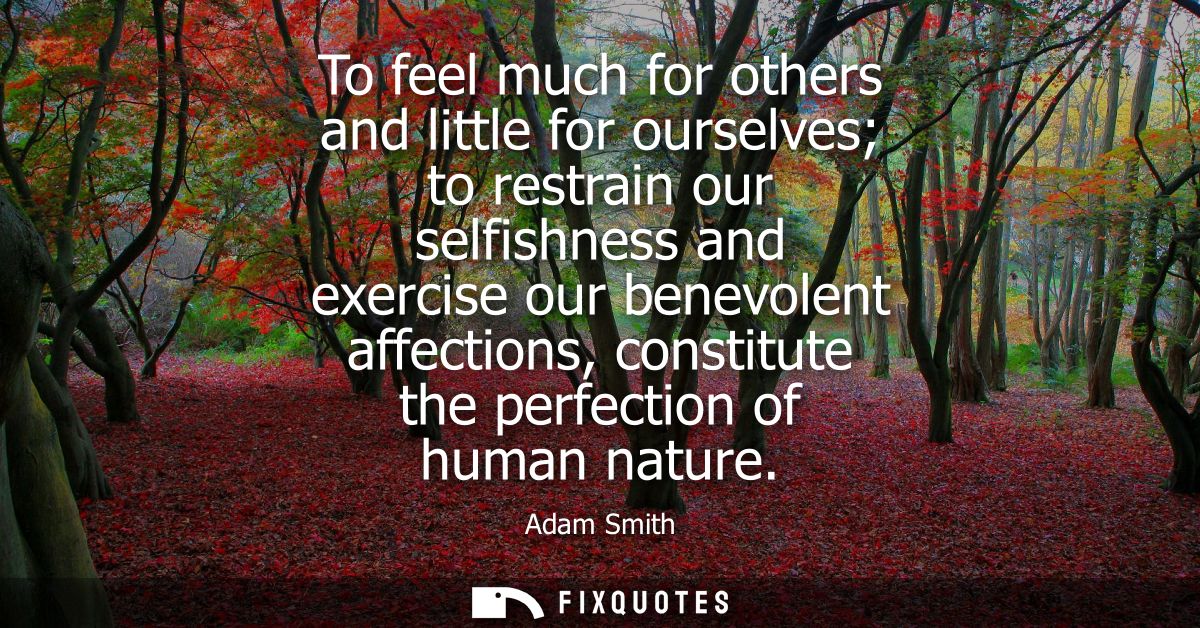
"To feel much for others and little for ourselves; to restrain our selfishness and exercise our benevolent affections, constitute the perfection of human nature"
About this Quote
The subtext is psychological and political at once. “To feel much for others” isn’t a Hallmark command; it’s a description of the social glue Smith believed markets and institutions quietly depend on. Sympathy (his term) is a skill, cultivated by imagining how our actions land in other people’s minds. “Little for ourselves” doesn’t mean self-erasure; it means curbing the tantrum of ego so the “impartial spectator” - that internalized public - can judge us. The key verb is “restrain.” Smith doesn’t romanticize benevolence as natural overflow. He treats selfishness as the default setting, requiring governance, habit, and social feedback.
Context matters: this is the Adam Smith of The Theory of Moral Sentiments (1759), writing in the Scottish Enlightenment, where commerce, urban life, and rising inequality forced a fresh question: what keeps a modern society from turning into a polite stampede? The quote works because it smuggles a radical claim into calm prose: the highest human achievement isn’t domination or accumulation; it’s self-management in the presence of others. In Smith’s world, morality isn’t opposed to economic life. It’s the operating system that lets it run.
Quote Details
| Topic | Kindness |
|---|---|
| Source | Help us find the source |
| Cite |
Citation Formats
APA Style (7th ed.)
Smith, Adam. (2026, January 18). To feel much for others and little for ourselves; to restrain our selfishness and exercise our benevolent affections, constitute the perfection of human nature. FixQuotes. https://fixquotes.com/quotes/to-feel-much-for-others-and-little-for-ourselves-3011/
Chicago Style
Smith, Adam. "To feel much for others and little for ourselves; to restrain our selfishness and exercise our benevolent affections, constitute the perfection of human nature." FixQuotes. January 18, 2026. https://fixquotes.com/quotes/to-feel-much-for-others-and-little-for-ourselves-3011/.
MLA Style (9th ed.)
"To feel much for others and little for ourselves; to restrain our selfishness and exercise our benevolent affections, constitute the perfection of human nature." FixQuotes, 18 Jan. 2026, https://fixquotes.com/quotes/to-feel-much-for-others-and-little-for-ourselves-3011/. Accessed 6 Feb. 2026.