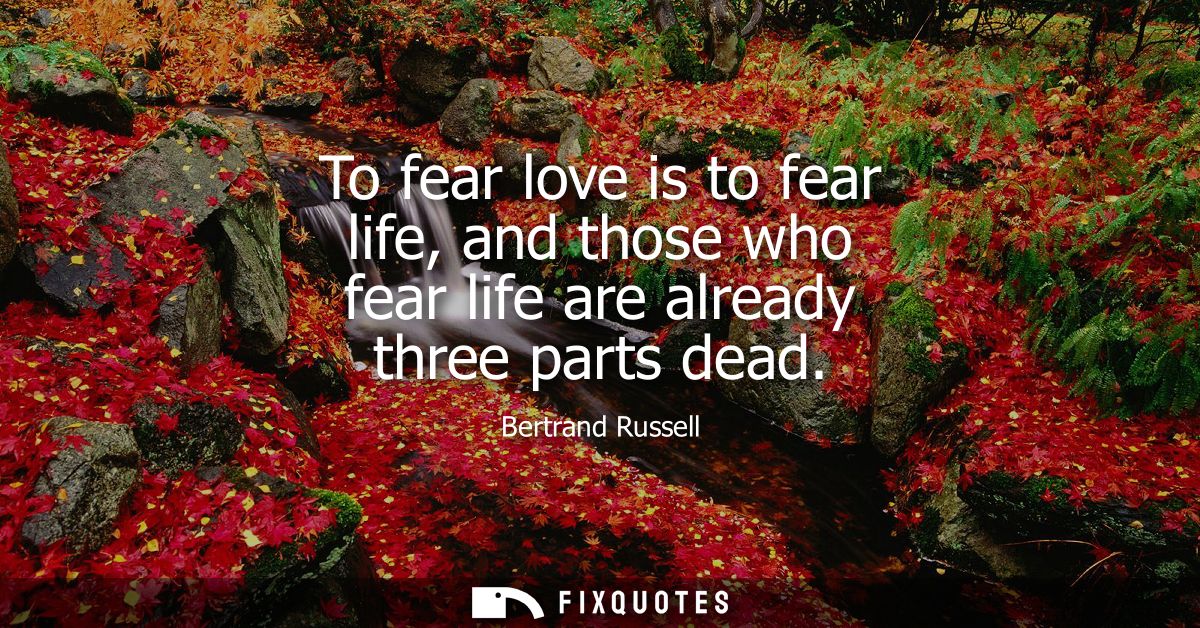
"To fear love is to fear life, and those who fear life are already three parts dead"
About this Quote
Russell lands this line like a slap because it treats "fear of love" not as a private quirk but as a philosophical capitulation. Love here isn’t just romance; it’s the messy willingness to be changed by other people, to be exposed to risk, dependence, disappointment. If you flinch from that, Russell implies, you’re not choosing safety so much as choosing a smaller form of existence. The bite is in the accounting: "three parts dead" is a deliberately cold metaphor for a very intimate evasion. He quantifies spiritual retreat the way a rationalist might tally costs, turning emotional avoidance into an almost medical diagnosis.
The subtext is anti-Puritan and anti-defensive. Russell had little patience for moral codes that confuse restraint with virtue, or for social arrangements that reward emotional caution as "respectability". Fear becomes a kind of self-administered anesthesia: it dulls pain, yes, but it also dulls appetite, curiosity, tenderness, the very faculties that make life feel like more than a sequence of duties.
Context matters. Russell lived through the mechanized slaughter of World War I, the brittle ideologies of the interwar period, and the anxieties of the nuclear age. In a century that trained people to equate survival with suspicion, he argues for the opposite: real aliveness requires vulnerability. The line works because it refuses the sentimental pitch for love and instead frames it as courage under ordinary conditions, a daily resistance to the slow death of disengagement.
The subtext is anti-Puritan and anti-defensive. Russell had little patience for moral codes that confuse restraint with virtue, or for social arrangements that reward emotional caution as "respectability". Fear becomes a kind of self-administered anesthesia: it dulls pain, yes, but it also dulls appetite, curiosity, tenderness, the very faculties that make life feel like more than a sequence of duties.
Context matters. Russell lived through the mechanized slaughter of World War I, the brittle ideologies of the interwar period, and the anxieties of the nuclear age. In a century that trained people to equate survival with suspicion, he argues for the opposite: real aliveness requires vulnerability. The line works because it refuses the sentimental pitch for love and instead frames it as courage under ordinary conditions, a daily resistance to the slow death of disengagement.
Quote Details
| Topic | Love |
|---|---|
| Source | Bertrand Russell, The Conquest of Happiness (1930). |
More Quotes by Bertrand
Add to List