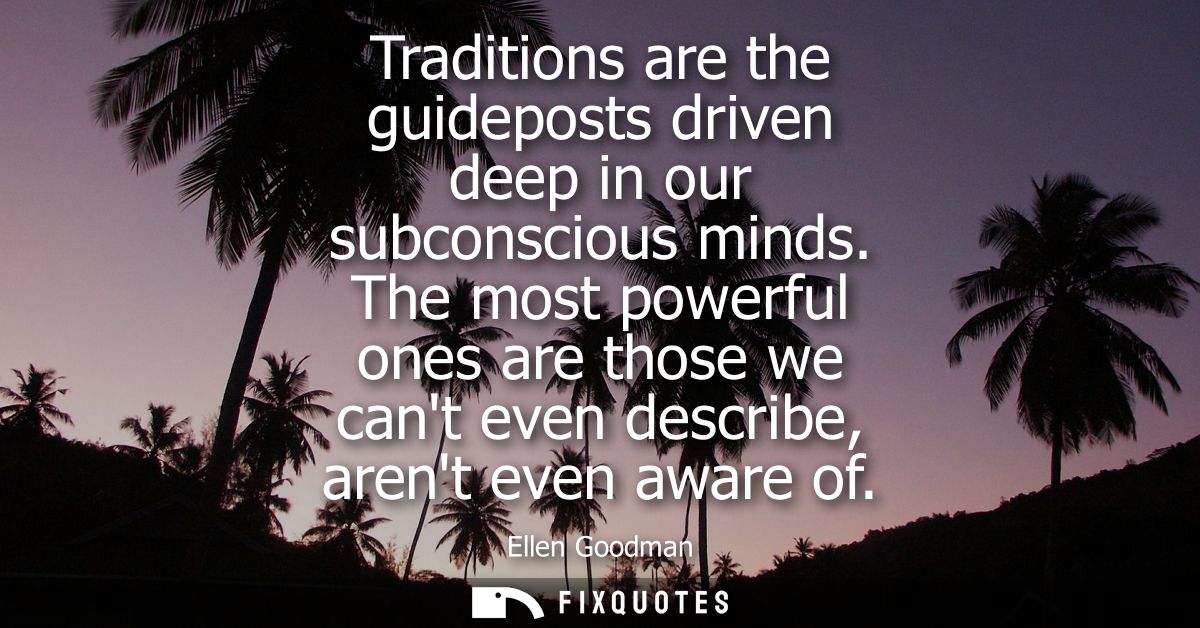
"Traditions are the guideposts driven deep in our subconscious minds. The most powerful ones are those we can't even describe, aren't even aware of"
About this Quote
Tradition, in Ellen Goodman’s telling, isn’t the cozy stuff you put on a calendar; it’s the invisible infrastructure of behavior. Calling traditions “guideposts” makes them sound helpful, even stabilizing, but “driven deep in our subconscious minds” flips the metaphor from gentle navigation to something closer to implantation. The line carries a journalist’s suspicion: the most influential forces are often the ones that never have to announce themselves.
Goodman’s key move is the hierarchy she draws. The “most powerful” traditions aren’t the ones we perform loudly - holidays, ceremonies, slogans - but the ones that have slipped past scrutiny. That’s the subtext: the rituals we can name are, by definition, already negotiable. If you can describe a tradition, you can argue with it, opt out of it, remix it. The truly commanding ones operate as “common sense,” and common sense is where culture hides its sharpest edges: who gets believed, who gets interrupted, whose anger reads as “passion” versus “attitude,” what a “real” family looks like, what kinds of ambition are deemed admirable or suspect.
As a late-20th-century American columnist, Goodman wrote in the thick of second-wave feminism, workplace reshuffling, and culture-war refrains about “values.” Her line quietly rebukes the nostalgia industry that treats tradition as inherently virtuous. She’s also cautioning reformers: you don’t defeat a norm by banning a ritual. You have to surface the unspoken rule beneath it. The sentence works because it makes tradition feel less like heritage and more like software running in the background - powerful precisely because it doesn’t ask permission.
Goodman’s key move is the hierarchy she draws. The “most powerful” traditions aren’t the ones we perform loudly - holidays, ceremonies, slogans - but the ones that have slipped past scrutiny. That’s the subtext: the rituals we can name are, by definition, already negotiable. If you can describe a tradition, you can argue with it, opt out of it, remix it. The truly commanding ones operate as “common sense,” and common sense is where culture hides its sharpest edges: who gets believed, who gets interrupted, whose anger reads as “passion” versus “attitude,” what a “real” family looks like, what kinds of ambition are deemed admirable or suspect.
As a late-20th-century American columnist, Goodman wrote in the thick of second-wave feminism, workplace reshuffling, and culture-war refrains about “values.” Her line quietly rebukes the nostalgia industry that treats tradition as inherently virtuous. She’s also cautioning reformers: you don’t defeat a norm by banning a ritual. You have to surface the unspoken rule beneath it. The sentence works because it makes tradition feel less like heritage and more like software running in the background - powerful precisely because it doesn’t ask permission.
Quote Details
| Topic | Wisdom |
|---|
More Quotes by Ellen
Add to List