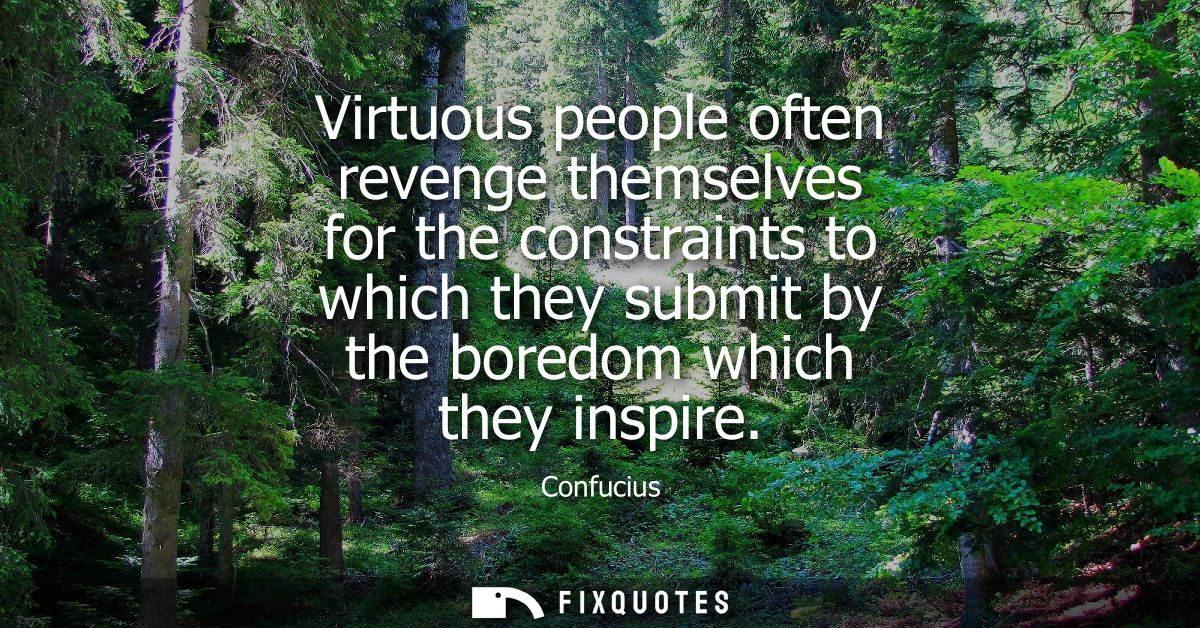
"Virtuous people often revenge themselves for the constraints to which they submit by the boredom which they inspire"
About this Quote
Virtue, in this line, isn’t a halo; it’s a collar, and Confucius is dryly pointing at the rash it leaves. The “virtuous people” here are the ones who swallow their impulses in the name of propriety, ritual, and social order. That suppression may look like moral strength from the outside, but Confucius sketches a darker compensation: they “revenge themselves” not through scandal or violence, but by radiating a punishing dullness. Boredom becomes a socially acceptable weapon, a way to make everyone else pay for their self-denial.
The bite is in the psychological accounting. If you’ve built your identity around constraint, you need proof it was worth it. One way is to make constraint contagious: you enforce the same narrowness through a suffocating atmosphere. The “boredom” they inspire isn’t incidental; it’s discipline by vibes, a soft coercion that pressures others to conform without a single explicit command.
In context, it’s a warning that a moral system obsessed with restraint can breed its own petty tyrannies. Confucius championed li (ritual propriety) and social harmony, but he also understood how quickly “uprightness” curdles into performance and control. The line reads like a diagnostic for sanctimony: when someone’s goodness feels like a lecture you can’t leave, it may be less about ethics than about resentment dressed in clean robes. The sharpest part is the suggestion that boredom can be an aggression - the slow, polite kind that still dominates a room.
The bite is in the psychological accounting. If you’ve built your identity around constraint, you need proof it was worth it. One way is to make constraint contagious: you enforce the same narrowness through a suffocating atmosphere. The “boredom” they inspire isn’t incidental; it’s discipline by vibes, a soft coercion that pressures others to conform without a single explicit command.
In context, it’s a warning that a moral system obsessed with restraint can breed its own petty tyrannies. Confucius championed li (ritual propriety) and social harmony, but he also understood how quickly “uprightness” curdles into performance and control. The line reads like a diagnostic for sanctimony: when someone’s goodness feels like a lecture you can’t leave, it may be less about ethics than about resentment dressed in clean robes. The sharpest part is the suggestion that boredom can be an aggression - the slow, polite kind that still dominates a room.
Quote Details
| Topic | Wisdom |
|---|
More Quotes by Confucius
Add to List