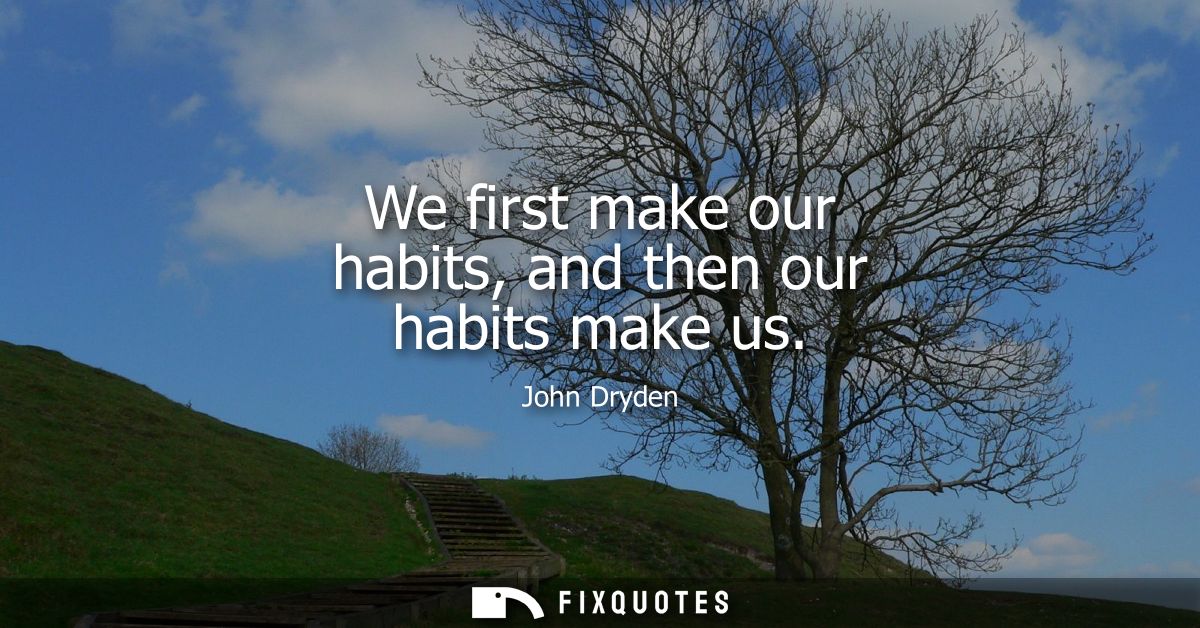
"We first make our habits, and then our habits make us"
About this Quote
Dryden’s line is a neat little trap: it flatters your sense of agency for exactly half a sentence, then yanks it away. “We first make our habits” grants the comforting idea that character is a project you manage. The turn - “and then our habits make us” - converts that project into a machine. The craft is in the symmetry: the phrasing loops back on itself the way routines do, repeating until they stop feeling chosen and start feeling inevitable.
As a Restoration poet, Dryden wrote in a culture newly obsessed with performance - of loyalty, of piety, of refinement - after the upheavals of civil war and regime change. In that world, “habit” isn’t just a self-help buzzword; it’s the social technology of survival. Manners, religious observance, and political posture were not simply personal preferences but public signals, practiced until they became indistinguishable from identity. The subtext is slightly unnerving: you can cultivate virtue, sure, but you can just as easily rehearse yourself into a mask that hardens.
Dryden’s intent isn’t moral scolding so much as moral accounting. Habits are portrayed as compounding interest: small actions accrue, then begin paying out a person. The line works because it shrinks grand concepts like “selfhood” down to the scale of daily repetition, then implies that’s where the real power has been hiding all along. In a time suspicious of sudden conversions and dramatic sincerity, it argues that the self is less a revelation than a practice.
As a Restoration poet, Dryden wrote in a culture newly obsessed with performance - of loyalty, of piety, of refinement - after the upheavals of civil war and regime change. In that world, “habit” isn’t just a self-help buzzword; it’s the social technology of survival. Manners, religious observance, and political posture were not simply personal preferences but public signals, practiced until they became indistinguishable from identity. The subtext is slightly unnerving: you can cultivate virtue, sure, but you can just as easily rehearse yourself into a mask that hardens.
Dryden’s intent isn’t moral scolding so much as moral accounting. Habits are portrayed as compounding interest: small actions accrue, then begin paying out a person. The line works because it shrinks grand concepts like “selfhood” down to the scale of daily repetition, then implies that’s where the real power has been hiding all along. In a time suspicious of sudden conversions and dramatic sincerity, it argues that the self is less a revelation than a practice.
Quote Details
| Topic | Habits |
|---|---|
| Source | Help us find the source |
| Cite | Cite this Quote |
Citation Formats
APA Style (7th ed.)
Dryden, John. (n.d.). We first make our habits, and then our habits make us. FixQuotes. https://fixquotes.com/quotes/we-first-make-our-habits-and-then-our-habits-make-151598/
Chicago Style
Dryden, John. "We first make our habits, and then our habits make us." FixQuotes. Accessed February 3, 2026. https://fixquotes.com/quotes/we-first-make-our-habits-and-then-our-habits-make-151598/.
MLA Style (9th ed.)
"We first make our habits, and then our habits make us." FixQuotes, https://fixquotes.com/quotes/we-first-make-our-habits-and-then-our-habits-make-151598/. Accessed 3 Feb. 2026.
More Quotes by John
Add to List