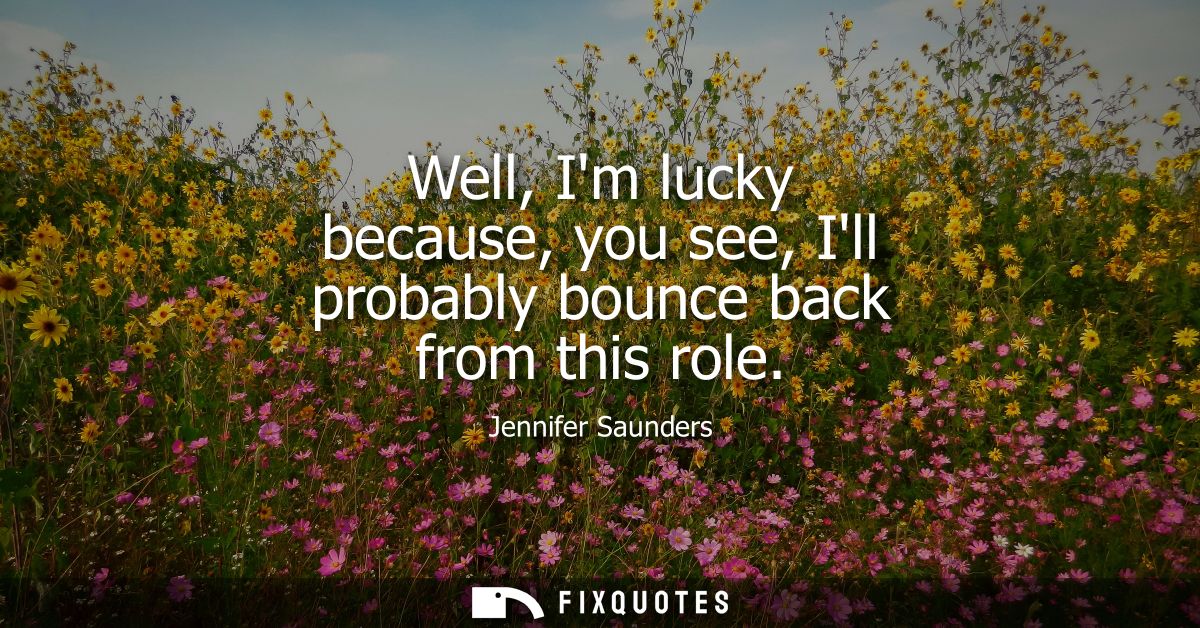
"Well, I'm lucky because, you see, I'll probably bounce back from this role"
About this Quote
The subtext is occupational toughness. "This role" implies something grueling, humiliating, or emotionally radioactive - the kind of part that invites headlines about an actor "losing themselves". Saunders punctures that prestige narrative. By saying she'll "probably" bounce back, she keeps a sliver of uncertainty, which is where the humor lives: resilience is presented as both a skill and a gamble. It's also a quiet flex. Comedians trade in persona; they know how to put on a face and take it off. "Bounce back" is the language of hangovers, tabloids, and bad press cycles, not Method sanctimony.
Contextually, it reads like a performer preempting the cultural script that demands suffering as proof of seriousness. Saunders signals that she can go dark without fetishizing damage. The line protects her core identity while acknowledging the role's impact - a controlled confession that keeps the audience close, but never lets the work swallow the woman making the joke.
Quote Details
| Topic | Resilience |
|---|---|
| Source | Help us find the source |
| Cite |
Citation Formats
APA Style (7th ed.)
Saunders, Jennifer. (2026, January 15). Well, I'm lucky because, you see, I'll probably bounce back from this role. FixQuotes. https://fixquotes.com/quotes/well-im-lucky-because-you-see-ill-probably-bounce-146478/
Chicago Style
Saunders, Jennifer. "Well, I'm lucky because, you see, I'll probably bounce back from this role." FixQuotes. January 15, 2026. https://fixquotes.com/quotes/well-im-lucky-because-you-see-ill-probably-bounce-146478/.
MLA Style (9th ed.)
"Well, I'm lucky because, you see, I'll probably bounce back from this role." FixQuotes, 15 Jan. 2026, https://fixquotes.com/quotes/well-im-lucky-because-you-see-ill-probably-bounce-146478/. Accessed 4 Apr. 2026.