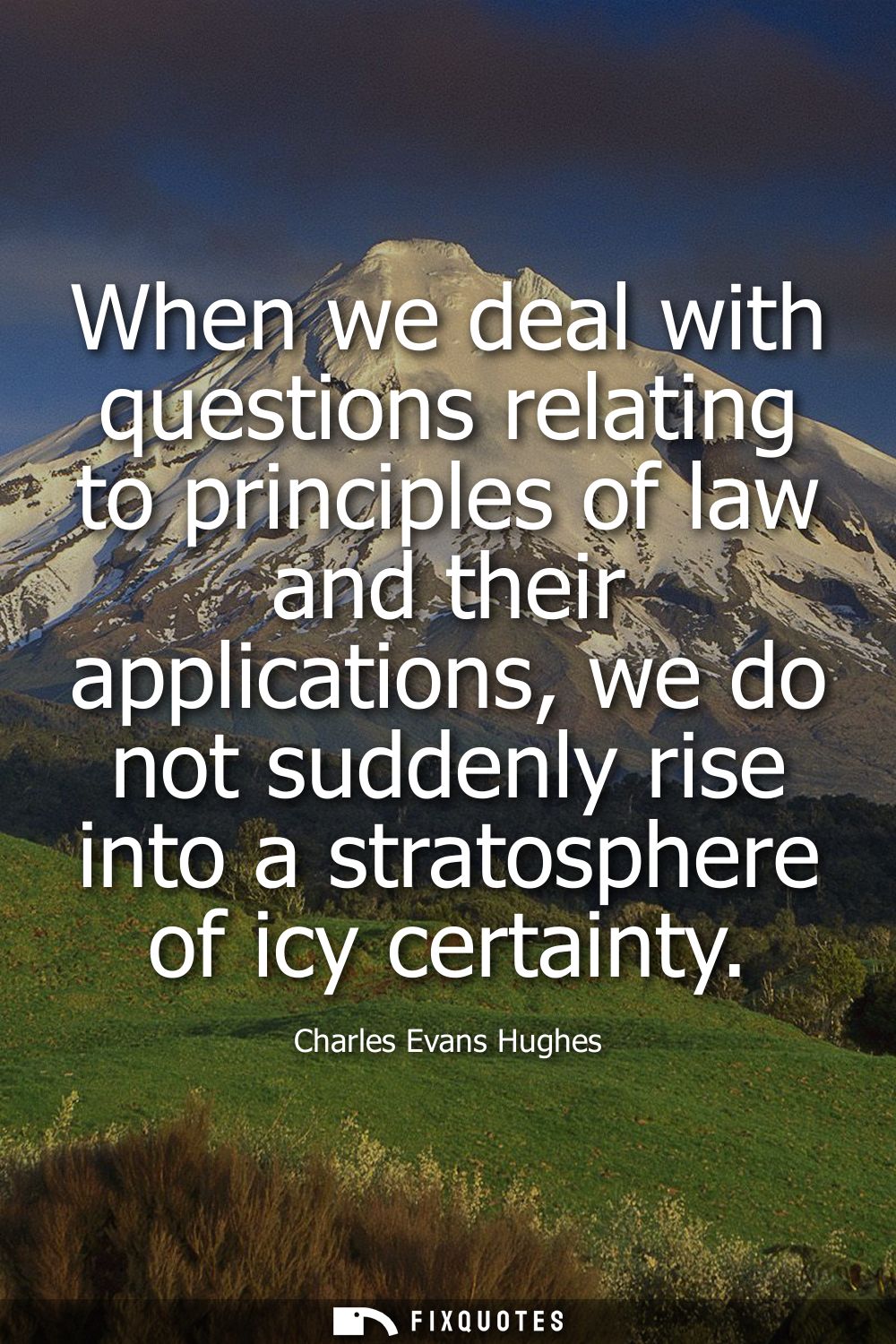
"When we deal with questions relating to principles of law and their applications, we do not suddenly rise into a stratosphere of icy certainty"
About this Quote
The specific intent is almost disciplinary: a reminder to lawyers and judges that principles are not self-applying. "Principles of law" sounds grand and fixed, but "their applications" is where discretion enters, where competing values - liberty versus order, property versus equality, precedent versus practicality - start elbowing for space. Hughes doesn’t deny that law has structure; he denies that structure eliminates uncertainty. The subtext is a quiet rebuke to absolutists: the ones who cite doctrine as if it were physics, and the ones who treat interpretation as a moral alibi.
Contextually, Hughes lived through the period when American courts were openly wrestling with industrial capitalism, labor rights, and the expanding administrative state - fights that exposed how much judicial decision-making is shaped by assumptions about society. His realism isn’t cynicism; it’s accountability. If certainty isn’t available, then judges owe the public something harder: candor about judgment, limits, and the human stakes beneath the legal prose.
Quote Details
| Topic | Justice |
|---|---|
| Source | Help us find the source |
| Cite |
Citation Formats
APA Style (7th ed.)
Hughes, Charles Evans. (2026, January 16). When we deal with questions relating to principles of law and their applications, we do not suddenly rise into a stratosphere of icy certainty. FixQuotes. https://fixquotes.com/quotes/when-we-deal-with-questions-relating-to-109952/
Chicago Style
Hughes, Charles Evans. "When we deal with questions relating to principles of law and their applications, we do not suddenly rise into a stratosphere of icy certainty." FixQuotes. January 16, 2026. https://fixquotes.com/quotes/when-we-deal-with-questions-relating-to-109952/.
MLA Style (9th ed.)
"When we deal with questions relating to principles of law and their applications, we do not suddenly rise into a stratosphere of icy certainty." FixQuotes, 16 Jan. 2026, https://fixquotes.com/quotes/when-we-deal-with-questions-relating-to-109952/. Accessed 31 Mar. 2026.