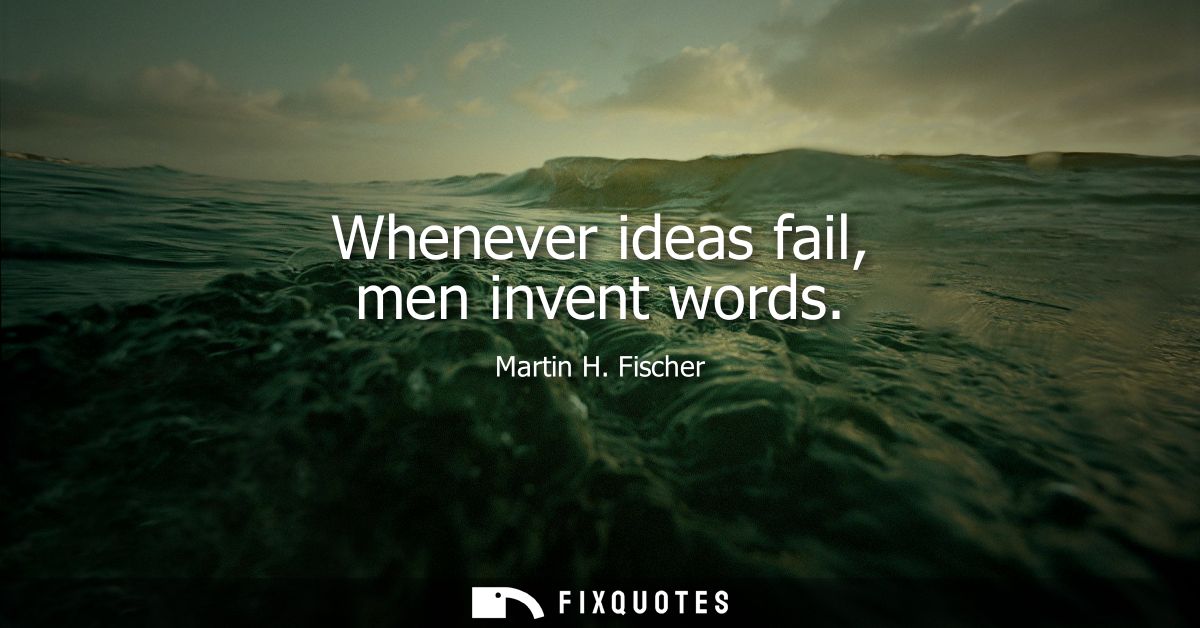
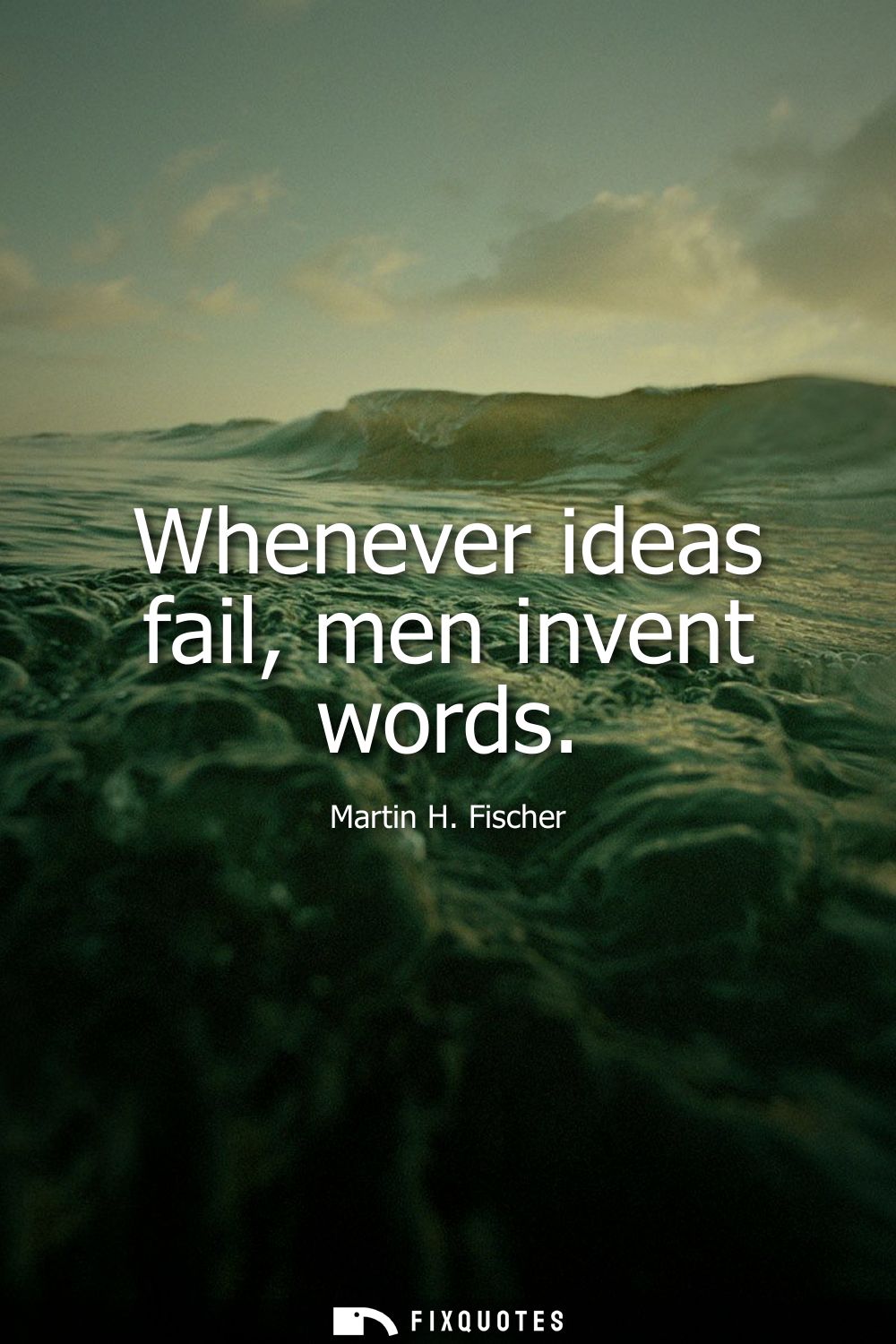
"Whenever ideas fail, men invent words"
About this Quote
When thinking stalls, language starts tap-dancing. Fischer’s line is a jab at the moment a writer, politician, or academic realizes the engine of meaning has died and decides to decorate the corpse. It’s not anti-language; it’s anti-wordiness as camouflage. The target is the verbal fog that rolls in when clarity would force a concession: we don’t know, we can’t do it, the plan doesn’t work.
The sentence works because it reverses a comforting assumption. We like to believe new words signal new thoughts - progress, nuance, discovery. Fischer flips that: invention can be a symptom, not an achievement. “Ideas fail” suggests a hard limit - conceptual collapse, not just a gap in vocabulary. “Men invent words” lands with a dry, almost clinical cynicism, as if this is a predictable reflex rather than a moral outrage. The gendered “men,” typical of the era, also reads as an indictment of the public actors who dominate institutions: the people with microphones and committees.
Context matters. Fischer lived through a period when modern bureaucracy, mass media, and specialized professional fields expanded fast, and so did the jargon that came with them. The early 20th century also saw advertising and propaganda refine the art of selling feelings as facts. In that world, word-making isn’t neutral; it’s often a power move - renaming failure as “restructuring,” violence as “pacification,” confusion as “complexity.” Fischer’s warning is compact: when the vocabulary suddenly blossoms, check whether the thinking has quietly withered.
The sentence works because it reverses a comforting assumption. We like to believe new words signal new thoughts - progress, nuance, discovery. Fischer flips that: invention can be a symptom, not an achievement. “Ideas fail” suggests a hard limit - conceptual collapse, not just a gap in vocabulary. “Men invent words” lands with a dry, almost clinical cynicism, as if this is a predictable reflex rather than a moral outrage. The gendered “men,” typical of the era, also reads as an indictment of the public actors who dominate institutions: the people with microphones and committees.
Context matters. Fischer lived through a period when modern bureaucracy, mass media, and specialized professional fields expanded fast, and so did the jargon that came with them. The early 20th century also saw advertising and propaganda refine the art of selling feelings as facts. In that world, word-making isn’t neutral; it’s often a power move - renaming failure as “restructuring,” violence as “pacification,” confusion as “complexity.” Fischer’s warning is compact: when the vocabulary suddenly blossoms, check whether the thinking has quietly withered.
Quote Details
| Topic | Witty One-Liners |
|---|---|
| Source | Help us find the source |
| Cite |
Citation Formats
APA Style (7th ed.)
Fischer, Martin H. (2026, January 15). Whenever ideas fail, men invent words. FixQuotes. https://fixquotes.com/quotes/whenever-ideas-fail-men-invent-words-148998/
Chicago Style
Fischer, Martin H. "Whenever ideas fail, men invent words." FixQuotes. January 15, 2026. https://fixquotes.com/quotes/whenever-ideas-fail-men-invent-words-148998/.
MLA Style (9th ed.)
"Whenever ideas fail, men invent words." FixQuotes, 15 Jan. 2026, https://fixquotes.com/quotes/whenever-ideas-fail-men-invent-words-148998/. Accessed 12 Feb. 2026.
More Quotes by Martin
Add to List