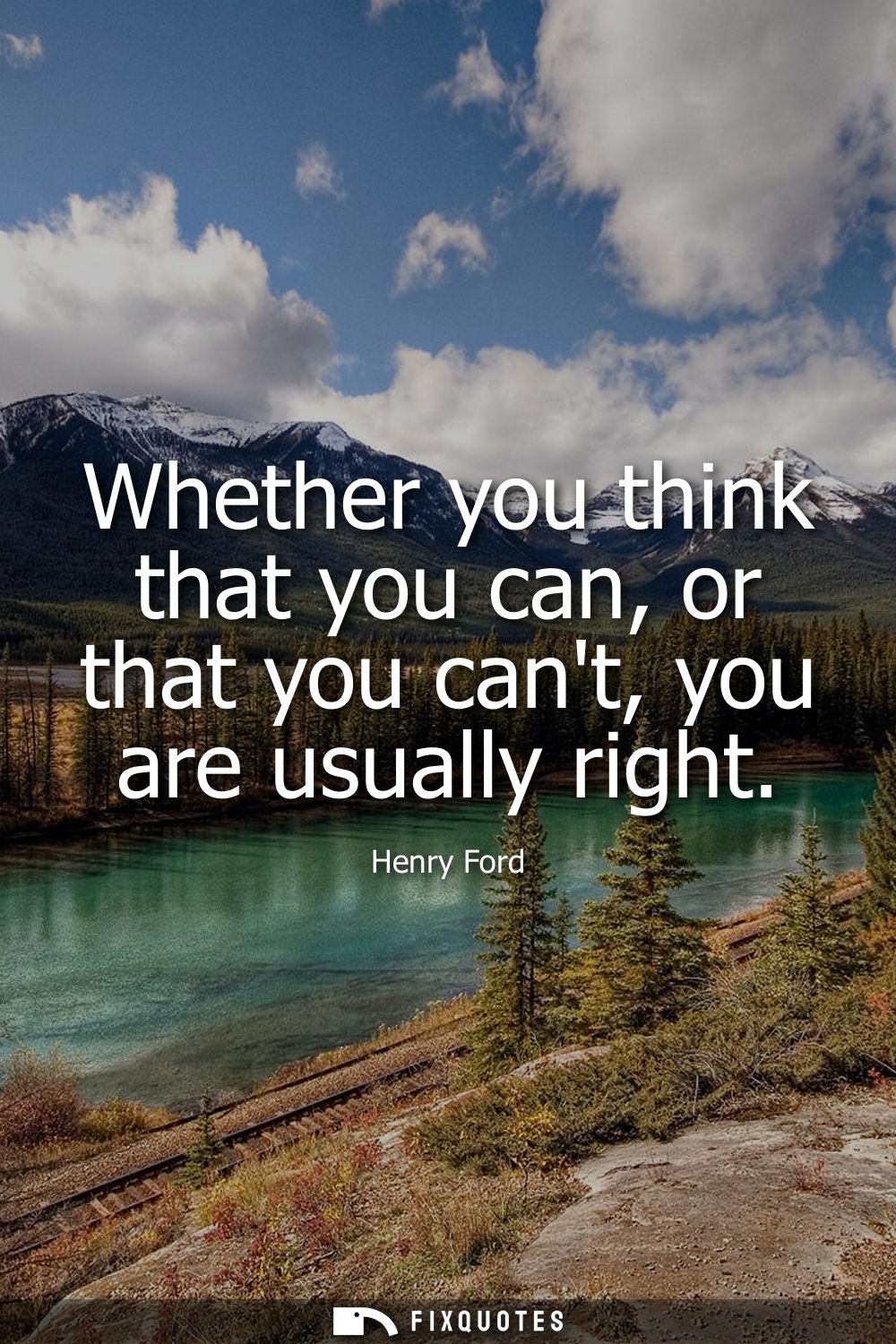
"Whether you think that you can, or that you can't, you are usually right"
About this Quote
Ford’s line flatters the listener into a kind of self-management: your biggest obstacle isn’t the market, the boss, or the machine, it’s the story you tell yourself about what’s possible. Coming from the man who made industrial optimism into a mass product, the quote doubles as both advice and ideology. It’s motivational on the surface, but it also smuggles in a worldview that’s incredibly convenient for an industrialist: success and failure get reframed as personal expectation rather than structural reality.
The phrasing is doing quiet rhetorical work. “Whether you think…or that you can’t” sets up a false symmetry, as if confidence and doubt are equally causal and equally chosen. “Usually right” is the pressure point: it concedes exceptions (bad luck, real constraints) while still granting the speaker the aura of realism. The listener hears permission and warning at once: you can win, but if you lose, you probably talked yourself into it.
Context matters. Ford built an empire on standardization, repetition, and systems that reduced human variability. Yet his maxim elevates psychology over machinery, individual mindset over the assembly line. That tension is the subtext: workers, entrepreneurs, and consumers are urged to internalize responsibility, to treat morale as destiny. It’s a powerful sentence because it feels empowering while also disciplining. Believe, produce, don’t complain. If you can’t, the quote implies, you’re “usually right” about that too.
The phrasing is doing quiet rhetorical work. “Whether you think…or that you can’t” sets up a false symmetry, as if confidence and doubt are equally causal and equally chosen. “Usually right” is the pressure point: it concedes exceptions (bad luck, real constraints) while still granting the speaker the aura of realism. The listener hears permission and warning at once: you can win, but if you lose, you probably talked yourself into it.
Context matters. Ford built an empire on standardization, repetition, and systems that reduced human variability. Yet his maxim elevates psychology over machinery, individual mindset over the assembly line. That tension is the subtext: workers, entrepreneurs, and consumers are urged to internalize responsibility, to treat morale as destiny. It’s a powerful sentence because it feels empowering while also disciplining. Believe, produce, don’t complain. If you can’t, the quote implies, you’re “usually right” about that too.
Quote Details
| Topic | Confidence |
|---|
More Quotes by Henry
Add to List