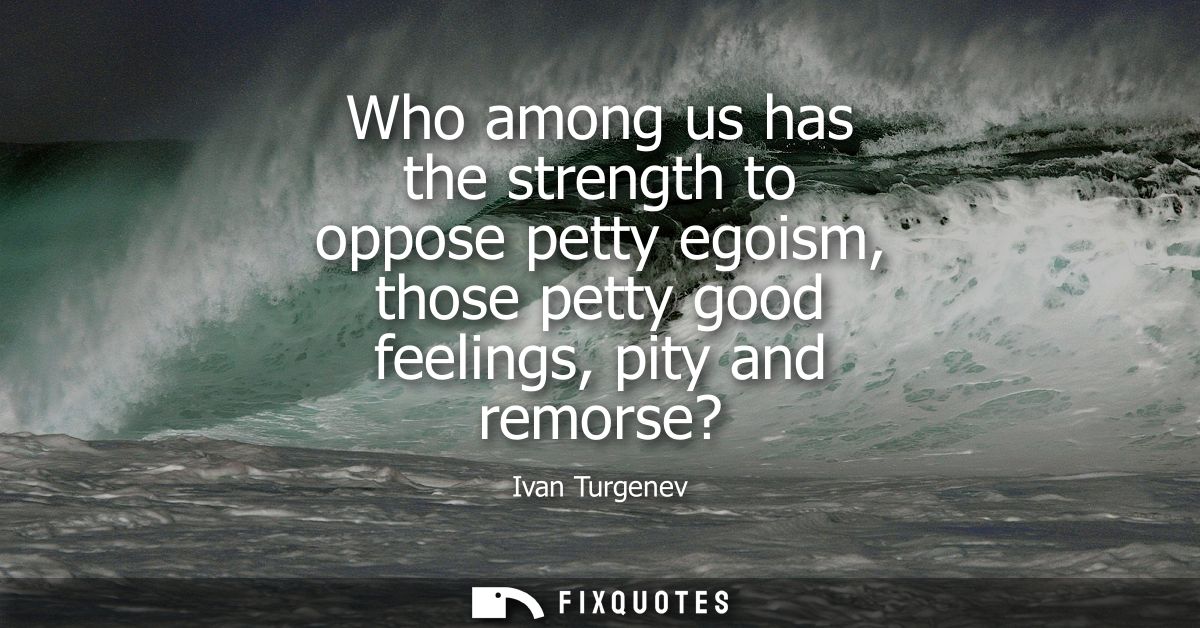
"Who among us has the strength to oppose petty egoism, those petty good feelings, pity and remorse?"
About this Quote
The question form matters. “Who among us” recruits the reader into a guilty fellowship, turning private self-deception into a social reflex. It’s also a trap: if you answer “me,” you’ve already fallen into the egoism of exceptionalism; if you answer “no one,” you confess the indictment. That’s Turgenev’s quiet cruelty and his craft as a novelist of conscience. He’s less interested in condemning sin than in anatomizing the subtle ways people narrate themselves as decent.
Contextually, this is a Russian 19th-century moral weather report: a culture wrestling with reform, class obligation, and the intelligentsia’s self-image. Turgenev, forever suspicious of grand postures, suggests that the real obstacle to ethical action isn’t monstrous cruelty. It’s the soft cushion of feeling right. Pity becomes a performance, remorse a ritual, and “strength” is redefined as the ability to forgo the emotional rewards of being “one of the good.”
Quote Details
| Topic | Ethics & Morality |
|---|---|
| Source | Help us find the source |
| Cite | Cite this Quote |
Citation Formats
APA Style (7th ed.)
Turgenev, Ivan. (n.d.). Who among us has the strength to oppose petty egoism, those petty good feelings, pity and remorse? FixQuotes. https://fixquotes.com/quotes/who-among-us-has-the-strength-to-oppose-petty-7192/
Chicago Style
Turgenev, Ivan. "Who among us has the strength to oppose petty egoism, those petty good feelings, pity and remorse?" FixQuotes. Accessed February 2, 2026. https://fixquotes.com/quotes/who-among-us-has-the-strength-to-oppose-petty-7192/.
MLA Style (9th ed.)
"Who among us has the strength to oppose petty egoism, those petty good feelings, pity and remorse?" FixQuotes, https://fixquotes.com/quotes/who-among-us-has-the-strength-to-oppose-petty-7192/. Accessed 2 Feb. 2026.