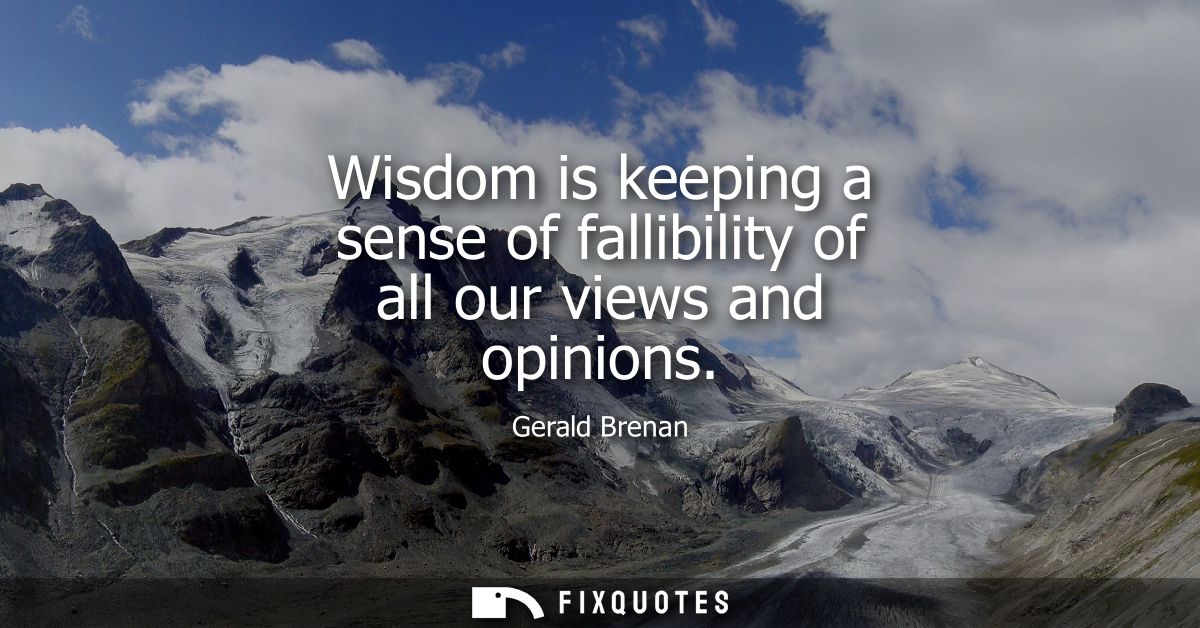
"Wisdom is keeping a sense of fallibility of all our views and opinions"
About this Quote
The subtext is a critique of modern argument-as-identity. If your views are extensions of the self, revising them feels like self-erasure; Brenan insists wisdom is the opposite move, separating ego from belief so reality can get a vote. He’s also wary of the seductive moral status that certainty provides. Conviction can look like character, but it often functions as insulation, a way to stop listening while still feeling principled.
Context sharpens the edge. Brenan lived through the ideological furnace of the 20th century, when grand systems promised total explanations and delivered mass suffering. Against that backdrop, fallibilism isn’t soft relativism; it’s a safety mechanism. By insisting “all our views and opinions” are potentially wrong, he’s leveling the hierarchy between pet theories and sacred causes. Wisdom, in his framing, is not neutrality but intellectual self-restraint: the ability to act, argue, and commit without pretending your mind is a court of final appeal.
Quote Details
| Topic | Wisdom |
|---|---|
| Source | Help us find the source |
| Cite |
Citation Formats
APA Style (7th ed.)
Brenan, Gerald. (2026, January 16). Wisdom is keeping a sense of fallibility of all our views and opinions. FixQuotes. https://fixquotes.com/quotes/wisdom-is-keeping-a-sense-of-fallibility-of-all-94516/
Chicago Style
Brenan, Gerald. "Wisdom is keeping a sense of fallibility of all our views and opinions." FixQuotes. January 16, 2026. https://fixquotes.com/quotes/wisdom-is-keeping-a-sense-of-fallibility-of-all-94516/.
MLA Style (9th ed.)
"Wisdom is keeping a sense of fallibility of all our views and opinions." FixQuotes, 16 Jan. 2026, https://fixquotes.com/quotes/wisdom-is-keeping-a-sense-of-fallibility-of-all-94516/. Accessed 7 Feb. 2026.