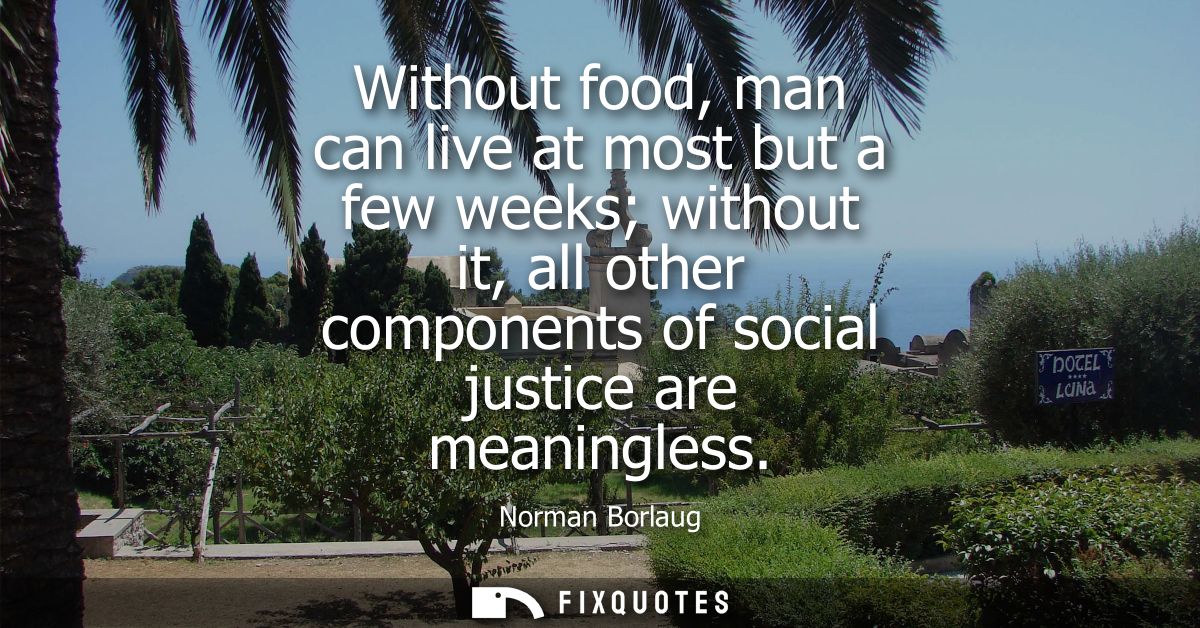
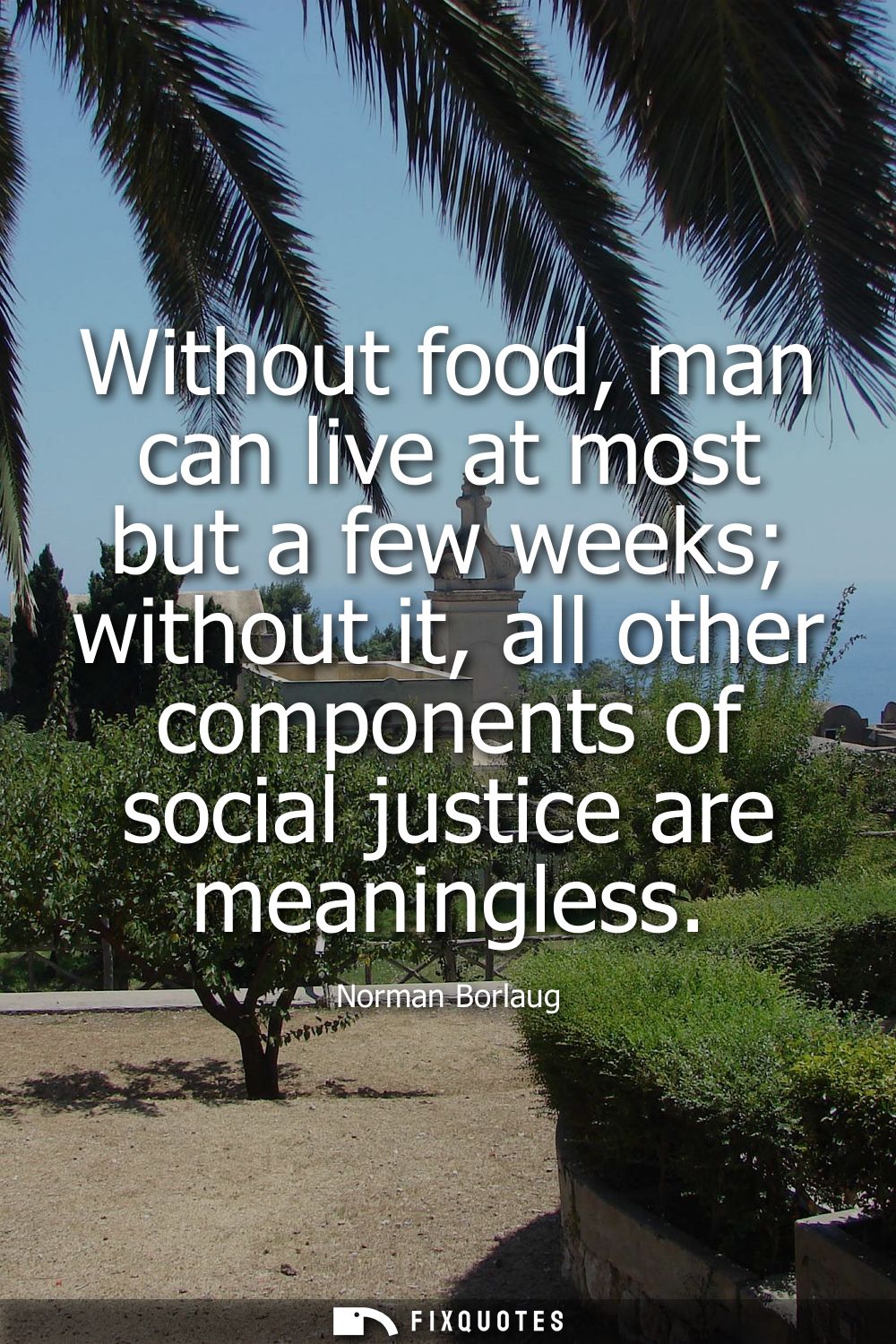
"Without food, man can live at most but a few weeks; without it, all other components of social justice are meaningless"
About this Quote
Hunger is the original inequality, the one that makes every other debate feel like a luxury item. Norman Borlaug, the agronomist most associated with the Green Revolution, isn’t offering a sentimental plea for charity here; he’s issuing a hard-nosed hierarchy of needs, engineered for policy fights. The sentence is built like a demolition: the first clause is biology, blunt and time-bound ("a few weeks"), then the second clause detonates the moral abstractions that often dominate social-justice rhetoric. If people are starving, rights exist only on paper; participation, dignity, and due process become inaccessible technologies.
The intent is strategic. Borlaug is defending food security as the non-negotiable baseline of any just society, implicitly pushing back against critics who framed high-yield agriculture, fertilizers, and modern seed systems as environmentally suspect or politically compromised. The subtext is that moral purity can be lethal. You can argue about land reform, labor rights, or representation (and you should), but if crop yields collapse, the argument ends in riots, displacement, and state violence. His framing makes hunger not just a humanitarian crisis but a governance problem.
Context matters: Borlaug worked in an era when famine was widely predicted for the developing world, and his career became proof that scarcity is often a technical and political choice, not a natural fate. The quote carries his signature pragmatism: justice begins where calories are stable, because survival is the first civil right.
The intent is strategic. Borlaug is defending food security as the non-negotiable baseline of any just society, implicitly pushing back against critics who framed high-yield agriculture, fertilizers, and modern seed systems as environmentally suspect or politically compromised. The subtext is that moral purity can be lethal. You can argue about land reform, labor rights, or representation (and you should), but if crop yields collapse, the argument ends in riots, displacement, and state violence. His framing makes hunger not just a humanitarian crisis but a governance problem.
Context matters: Borlaug worked in an era when famine was widely predicted for the developing world, and his career became proof that scarcity is often a technical and political choice, not a natural fate. The quote carries his signature pragmatism: justice begins where calories are stable, because survival is the first civil right.
Quote Details
| Topic | Justice |
|---|---|
| Source | Help us find the source |
More Quotes by Norman
Add to List