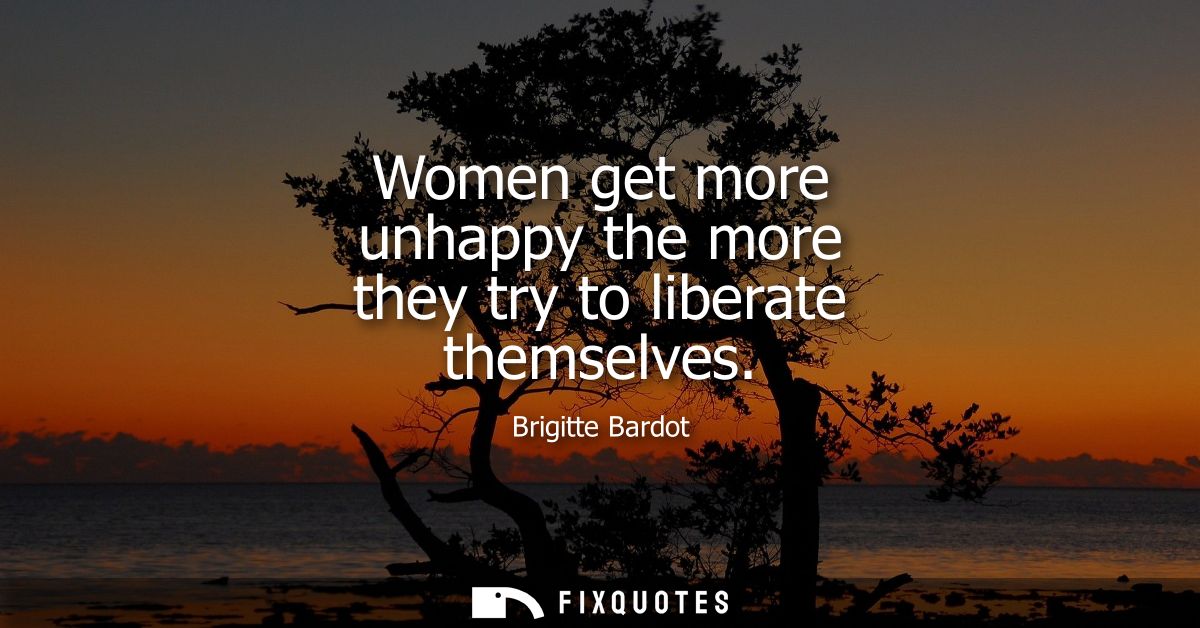
"Women get more unhappy the more they try to liberate themselves"
About this Quote
Bardot’s line lands like a shrug dressed up as prophecy: the more women reach for freedom, the more miserable they become. It’s a classic move from a celebrity who turned her own image into a global commodity and later built a public persona around provocation. The phrasing “try to liberate themselves” quietly demotes liberation from a structural fight to a personal experiment that’s bound to backfire. “Try” implies fumbling. “The more” frames emancipation as a dosage with side effects. The result is not an argument so much as a warning label.
The subtext is defensive nostalgia with a glamorous alibi. If liberation makes women unhappy, then the old bargain - beauty, desirability, protection, a curated kind of power - can be sold as emotionally safer. It also shifts blame neatly onto women: if you’re unhappy, it’s because you pursued the wrong kind of life, not because sexism rerouted your options or punished your ambition. That’s an ideological sleight of hand that flatters the listener who already wants the answer to be simple.
Context matters: Bardot emerged in an era when women’s visibility expanded while the terms of that visibility stayed punishing. Her fame was built on being watched; her later contempt for feminism reads like a reaction to the whiplash between sexual “freedom” and sexual objectification. The quote captures a real tension - liberation can expose conflict, loneliness, and backlash - then turns it into a verdict against liberation itself. It’s less sociology than self-justification, sharpened for headlines.
The subtext is defensive nostalgia with a glamorous alibi. If liberation makes women unhappy, then the old bargain - beauty, desirability, protection, a curated kind of power - can be sold as emotionally safer. It also shifts blame neatly onto women: if you’re unhappy, it’s because you pursued the wrong kind of life, not because sexism rerouted your options or punished your ambition. That’s an ideological sleight of hand that flatters the listener who already wants the answer to be simple.
Context matters: Bardot emerged in an era when women’s visibility expanded while the terms of that visibility stayed punishing. Her fame was built on being watched; her later contempt for feminism reads like a reaction to the whiplash between sexual “freedom” and sexual objectification. The quote captures a real tension - liberation can expose conflict, loneliness, and backlash - then turns it into a verdict against liberation itself. It’s less sociology than self-justification, sharpened for headlines.
Quote Details
| Topic | Equality |
|---|---|
| Source | Help us find the source |
| Cite |
Citation Formats
APA Style (7th ed.)
Bardot, Brigitte. (2026, January 16). Women get more unhappy the more they try to liberate themselves. FixQuotes. https://fixquotes.com/quotes/women-get-more-unhappy-the-more-they-try-to-134452/
Chicago Style
Bardot, Brigitte. "Women get more unhappy the more they try to liberate themselves." FixQuotes. January 16, 2026. https://fixquotes.com/quotes/women-get-more-unhappy-the-more-they-try-to-134452/.
MLA Style (9th ed.)
"Women get more unhappy the more they try to liberate themselves." FixQuotes, 16 Jan. 2026, https://fixquotes.com/quotes/women-get-more-unhappy-the-more-they-try-to-134452/. Accessed 5 Apr. 2026.
More Quotes by Brigitte
Add to List