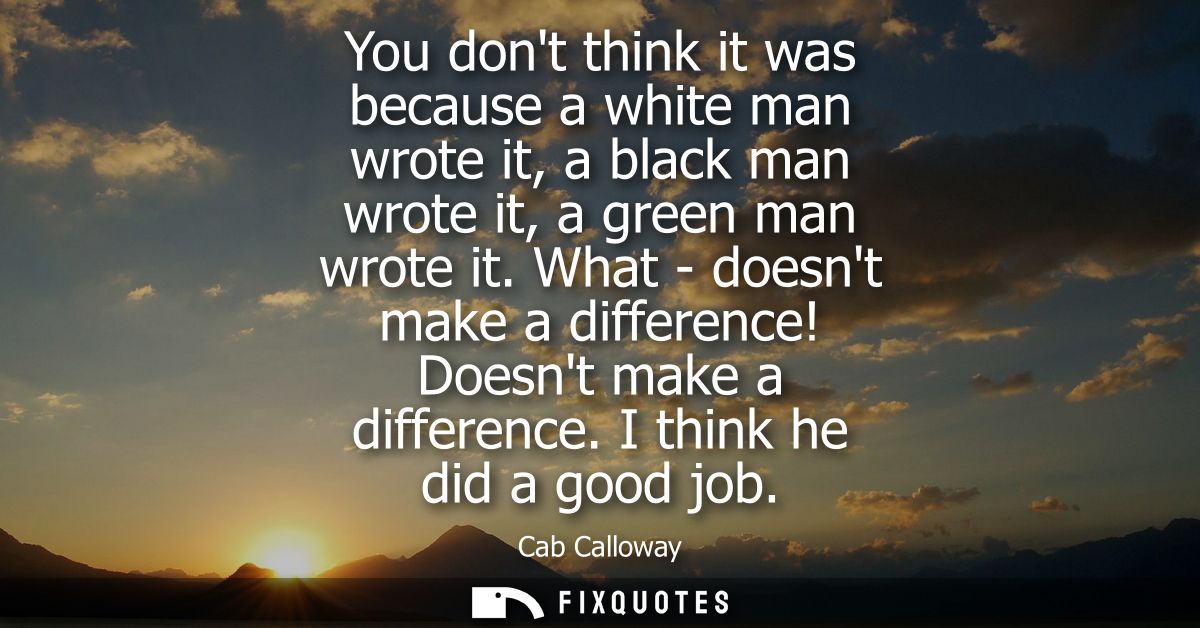
"You don't think it was because a white man wrote it, a black man wrote it, a green man wrote it. What - doesn't make a difference! Doesn't make a difference. I think he did a good job"
About this Quote
In context, that stance is both principled and strategic. Calloway came up in an era when Black musicians were routinely celebrated for their talent and simultaneously boxed in by segregation, exploitation, and “authenticity” policing from white gatekeepers. His refusal to make authorship a racial litmus test reads as a demand for artistic evaluation on the merits, not on the demographics of who held the pen. It’s also a subtle bid for autonomy: if your work is forever treated as an artifact of race first and craft second, you’re never allowed to be simply excellent.
The subtext isn’t naive colorblindness so much as impatience with a particular kind of reductionism. Calloway isn’t denying racism; he’s rejecting the idea that it’s the only lens worth using. “I think he did a good job” is the closer, and it’s deceptively radical: a claim that taste, skill, and generosity of judgment can be acts of resistance in a culture addicted to sorting.
Quote Details
| Topic | Equality |
|---|---|
| Source | Help us find the source |
| Cite |
Citation Formats
APA Style (7th ed.)
Calloway, Cab. (2026, January 16). You don't think it was because a white man wrote it, a black man wrote it, a green man wrote it. What - doesn't make a difference! Doesn't make a difference. I think he did a good job. FixQuotes. https://fixquotes.com/quotes/you-dont-think-it-was-because-a-white-man-wrote-118195/
Chicago Style
Calloway, Cab. "You don't think it was because a white man wrote it, a black man wrote it, a green man wrote it. What - doesn't make a difference! Doesn't make a difference. I think he did a good job." FixQuotes. January 16, 2026. https://fixquotes.com/quotes/you-dont-think-it-was-because-a-white-man-wrote-118195/.
MLA Style (9th ed.)
"You don't think it was because a white man wrote it, a black man wrote it, a green man wrote it. What - doesn't make a difference! Doesn't make a difference. I think he did a good job." FixQuotes, 16 Jan. 2026, https://fixquotes.com/quotes/you-dont-think-it-was-because-a-white-man-wrote-118195/. Accessed 14 Mar. 2026.