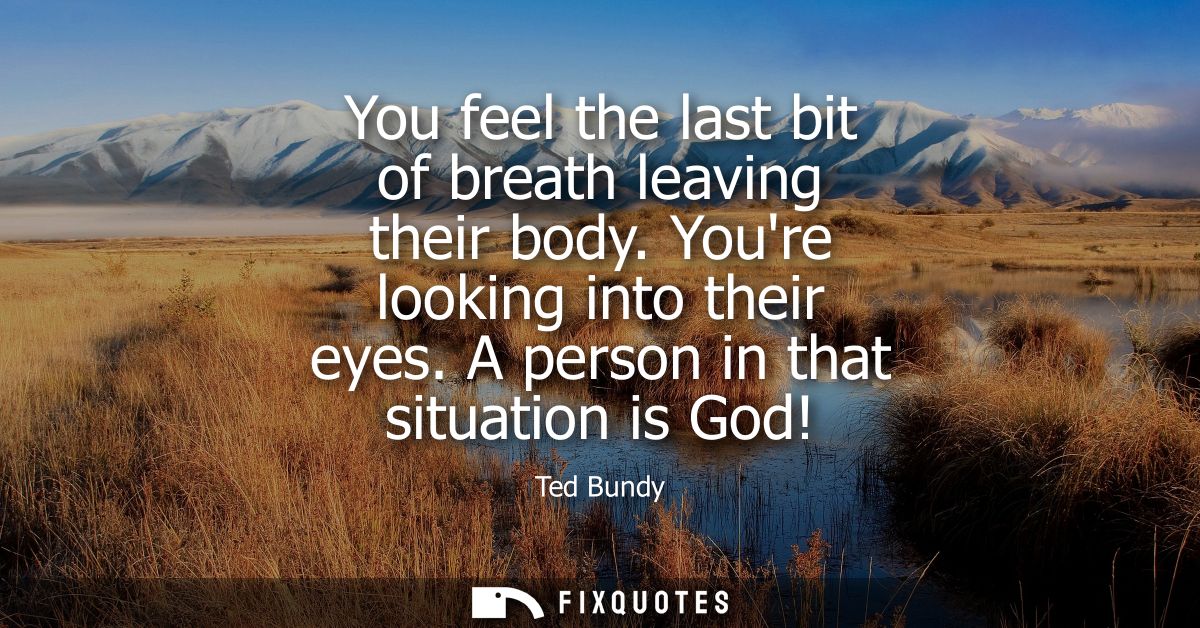
"You feel the last bit of breath leaving their body. You're looking into their eyes. A person in that situation is God!"
About this Quote
Bundy isn’t describing a murder; he’s pitching a theology of control. The line’s crude power comes from how it smuggles domination into the language of intimacy: breath, eyes, presence. These are the cues of closeness, the bodily details we associate with care, confession, even love. He weaponizes them to reframe a killing as a kind of sacred encounter, with himself cast not as a predator but as a godlike witness to someone’s final seconds.
The intent is pure self-mythologizing. Bundy’s phrase “A person in that situation is God!” isn’t metaphor so much as alibi. If he can elevate the act to the level of divinity, then ordinary categories - cruelty, cowardice, guilt - become too small to hold it. The subtext is that power is not just the point, it’s the pleasure: the thrill of deciding whether a body continues. “You feel” is doing work, too. It’s an invitation to empathize with the killer’s sensations, to center his experience as the primary reality in the room.
Context matters because Bundy cultivated performance: the educated, articulate charm deployed to confuse, seduce, and control narratives around his violence. This quote is an extension of that strategy, a rhetorical costume for sadism. By calling it God, he tries to convert horror into awe, as if spectatorship could substitute for accountability. The line endures because it’s a chillingly efficient snapshot of the psychology of coercion: intimacy stripped of reciprocity, made into a stage for omnipotence.
The intent is pure self-mythologizing. Bundy’s phrase “A person in that situation is God!” isn’t metaphor so much as alibi. If he can elevate the act to the level of divinity, then ordinary categories - cruelty, cowardice, guilt - become too small to hold it. The subtext is that power is not just the point, it’s the pleasure: the thrill of deciding whether a body continues. “You feel” is doing work, too. It’s an invitation to empathize with the killer’s sensations, to center his experience as the primary reality in the room.
Context matters because Bundy cultivated performance: the educated, articulate charm deployed to confuse, seduce, and control narratives around his violence. This quote is an extension of that strategy, a rhetorical costume for sadism. By calling it God, he tries to convert horror into awe, as if spectatorship could substitute for accountability. The line endures because it’s a chillingly efficient snapshot of the psychology of coercion: intimacy stripped of reciprocity, made into a stage for omnipotence.
Quote Details
| Topic | Ethics & Morality |
|---|
More Quotes by Ted
Add to List