
Book: Culture and Commitment
Overview
Margaret Mead’s Culture and Commitment (1970) examines how cultures transmit values and knowledge across generations and how that transmission was being disrupted in the late twentieth century. Using an anthropological lens, Mead argues that the “generation gap” of the 1960s and 1970s reflects a deep structural shift in the way societies reproduce themselves, driven by the accelerating pace of technological, social, and political change. Rather than treating youth rebellion as a moral failing or a transient fashion, she frames it as an adaptive response to new historical conditions that outstrip traditional forms of adult authority.
Key concepts
Mead’s central contribution is a typology of cultural transmission: postfigurative, cofigurative, and prefigurative cultures. In postfigurative cultures, characteristic of more stable societies, children learn primarily from elders, and the past provides reliable templates for life. Cofigurative cultures arise amid rapid change, where peers become the main models because older generations lack experience with novel conditions; immigrant communities and industrializing societies often show this pattern. Prefigurative cultures, which Mead sees emerging in modern societies, invert the traditional flow of knowledge: adults must learn from their children, who are the first to master new technologies, languages of media, and social norms. The move toward prefiguration explains both the insecurity of adults and the assertiveness of youth in setting agendas for the future.
The generation gap and modernity
Mead ties the generation gap to compressed time horizons created by mass media, scientific breakthroughs, mobility, and global interdependence. Parents cannot promise their children a world resembling their own childhood; teachers cannot rely on fixed curricula when knowledge obsolesces quickly. This disjuncture erodes the authority that once came from age and experience, while youth cultures proliferate to meet needs that established institutions ignore. She neither romanticizes youth nor condemns adults; the gap is a systemic effect of change, not a moral defect of either side.
Education, family, and institutions
Because the old guarantees of continuity no longer hold, Mead calls for institutions that teach how to learn, not merely what to know. Education should emphasize inquiry, ethical reasoning, cultural comparison, and the capacity to collaborate across differences and generations. Families and schools must legitimize reciprocal learning, allowing adults to acknowledge children’s expertise without surrendering responsibility for setting values and limits. Rather than rigid authority or permissive withdrawal, she favors a partnership model in which adults provide moral orientation and long-term perspective while actively learning from the young about emerging realities.
Commitment under conditions of change
The title’s second term, commitment, addresses the fear that continuous change dissolves loyalty and purpose. Mead argues that commitment must be redefined as a consciously chosen, revisable, yet binding engagement to people, causes, and institutions. The challenge is to develop forms of commitment that can adapt to novelty without collapsing into cynicism or drift. Rituals of passage, public deliberation, and shared projects can anchor continuity even as specific skills and roles evolve. Commitment becomes not the defense of a fixed past but a sustained pledge to create a livable future together.
Comparative perspective and implications
Drawing on cross-cultural cases from small-scale societies and modern nation-states, Mead shows that no single pattern of transmission is universal or permanent. Societies flourish when they align educational practices and intergenerational relations with their tempo of change. The contemporary move toward prefiguration, if recognized and thoughtfully managed, can broaden participation, diversify leadership, and accelerate humane innovation; if denied, it breeds mistrust, polarization, and a loss of cultural memory.
Legacy
Culture and Commitment gave scholars and the public a vocabulary for thinking about generational dynamics beyond stereotypes. Its threefold model has shaped debates in anthropology, education, and policy, and its counsel, to cultivate reciprocal learning while sustaining ethical commitments, remains salient in an era of even faster change.
Citation Formats
APA Style (7th ed.)
Culture and commitment. (2026, February 4). FixQuotes. https://fixquotes.com/works/culture-and-commitment/
Chicago Style
"Culture and Commitment." FixQuotes. February 4, 2026. https://fixquotes.com/works/culture-and-commitment/.
MLA Style (9th ed.)
"Culture and Commitment." FixQuotes, 4 Feb. 2026, https://fixquotes.com/works/culture-and-commitment/. Accessed 28 Mar. 2026.
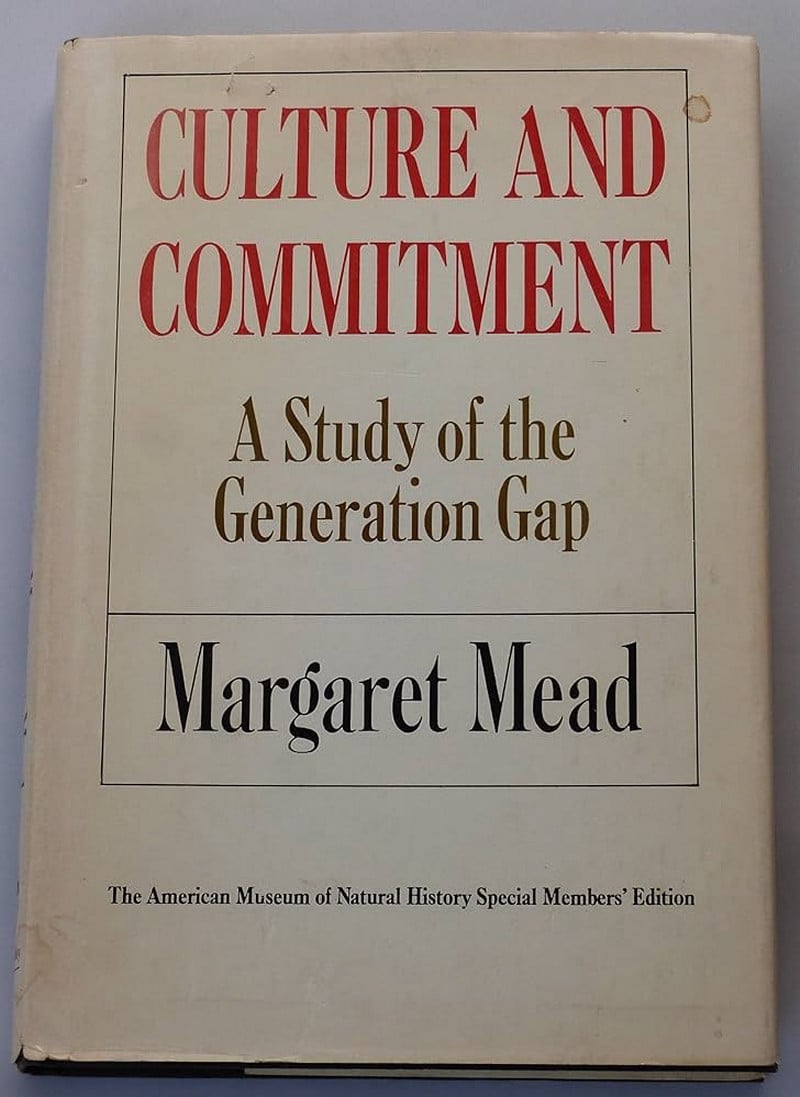
Culture and Commitment
A study of the generation gap and the ways in which changing cultural values impact the relationship between generations.
- Published1970
- TypeBook
- GenreAnthropology, Non-Fiction
- LanguageEnglish
About the Author

Margaret Mead
Margaret Mead, a pioneering anthropologist known for her influential research in cultural anthropology and advocacy for social change.
View Profile- OccupationScientist
- FromUSA
-
Other Works
- Coming of Age in Samoa (1928)
- Growing Up in New Guinea (1930)
- Sex and Temperament in Three Primitive Societies (1935)
- Male and Female (1949)
- Blackberry Winter: My Earlier Years (1972)