
Book: Experience and Education
Overview
John Dewey presents a concise, forceful rethinking of education that rejects simple labels and demands careful attention to how learning actually grows out of experience. He frames education as reconstruction of experience, where the goal is not merely the transmission of facts or the laissez-faire cultivation of natural impulses, but the deliberate arrangement of environments and activities that foster intelligent, social, and continuous growth.
Dewey positions his argument against polarized practices of his time and offers principles meant to guide educators toward a balanced, reflective method. He emphasizes that educational quality rests on how experiences are organized and linked over time, and on how teachers shape conditions for purposeful inquiry and democratic participation.
Diagnosis of the Two Extremes
Dewey criticizes what he calls "traditional" education for treating pupils as passive recipients of predetermined subject matter. In this model, discipline and rote learning prevail, and the teacher's authority is exercised to impose intellectual content without connecting it to pupils' lives; such an approach stunts initiative and makes knowledge inert.
He is equally critical of a caricatured "progressive" education that mistakes freedom for mere permissiveness and believes that any activity chosen by the child is ipso facto educational. Without structure, direction, or thoughtful sequencing, activities become isolated experiences that fail to build a coherent growth of capacities and understanding.
Experience and Continuity
Central to Dewey's theory is the principle of continuity: every experience influences the quality of future experiences. Education should therefore cultivate experiences that enrich and extend one another, so that learning is cumulative and purposeful rather than episodic and random. Continuity links personal growth to a trajectory of increasing intelligence and social responsibility.
For Dewey, continuity requires the teacher to attend to the past experiences pupils bring and to anticipate the consequences of present activities. This temporal dimension makes schooling a process of reconstruction, where educators intentionally select and sequence experiences to create meaningful progress.
Interaction and Growth
The second pivotal idea is interaction: experience arises through the dynamic interplay between a person and their environment. Learning is neither solely internal nor merely environmental; it is produced in the transactions where needs, interests, tools, materials, and social relationships converge. Educators must therefore design environments that provoke inquiry, experimentation, and reflective thought.
Interaction grounds education in problems that matter. When pupils confront conditions that stimulate reflective thinking, they exercise judgment and develop habits of inquiry. Growth, for Dewey, is measured by an expanded capacity to transform situations through intelligent action, not by mere accumulation of information.
Freedom, Discipline, and Deliberate Instruction
Dewey insists that freedom in education must be balanced by purposeful guidance. Genuine freedom arises within a framework of organized experiences that provide both opportunities and constraints necessary for learning. Discipline is not external coercion but the cultivation of powers that enable self-directed action and responsible choice.
Deliberate instruction complements freedom by offering direction, modeling methods of inquiry, and presenting subject matter in ways that connect to pupil interests and social aims. The teacher's role is to mediate, to plan sequences that make inquiry fruitful, and to assess experiences by how well they prepare pupils for future intelligent activity.
Practical Implications and Legacy
Dewey's pragmatic emphasis leads to curricular and pedagogical implications: curricula should grow from activities rooted in real problems, instruction should integrate subjects around meaningful projects, and assessment should focus on growth and the capacity for further experience. Education is, ultimately, a social enterprise aimed at equipping individuals for democratic life.
Experience and Education remains influential because it refuses easy formulas and insists on reflective practice. Its legacy is a balanced, practice-oriented framework that continues to inform debates about active learning, teacher development, and the democratic purposes of schooling.
Citation Formats
APA Style (7th ed.)
Experience and education. (2026, February 5). FixQuotes. https://fixquotes.com/works/experience-and-education/
Chicago Style
"Experience and Education." FixQuotes. February 5, 2026. https://fixquotes.com/works/experience-and-education/.
MLA Style (9th ed.)
"Experience and Education." FixQuotes, 5 Feb. 2026, https://fixquotes.com/works/experience-and-education/. Accessed 26 Mar. 2026.
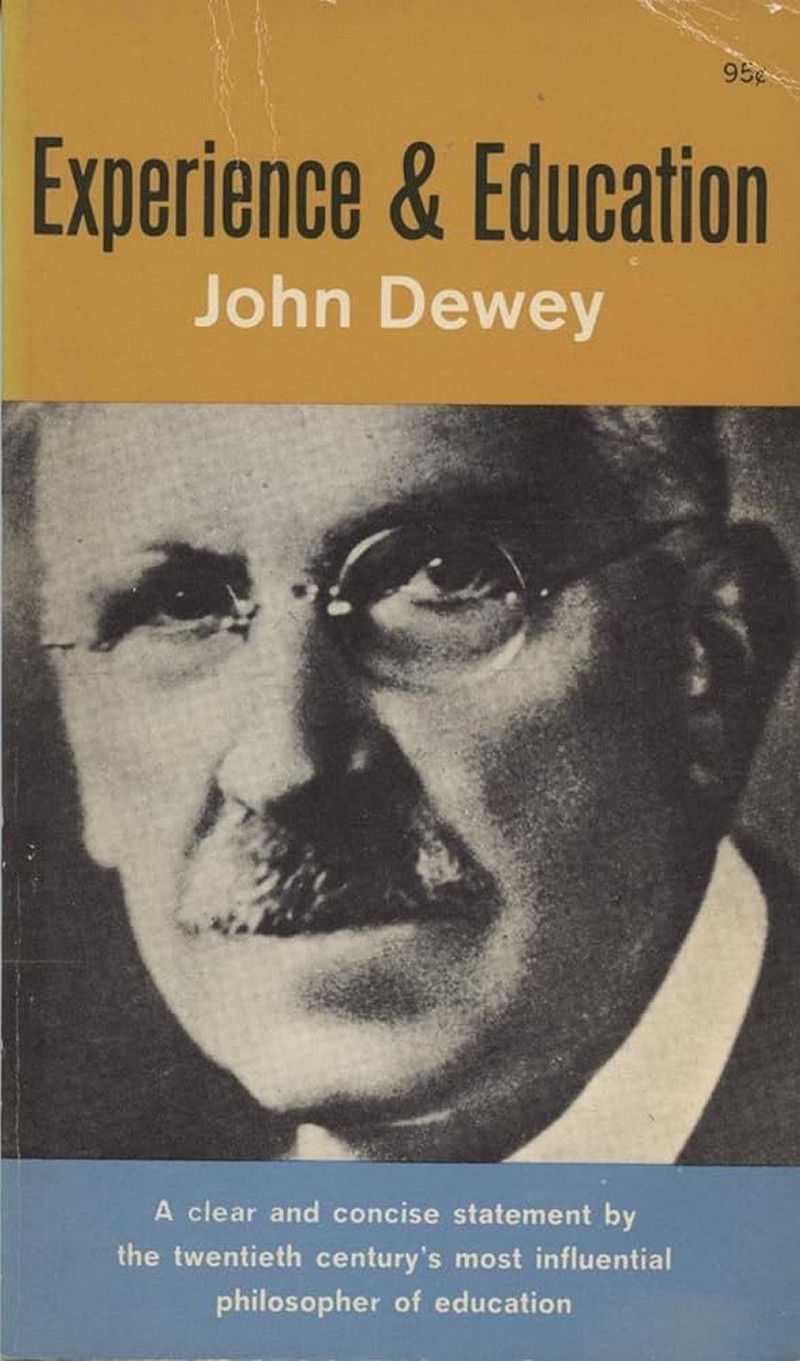
Experience and Education
A concise critique of progressive and traditional schooling that clarifies Dewey's educational principles: continuity of experience, interaction, and the need to balance freedom with deliberate instruction.
- Published1938
- TypeBook
- GenreEducation
- Languageen
About the Author

John Dewey
John Dewey, American philosopher and educator who shaped pragmatism, progressive education, and democratic theory.
View Profile- OccupationPhilosopher
- FromUSA
-
Other Works
- My Pedagogic Creed (1897)
- School and Society (1899)
- The Child and the Curriculum (1902)
- Studies in Logical Theory (1903)
- The Influence of Darwin on Philosophy and Other Essays (1910)
- How We Think (1910)
- Democracy and Education (1916)
- Reconstruction in Philosophy (1920)
- Human Nature and Conduct (1922)
- Experience and Nature (1925)
- The Public and Its Problems (1927)
- Impressions of Soviet Russia and the Revolutionary World (1929)
- Individualism Old and New (1930)
- A Common Faith (1934)
- Art as Experience (1934)
- Logic: The Theory of Inquiry (1938)
- Creative Democracy , The Task Before Us (1939)
- Freedom and Culture (1939)