
Book: In the Evening of My Thought
Overview
Georges Clemenceau’s In the Evening of My Thought (1927) gathers the statesman’s late-life reflections into a luminous, unsentimental testament. Written after the First World War and at the threshold of old age, the book turns from day-to-day politics to enduring questions: the weight of time, the fragility of glory, the stubbornness of error, and the conditions under which human beings deserve to call themselves free. It is less a memoir than a meditation, braiding personal memory, philosophical skepticism, and a hard-earned ethic of civic courage. The voice is unmistakably Clemenceau’s, brusque, lucid, ironic, yet often tender when speaking of friendship, art, and the landscapes that formed him.
Form and Voice
The book proceeds as a sequence of essays and aphoristic passages rather than a continuous argument. Clemenceau prefers flashes of analysis to system-building, trusting observation and experience over abstract doctrine. He tests ideas as a doctor palpates a wound, probing for tenderness and truth. The prose moves from the airy heights of speculation to anecdote and back again, insisting that thought only matters if it meets the stubborn facts of life. This discontinuous architecture lets him return, from shifting angles, to themes that have preoccupied him for decades: responsibility, doubt, endurance.
History and the Republic
Clemenceau writes as one who has seen revolutions flame out and wars burn through illusions. He distrusts historical teleology and mocks any philosophy that promises inevitable progress. What he accepts instead is a republican discipline: institutions must be guarded by citizens who do not wait for providence. He revisits episodes of injustice to argue that civic virtue is made, not inherited, and that rights are secured by vigilance more than by eloquence. Victory, he suggests, is less a final state than a labor of repair; peace exists only where truth is told, contracts are kept, and power is balanced by law. He respects force as a fact, never as a principle.
Science, Faith, and the Limits of Knowledge
A lifelong admirer of scientific method, Clemenceau turns its light on the realms that most tempt dogma. Science, he argues, is not a temple but a tool: its greatness lies in its willingness to be corrected. He is unsparing toward revelation that demands submission, especially when it hardens into clerical power. Yet he does not confuse anticlericalism with nihilism. He speaks with respect for ethical traditions that cultivate restraint without asserting cosmic privilege, and he finds in certain spiritual disciplines an honesty about suffering and impermanence that harmonizes with inquiry. What he refuses, everywhere, is abdication of thought. Knowledge has borders; humility begins at those borders; superstition begins when we pretend they are not there.
Art, Nature, and Memory
If politics sharpens his sentences, art and landscape soften them. Clemenceau returns often to light on water, the patient labor of the painter, the dignity of crafted work. Art, for him, trains the eye to see without lying; it draws the mind out of rhetoric into attention. He writes with special warmth about the consolation of beauty after catastrophe, not as escape but as a re-education of the senses toward proportion, measure, and pity. Memory, too, is a moral faculty in these pages. It is not a museum but a conscience that prevents both despair and self-congratulation. To remember rightly is to balance gratitude with regret and to keep the future open.
Style and Legacy
The book’s severity is humane. Clemenceau uses wit as a disinfectant, not a weapon. He favors the clean edge of a sentence that leaves room for thought to breathe. In the Evening of My Thought stands as a secular examen of conscience by a man who refuses to trade clarity for comfort. Its counsel is plain: distrust inevitabilities, honor labor, cherish the free mind, and let institutions answer to citizens who have learned to endure disillusion without surrendering hope.
Georges Clemenceau’s In the Evening of My Thought (1927) gathers the statesman’s late-life reflections into a luminous, unsentimental testament. Written after the First World War and at the threshold of old age, the book turns from day-to-day politics to enduring questions: the weight of time, the fragility of glory, the stubbornness of error, and the conditions under which human beings deserve to call themselves free. It is less a memoir than a meditation, braiding personal memory, philosophical skepticism, and a hard-earned ethic of civic courage. The voice is unmistakably Clemenceau’s, brusque, lucid, ironic, yet often tender when speaking of friendship, art, and the landscapes that formed him.
Form and Voice
The book proceeds as a sequence of essays and aphoristic passages rather than a continuous argument. Clemenceau prefers flashes of analysis to system-building, trusting observation and experience over abstract doctrine. He tests ideas as a doctor palpates a wound, probing for tenderness and truth. The prose moves from the airy heights of speculation to anecdote and back again, insisting that thought only matters if it meets the stubborn facts of life. This discontinuous architecture lets him return, from shifting angles, to themes that have preoccupied him for decades: responsibility, doubt, endurance.
History and the Republic
Clemenceau writes as one who has seen revolutions flame out and wars burn through illusions. He distrusts historical teleology and mocks any philosophy that promises inevitable progress. What he accepts instead is a republican discipline: institutions must be guarded by citizens who do not wait for providence. He revisits episodes of injustice to argue that civic virtue is made, not inherited, and that rights are secured by vigilance more than by eloquence. Victory, he suggests, is less a final state than a labor of repair; peace exists only where truth is told, contracts are kept, and power is balanced by law. He respects force as a fact, never as a principle.
Science, Faith, and the Limits of Knowledge
A lifelong admirer of scientific method, Clemenceau turns its light on the realms that most tempt dogma. Science, he argues, is not a temple but a tool: its greatness lies in its willingness to be corrected. He is unsparing toward revelation that demands submission, especially when it hardens into clerical power. Yet he does not confuse anticlericalism with nihilism. He speaks with respect for ethical traditions that cultivate restraint without asserting cosmic privilege, and he finds in certain spiritual disciplines an honesty about suffering and impermanence that harmonizes with inquiry. What he refuses, everywhere, is abdication of thought. Knowledge has borders; humility begins at those borders; superstition begins when we pretend they are not there.
Art, Nature, and Memory
If politics sharpens his sentences, art and landscape soften them. Clemenceau returns often to light on water, the patient labor of the painter, the dignity of crafted work. Art, for him, trains the eye to see without lying; it draws the mind out of rhetoric into attention. He writes with special warmth about the consolation of beauty after catastrophe, not as escape but as a re-education of the senses toward proportion, measure, and pity. Memory, too, is a moral faculty in these pages. It is not a museum but a conscience that prevents both despair and self-congratulation. To remember rightly is to balance gratitude with regret and to keep the future open.
Style and Legacy
The book’s severity is humane. Clemenceau uses wit as a disinfectant, not a weapon. He favors the clean edge of a sentence that leaves room for thought to breathe. In the Evening of My Thought stands as a secular examen of conscience by a man who refuses to trade clarity for comfort. Its counsel is plain: distrust inevitabilities, honor labor, cherish the free mind, and let institutions answer to citizens who have learned to endure disillusion without surrendering hope.
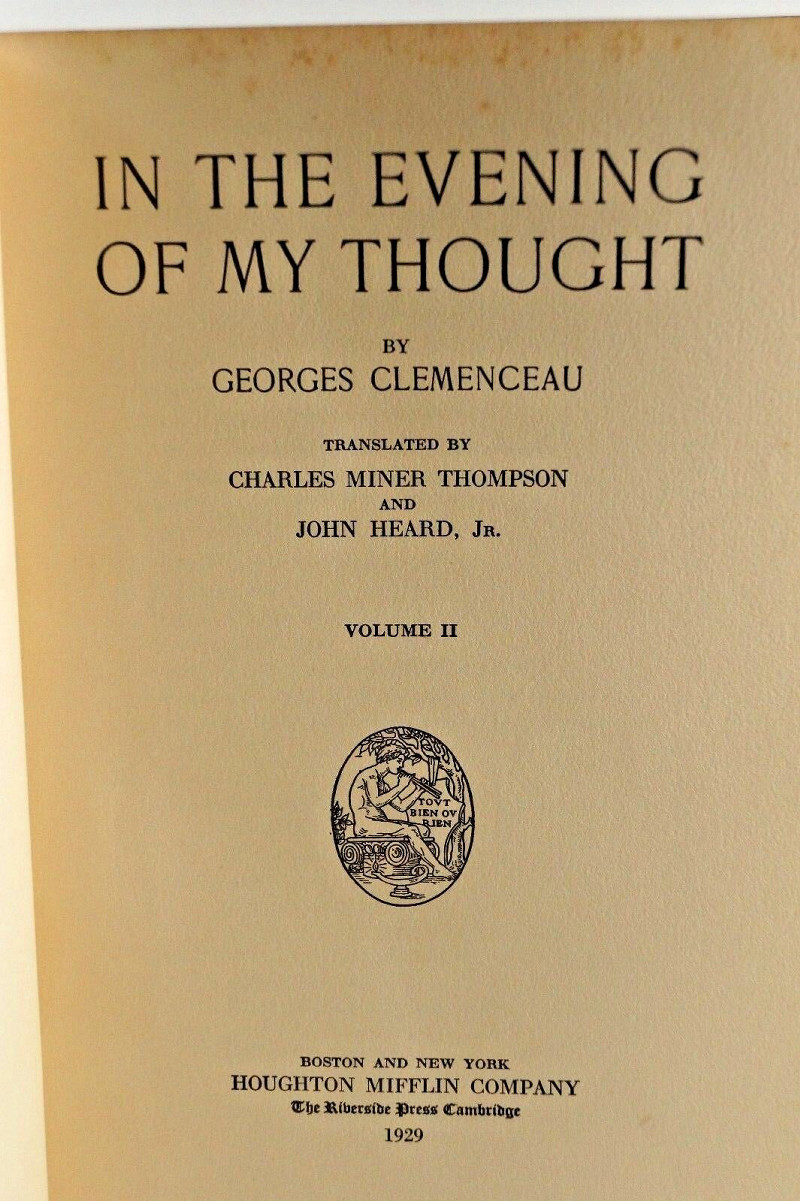
In the Evening of My Thought
Original Title: Au soir de la pensée
In the Evening of My Thought is a collection of reflections from the author, addressing a variety of topics like international relations, education, and human rights. The book presents Clemenceau's thoughts and insights in a conversational tone, encouraging readers to engage with the ideas presented.
- Publication Year: 1927
- Type: Book
- Genre: Politics, Philosophy
- Language: French
- View all works by Georges Clemenceau on Amazon
Author: Georges Clemenceau

More about Georges Clemenceau
- Occup.: Leader
- From: France
- Other works:
- The Strong Man's Vade-Mecum (Le Vade-Mecum de l'homme fort) (1901 Book)
- South America To-Day (1912 Book)