
Book: Opera Omnia
Overview
Leonhard Euler's Opera Omnia is the complete, collected edition of one of history's most prolific mathematicians and physicists. It assembles his articles, treatises, textbooks and correspondence into a comprehensive body of work that illuminates the breadth and depth of 18th‑century mathematical thought. The collection functions both as a reference forEuler's original papers and as a window into the development of modern mathematical language and methods.
Contents and scope
The Opera Omnia spans analytical theory, number theory, geometry, mechanics, optics, astronomy, fluid dynamics and applied problems, along with pedagogical texts and extensive letters. Major texts such as Introductio in analysin infinitorum, the Institutiones on differential and integral calculus, Elements of Algebra and his popular "Letters to a German Princess" appear alongside specialized research on celestial mechanics, the theory of infinite series, the calculus of variations and problems in elasticity and hydraulics. The edition preserves works written in Latin, French and German, and it includes both polished memoirs and less formal correspondence that reveal the working methods and problems of the time.
Editorial character and presentation
The Opera Omnia is organized as a critical corpus intended to present Euler's writings faithfully, often with scholarly notes and bibliographic apparatus. The presentation keeps original language and notation, while modern editors provide contextual information, variant readings and cross‑references that help readers follow the evolution of ideas across decades. Because Euler published prolifically in journals, academy memoirs and private letters, the collected edition groups related materials to show continuities between textbook exposition, research papers and applied investigations.
Key mathematical achievements represented
Within the Opera Omnia readers encounter the introduction and systematization of many notational and conceptual tools central to modern mathematics: systematic function notation, a rigorous exploitation of infinite series, development of analytic methods for geometry and mechanics, and foundational contributions to number theory such as work on partitions, primes and what later became known as the zeta function. Euler's mixture of computational virtuosity and clear exposition made deep ideas accessible to contemporaries and laid groundwork still used in research and teaching.
Historical and scientific significance
The collected works document how a single mind shaped multiple mathematical disciplines and how practical problems in astronomy, engineering and navigation drove theoretical advances. Euler's output influenced contemporaries and succeeding generations by providing techniques, examples and problems that became standard. The Opera Omnia is not merely an archival monument; it is an active resource for historians of science, mathematicians tracing the genealogy of concepts, and teachers seeking original expositions that combine rigor with calculational insight.
Legacy and continued relevance
More than two centuries after their composition, Euler's writings remain central to mathematical culture. The Opera Omnia preserves the primary sources that allow modern readers to trace the emergence of notation, to study original proofs and computations, and to appreciate the interplay between theory and application that characterized the Enlightenment sciences. For anyone interested in the historical roots of analysis, mechanics and number theory, the collected works provide an indispensable, richly detailed portrait of mathematical creativity.
Citation Formats
APA Style (7th ed.)
Opera omnia. (2026, February 4). FixQuotes. https://fixquotes.com/works/opera-omnia/
Chicago Style
"Opera Omnia." FixQuotes. February 4, 2026. https://fixquotes.com/works/opera-omnia/.
MLA Style (9th ed.)
"Opera Omnia." FixQuotes, 4 Feb. 2026, https://fixquotes.com/works/opera-omnia/. Accessed 12 Feb. 2026.
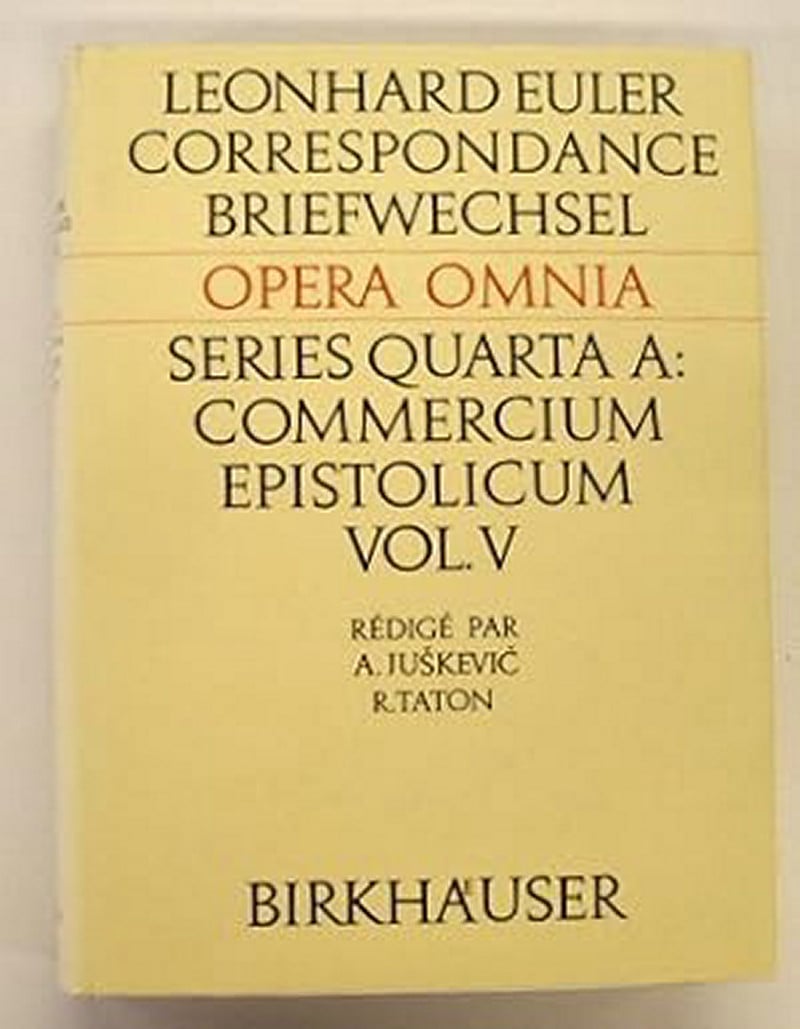
Opera Omnia
Original: Leonhardi Euleri Opera Omnia
The complete works of Leonhard Euler, comprising more than 70 volumes of mathematics and physics, including articles, books, and correspondence.
- Published1911
- TypeBook
- GenreMathematics, Physics
- LanguageLatin, French, German
About the Author

Leonhard Euler
Leonhard Euler, a pioneering mathematician in graph theory, calculus, and number theory.
View Profile- OccupationMathematician
- FromSwitzerland
-
Other Works
- Mechanica (1736)
- Theoria motuum planetarum et cometarum (1744)
- Methodus Inveniendi Lineas Curvas Maximi Minimive Proprietate Gaudentes (1744)
- Introductio in analysin infinitorum (1748)
- Institutiones calculi differentialis (1755)
- De seriebus divergentibus (1760)
- Institutiones calculi integralis (1768)
- Dioptrica (1769)