
Novel: Sartor Resartus
Overview
Thomas Carlyle’s Sartor Resartus (Latin for “The Tailor Re-tailored”) is a hybrid of novel, philosophical treatise, and satire. It purports to review and annotate a nonexistent German volume, “Clothes: Their Origin and Influence, ” by the equally fictitious Professor Diogenes Teufelsdröckh. Through this masquerade, the book examines how outer forms, customs, institutions, creeds, fashions, are like garments that both conceal and reveal spiritual realities. The narrative tracks a mind’s passage from skepticism to affirmation, turning a mock-scholar’s commentary into a spiritual autobiography and a critique of a mechanized, utilitarian age.
Framing and Structure
An English Editor-narrator undertakes to introduce Teufelsdröckh and his philosophy to a British audience. Denied a coherent manuscript, he receives six paper-bags stuffed with scraps: letters, municipal records, marginalia. From these fragments he reconstructs the professor’s life in the university town of Weissnichtwo (“Know-not-where”), interleaving biography with exegesis of the “Philosophy of Clothes.” The oscillation between footnoted erudition and personal revelation makes the book a collage, constantly calling attention to its own artifices while pressing toward metaphysical insight.
Teufelsdröckh’s Journey
The professor’s life unfolds as a modern bildungsroman. An obscure origin, a rural upbringing, and brilliant studies lead him to the bustle of cities and the halls of learning. A thwarted romance with Blumine and an academic dead-end precipitate spiritual crisis. He passes through the “Everlasting No, ” a phase of nihilism and rage at a universe stripped of meaning, into the “Centre of Indifference, ” where life becomes weary neutrality. In Paris, by the Rue Saint-Thomas de l’Enfer, he undergoes a pivotal revolt against despair, emerging into the “Everlasting Yea”: a hard-won acceptance of duty, reverence, and the possibility of joy. His cure is not speculative certainty but a vocation for work, gratitude for the daily, and openness to the numinous in ordinary time.
The Philosophy of Clothes
Clothes are the master metaphor. Human beings are clothed not only in fabric but in language, rites, offices, and laws; all social forms are vestures draped over the naked fact of spiritual existence. These vestures are necessary and yet transient; they demand periodic “stripping” and renewal. From this follows “Natural Supernaturalism”: the claim that the miraculous is not an exception to the world but its inner essence, that time and space are the forms through which spirit appears. Against the age’s “Mechanism” and narrow utility, Carlyle posits symbols that point beyond themselves, urging reverence for what endures while exposing sham, most pungently in his satire of the Dandiacal Body, whose worship of surface is a religion of clothes without soul.
Satire, Style, and Voice
The tone ricochets between solemn prophecy, comic pedantry, and editorial fussiness. Teufelsdröckh’s Germanic bombast meets the Editor’s British skepticism, generating irony and distance even as the book reaches for the absolute. Mock notes, invented authorities, and self-canceling asides lampoon academic apparatus while pressing real philosophical questions. The texture is fragmentary yet patterned, its discontinuities mirroring a modern consciousness seeking order amid flux.
Significance
Sartor Resartus stands as a manifesto for moral and spiritual renewal under the pressure of modernity. Its symbolic method invites readers to discern the sacred beneath convention and to remake worn institutions without discarding the spirit they protect. By dramatizing a conversion from negation to affirmation, Carlyle articulates an ethic of work, duty, and awe, challenging an age of surfaces to recover depth.
Citation Formats
APA Style (7th ed.)
Sartor resartus. (2026, January 2). FixQuotes. https://fixquotes.com/works/sartor-resartus/
Chicago Style
"Sartor Resartus." FixQuotes. January 2, 2026. https://fixquotes.com/works/sartor-resartus/.
MLA Style (9th ed.)
"Sartor Resartus." FixQuotes, 2 Jan. 2026, https://fixquotes.com/works/sartor-resartus/. Accessed 28 Mar. 2026.
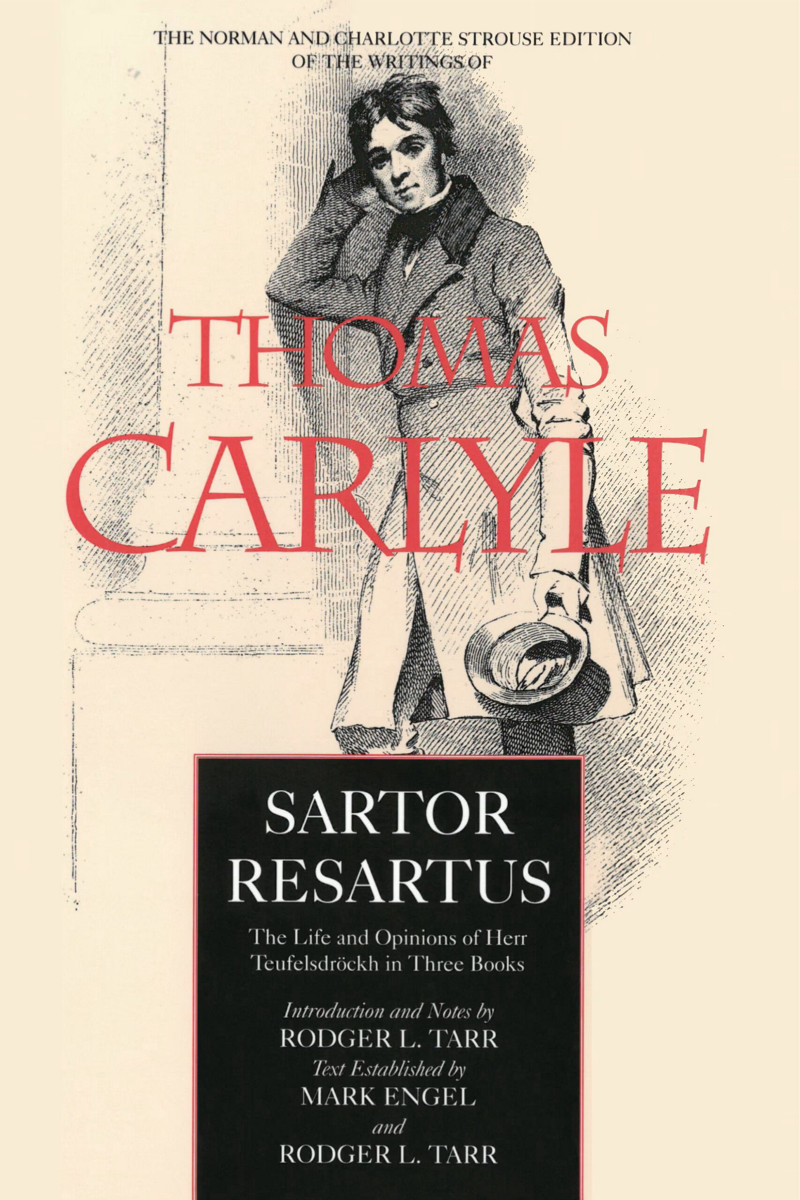
Sartor Resartus
Sartor Resartus is a satirical work that playfully blurs the lines between fiction and non-fiction, presenting a fictional autobiography of a German scholar named Diogenes Teufelsdröckh. The work is framed as an anthology of Teufelsdröckh's beliefs and opinions on a variety of subjects, primarily exploring his views on religion, society, and the human condition.
- Published1836
- TypeNovel
- GenreSatire
- LanguageEnglish
- CharactersDiogenes Teufelsdröckh
About the Author

Thomas Carlyle
Thomas Carlyle, a Scottish historian and satirical writer who shaped Victorian thought amidst social and scientific changes.
View Profile