
Book: Sesame and Lilies
Overview
John Ruskin’s Sesame and Lilies (1865) gathers two celebrated Victorian lectures that set out a program for cultural improvement through reading and a prescription for women’s moral influence in society. The title fuses two images: “Sesame, ” evoking the open-sesame to treasure, stands for the riches of literature; “Lilies, ” drawn from biblical symbolism and domestic ideal, points to purity and the shaping power of the feminine sphere. Compact yet ornate, the book pairs a manifesto on how to read with a sermon on what women should be educated to be, reflecting both Ruskin’s humanist aspirations and the era’s separate-spheres ideology.
Structure and Themes
The volume comprises “Of Kings’ Treasuries, ” a meditation on books as the storehouses of a civilization’s wisdom, and “Of Queens’ Gardens, ” an argument that women should be broadly educated so they may rule the home as moral queens. Together they press for elevating taste, conscience, and conduct, insisting that genuine culture is ethical as much as intellectual. Ruskin’s recurrent themes, reverence for great art, suspicion of commercial vulgarity, and belief in education as character formation, run through both lectures in a prose style dense with metaphor, scriptural cadence, and passionate exhortation.
Of Kings’ Treasuries
Ruskin casts the library as a royal treasury where readers gain access to the best minds “at their noblest moments.” He distinguishes “books of the hour, ” which gratify fashion or furnish passing information, from “books of all time, ” which speak across ages with inexhaustible power. Reading, he insists, is a form of fellowship under discipline: one must come to great authors with humility, patience, and moral alertness, choosing difficulty over entertainment and depth over novelty. The goal is not accumulation of facts but cultivation of judgment, imagination, and virtue.
He warns against the degradations of industrial modernity, cheap print, sensational journalism, haste, and urges readers to make a small, serious canon their lifelong companions. The right book, rightly read, is not a mirror for vanity but a challenge to the will; it places the reader under the right kind of authority. Access to such treasuries, he argues, should be truly public: education and libraries must serve rich and poor alike, so that national prosperity is measured by the quality of minds rather than the quantity of goods.
Of Queens’ Gardens
Turning to women’s education, Ruskin calls for an expansive curriculum that includes literature, history, and the sciences, not merely the ornamental arts. Yet he grounds this advocacy in a strict doctrine of sexual complementarity. “Man’s power is active, progressive, defensive; woman’s is for rule, not for battle.” He envisions the home as a realm where the woman’s sovereignty is moral and affective: she is to steady, refine, and protect, shaping the character of men and children through constancy and purity. The “lily” becomes an emblem of unworldly grace disciplined into practical governance.
By urging better schooling for women, he resists trivializing their talents, but he confines their vocation largely to domestic leadership and social conscience. The lecture thus affirms dignity and power for women while reinforcing Victorian boundaries that exclude them from public authority and professional ambition.
Style, Reception, and Legacy
Sesame and Lilies became one of Ruskin’s most popular books, cherished for its fervor about reading and debated for its prescriptions about gender. Its aphorisms, on the companionship of great books, on slow, reverent study, entered English-speaking commonplaces. Later critics praised the ethical vision of “Kings’ Treasuries” while challenging the restrictive ideal of “Queens’ Gardens.” Feminist readers have noted how the rhetoric of exaltation masks constraints, even as the call for robust female education fueled movements to expand women’s schooling. Today the volume stands both as a touchstone of Victorian cultural criticism and as a revealing document of its era’s aspirations and limits.
Citation Formats
APA Style (7th ed.)
Sesame and lilies. (2026, February 4). FixQuotes. https://fixquotes.com/works/sesame-and-lilies/
Chicago Style
"Sesame and Lilies." FixQuotes. February 4, 2026. https://fixquotes.com/works/sesame-and-lilies/.
MLA Style (9th ed.)
"Sesame and Lilies." FixQuotes, 4 Feb. 2026, https://fixquotes.com/works/sesame-and-lilies/. Accessed 5 Mar. 2026.
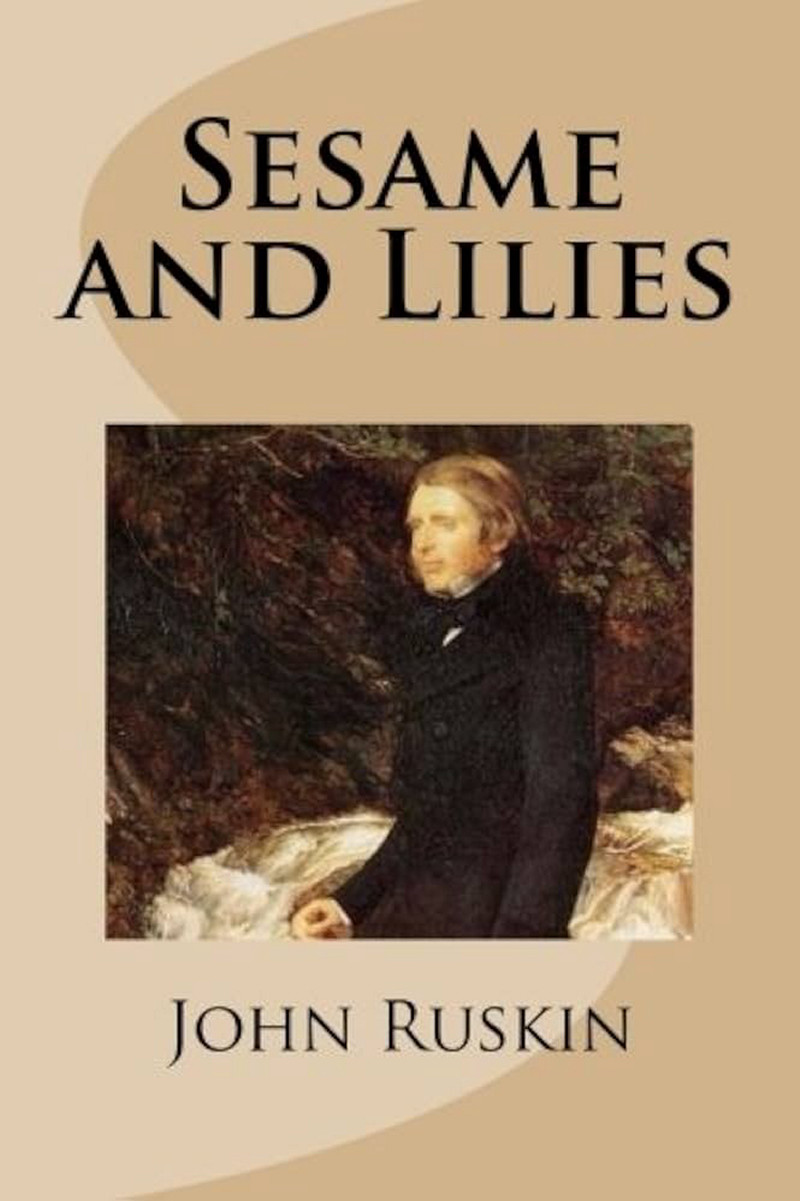
Sesame and Lilies
Sesame and Lilies is a collection of two lectures by John Ruskin: 'Of Kings' Treasuries' and 'Of Queens' Gardens'. In the first lecture, Ruskin discusses the role of reading and the importance of literature, while in the second lecture, he focuses on female education, its purpose, and the significance of women in society.
- Published1865
- TypeBook
- GenreEducation, Social criticism, Non-Fiction
- LanguageEnglish
About the Author

John Ruskin
John Ruskin, a major English writer and art critic renowned for his socio-political critiques and impact on 19th-century society.
View Profile- OccupationWriter
- FromEngland
-
Other Works
- Modern Painters (1843)
- The Seven Lamps of Architecture (1849)
- The Stones of Venice (1851)
- Unto This Last (1860)
- The Crown of Wild Olive (1866)
- Fors Clavigera (1871)