
Essay: Testaments Betrayed
Overview
"Testaments Betrayed" is a collection of essays by Milan Kundera published in 1993 that examines the modern European novel and defends its autonomy against reductionist, ideological readings. Kundera treats the novel as a form committed to doubt, memory and subtlety rather than to grand narratives or political instruments. The essays move between literary criticism, cultural history and personal reflection, insisting that literature resists being fully absorbed by historical or philosophical systems.
Kundera frames his arguments through close attention to the ethical and intellectual stakes of authorship. He probes how writers' intentions, literary forms and the reader's role have been reshaped or misrepresented by ideologies that demand singular meanings. The collection repeatedly returns to the idea that the novel's strength lies in its capacity to hold contradictions and to give voice to the ambiguous, the fragmentary and the ironic.
Main Themes
A dominant theme is the defense of ambiguity and plurality as central to the novel. Kundera objects to readings that force literature into moralistic or teleological frameworks, arguing that such readings betray the texts they claim to interpret. He insists that the novel's purpose is not to provide answers or to serve historical agendas but to investigate human consciousness in its messy, often contradictory reality.
Another persistent concern is the relationship between history and art. Kundera questions simplistic equations of literature with historical truth, suggesting instead that novels reveal the human experience of time, memory and forgetfulness. He also explores the moral responsibility of writers: not as moralists but as investigators of conscience whose work exposes the inner contradictions of individuals and societies.
Method and Style
Kundera's prose in these essays is aphoristic, polemical and often wry, combining scholarly erudition with personal anecdote and philosophical reflection. He alternates close textual readings with broader cultural critique, using examples to show how political or ideological interpretations can distort literary meaning. The voice is that of an engaged intellectual who values precision of thought and the ethical dimensions of interpretation.
Rather than a detached academic tone, the essays convey urgency and resistance. Kundera's method privileges the tension between detail and generality: a single image or motif in a novel is used to illuminate larger arguments about authorship, memory and the social uses of art. The result is both accessible and demanding, inviting readers to reconsider how they approach fiction.
Structure and Notable Arguments
The collection is organized as a sequence of interrelated meditations rather than a linear treatise, so themes reappear in different guises across essays. Kundera often returns to the motif of the "testament", the idea that a writer's declared intentions or last words can be co-opted, misread or turned into ideological weapons. He shows how such betrayals impoverish pluralistic reading and reduce complex artworks to single-purpose statements.
A striking argument is the critique of historicism and totalizing narratives that convert literary works into mere documents of social or political conditions. Kundera champions reading that preserves the novel's capacity for nuance, irony and internal conflict. He also emphasizes the humane dimension of fiction: novels teach readers how to live with moral uncertainty rather than prescribe fixed answers.
Significance and Reception
"Testaments Betrayed" reinforced Kundera's reputation as both novelist and critic, provoking debate about the role of ideology in literary interpretation and the ethics of reading. The essays appealed to those who defend aesthetic autonomy and attracted criticism from those who argue for literature's social responsibilities. Regardless of stance, readers have recognized the collection as a lucid, forceful defense of the novel's complexity.
The book remains a touchstone for discussions about interpretation, authorship and the politics of culture. Its call to respect ambiguity and to resist reductive readings preserves the novel as a space for questioning, contradiction and human depth.
Citation Formats
APA Style (7th ed.)
Testaments betrayed. (2025, September 14). FixQuotes. https://fixquotes.com/works/testaments-betrayed/
Chicago Style
"Testaments Betrayed." FixQuotes. September 14, 2025. https://fixquotes.com/works/testaments-betrayed/.
MLA Style (9th ed.)
"Testaments Betrayed." FixQuotes, 14 Sep. 2025, https://fixquotes.com/works/testaments-betrayed/. Accessed 13 Feb. 2026.
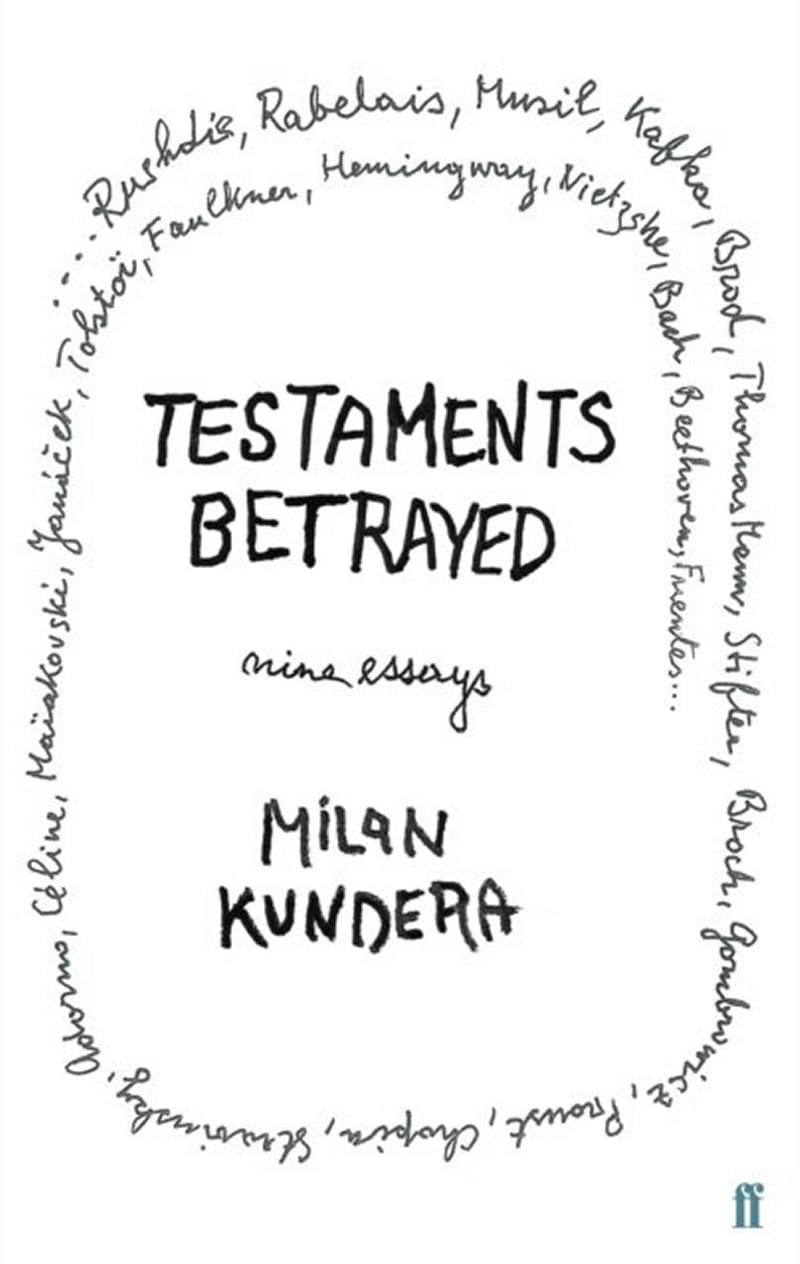
Testaments Betrayed
Original: Les Testaments trahis
A collection of essays on the modern European novel that defends the novel against ideological readings and reflects on authorship, history and the writer's responsibility.
- Published1993
- TypeEssay
- GenreLiterary Criticism, Essay
- Languagefr
About the Author
Milan Kundera
Milan Kundera with key life events, major works, themes, influences, and a selection of notable quotes.
View Profile- OccupationWriter
- FromCzech Republic
-
Other Works
- The Joke (1967)
- Laughable Loves (1968)
- Life Is Elsewhere (1973)
- The Farewell Waltz (1976)
- The Book of Laughter and Forgetting (1979)
- The Unbearable Lightness of Being (1984)
- The Art of the Novel (1986)
- Immortality (1990)
- Slowness (1995)
- Identity (1998)
- Ignorance (2000)
- The Curtain: An Essay in Seven Parts (2005)