
Book: The Controversy of Zion
Overview
Douglas Reed presents a sweeping, polemical narrative that traces the modern political movement of Zionism and its supposed influence on global affairs. He frames Zionism not merely as a nationalist project but as a covert, transnational force that has shaped major twentieth-century events. Reed's account moves through nineteenth- and twentieth-century Europe, the collapse of empires, the rise of revolutionary movements, and the aftermath of two world wars, arguing that these developments cannot be understood without acknowledging Zionist agency.
The book is written as a polemic rather than a detached scholarly study. Reed frames historical episodes as evidence of a continuous, organized campaign to achieve political and financial dominance, presenting an interpretation that reads historical contingency as deliberate design.
Central Arguments
Reed contends that Zionism evolved from religious and cultural origins into an assertive political movement that exerted disproportionate influence on governments, finance, and media. He argues that prominent events, diplomatic decisions, revolutions, and wars, were shaped or manipulated to advance Zionist objectives. Specific claims include alleged coordination between Zionist leaders and powerful political actors, and a tendency to connect disparate phenomena under a single conspiratorial explanation.
Key to Reed's thesis is the assertion that apparent coincidences and connections across national boundaries reveal a sustained strategy. He frequently links Zionism with other political currents, arguing that Jewish communities and Zionist institutions operated as an organized network pursuing long-term geopolitical goals. Reed presents these links as explanatory anchors for otherwise complex and multifactorial historical processes.
Method and Style
The book employs a rhetorical and often polemical style, combining selective documentary citation with broad generalizations. Reed draws on a mix of contemporary press reports, memoirs, and archival material, but arranges them to support sweeping conclusions rather than to present competing interpretations. His narrative favors pattern recognition and causation inferred from correlation, deploying charged language and provocative juxtapositions to make a persuasive case to sympathetic readers.
This approach yields a dramatic, readable narrative for those aligned with its premise, but it also means that nuance and methodological restraint are frequently sacrificed for rhetorical impact. Claims are often asserted with high confidence while countervailing evidence and the complexity of historical causation receive less attention.
Reception and Legacy
Reed's book has been highly controversial since its appearance, attracting both adherents and severe critics. Many historians, reviewers, and Jewish organizations have condemned its methodology and conclusions as conspiratorial and antisemitic, arguing that it relies on stereotypes, selective evidence, and an overarching narrative that attributes collective culpability to an entire people. At the same time, the book has circulated among anti-Zionist and far-right audiences who view it as a canonical critique of Zionism.
The work's legacy is therefore deeply contested: it is cited by those who seek a single, intentional explanation for twentieth-century upheavals, while mainstream scholarship regards it as an example of political polemic rather than responsible historical analysis. Readers encounter both a vigorous polemic and a cautionary case study in how interpretive ambition and selective sourcing can produce a compelling but problematic account of complex historical phenomena.
Citation Formats
APA Style (7th ed.)
The controversy of zion. (2025, September 13). FixQuotes. https://fixquotes.com/works/the-controversy-of-zion/
Chicago Style
"The Controversy of Zion." FixQuotes. September 13, 2025. https://fixquotes.com/works/the-controversy-of-zion/.
MLA Style (9th ed.)
"The Controversy of Zion." FixQuotes, 13 Sep. 2025, https://fixquotes.com/works/the-controversy-of-zion/. Accessed 11 Feb. 2026.
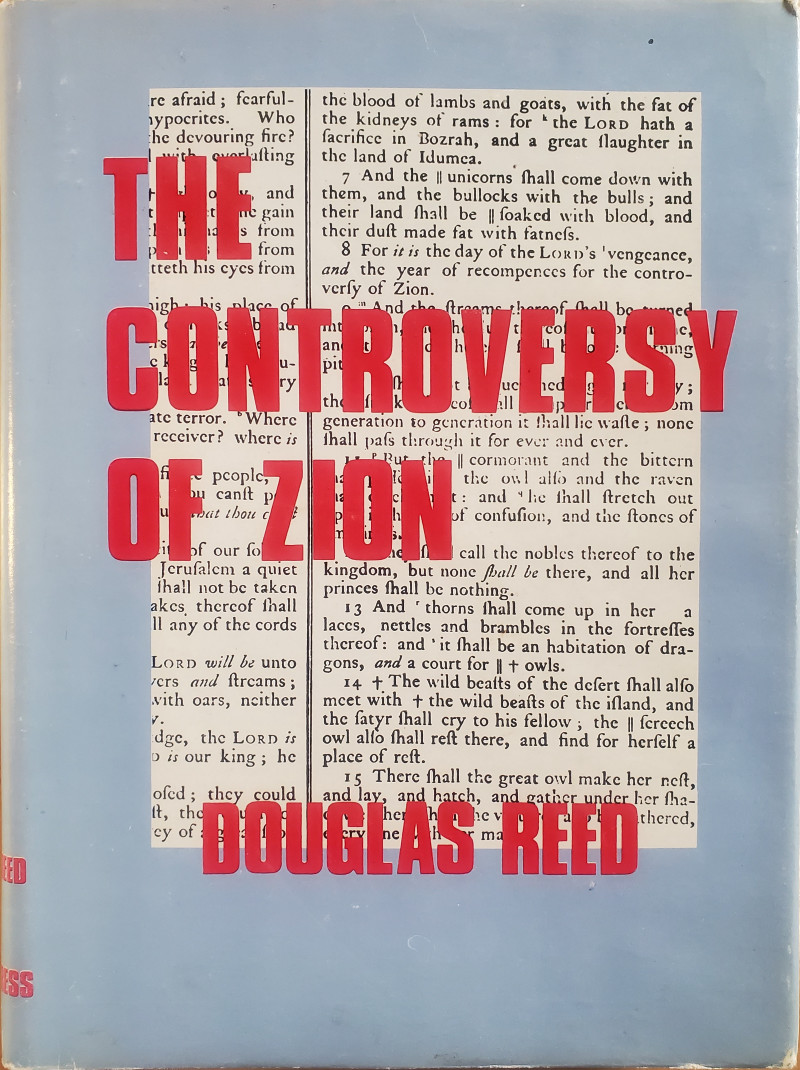
The Controversy of Zion
In The Controversy of Zion, Douglas Reed delves into the history of Zionism, its impact on world events, and the forces behind it.
- Published1978
- TypeBook
- GenreNon-Fiction, History
- LanguageEnglish
About the Author

Douglas Reed
Douglas Reed, a journalist and political writer known for his critiques of global politics and advocacy for national sovereignty.
View Profile- OccupationJournalist
- FromUnited Kingdom
-
Other Works
- Insanity Fair (1938)
- Disgrace Abounding (1939)
- Far and Wide (1951)