
Emily Dickinson Biography Quotes 45 Report mistakes
| 45 Quotes | |
| Occup. | Poet |
| From | USA |
| Born | December 10, 1830 |
| Died | May 15, 1886 |
| Aged | 55 years |
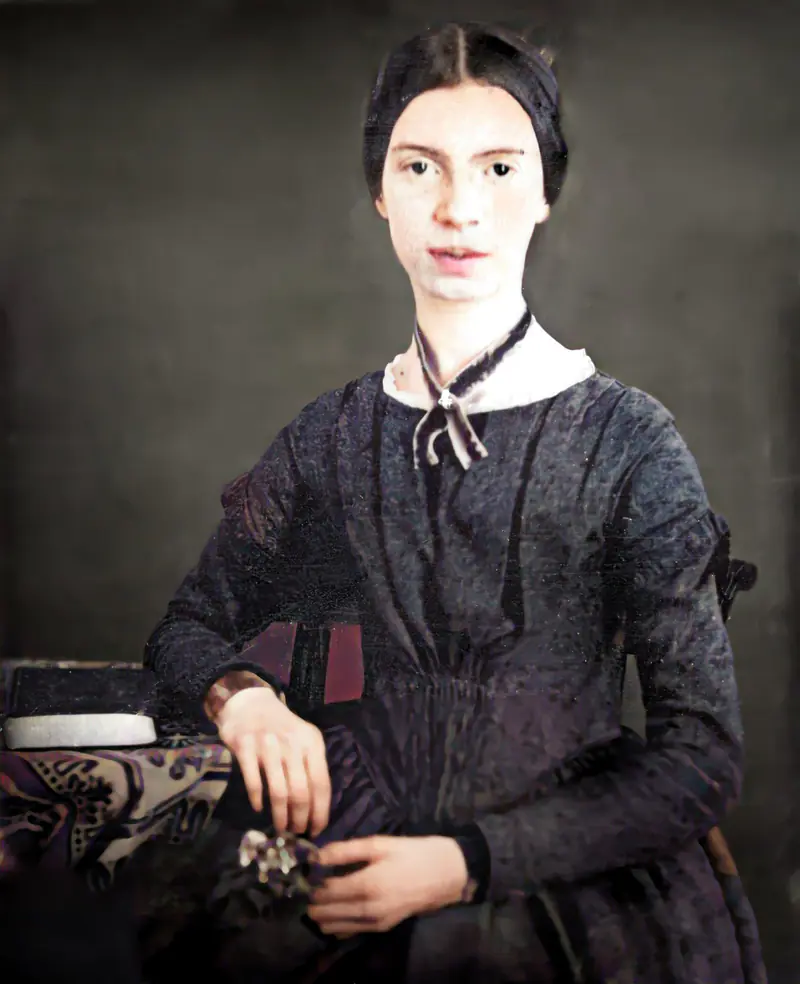
Emily Elizabeth Dickinson was born on December 10, 1830, in Amherst, Massachusetts, into a prominent New England family rooted in civic and educational life. Her father, Edward Dickinson, was a lawyer, a longtime treasurer of Amherst College, a state legislator, and later a Whig member of the U.S. Congress. Her mother, Emily Norcross Dickinson, managed the household and, despite periods of ill health, maintained the domestic sphere that framed the poet's early years. Emily was the middle child, between her elder brother William Austin (known as Austin) and her younger sister Lavinia (Vinnie). The family home, called the Homestead, became the nucleus of her life and imagination, and the neighboring house, the Evergreens, would later be occupied by Austin and his wife, Susan Gilbert Dickinson.
Education and Early Influences
Dickinson attended Amherst Academy, where a broad curriculum fostered her interests in science, languages, and literature. In 1847 she entered Mount Holyoke Female Seminary, remaining for about a year. The seminary's rigorous religious atmosphere contrasted with her independent cast of mind, and she returned to Amherst, where reading and reflection deepened her inward life. The Bible, Shakespeare, the metaphysical poets, and contemporary writers such as Ralph Waldo Emerson shaped her sensibility. Early letters and poems show a keen observer of nature and human feeling, and a writer already experimenting with meter and voice.
Home, Work, and Daily Life
Dickinson settled into an existence centered on the Homestead. She helped with household duties, cultivated a celebrated garden, and created an herbarium that reflects close study of plants. Over time, especially from the mid-1850s into the 1860s, she narrowed her social sphere, preferring correspondence to visits. Anecdotes about her preference for white dresses and her avoidance of callers capture a part of the truth, but her letters show humor, candor, and intellectual engagement. Friends and family, including Susan Gilbert Dickinson next door and cousins Frances and Louisa Norcross, remained vital interlocutors.
Poetic Development and Correspondence
The early 1860s marked a remarkable flowering. Dickinson composed intensively, often copying fair versions of poems and sewing them into small packets now known as fascicles. She developed a distinctive mode: concentrated lyrics in common and hymn meters, compressed syntax, striking images, unconventional capitalization, and the rhythmic propulsion of dashes. In 1862 she initiated a consequential correspondence with Thomas Wentworth Higginson, an editor and abolitionist, after reading his essay in The Atlantic Monthly inviting young writers to seek counsel. Their exchange, which continued for years, shows Dickinson testing the boundaries of editorial advice while preserving her inventive forms.
Relationships and Circle
Dickinson's network extended to figures such as Susan Gilbert Dickinson, a crucial early reader; Samuel Bowles, editor of the Springfield Republican; and Reverend Charles Wadsworth, a Philadelphia minister whose friendship and departure from the East weighed on her imagination. She maintained a long acquaintance with the writer Helen Hunt Jackson, who urged her to publish. In later years she formed a close bond with Judge Otis P. Lord. These relationships, sustained largely through letters, offered companionship and critique, while the poems transform private experience into meditations on love, absence, faith, nature, and mortality.
Publication in Her Lifetime
Only a handful of Dickinson's poems appeared publicly while she lived, and those few were often altered to meet prevailing standards of rhyme and punctuation. She valued circulation among trusted readers more than conventional publication, and she resisted editorial smoothing that might flatten the strangeness she considered integral to the work. Her immediate world thus contained a writer of great productivity almost hidden in plain sight.
Health, Retreat, and Final Years
In the mid-1860s Dickinson traveled to Boston and Cambridge for treatment of eye trouble under Dr. Henry Willard Williams, an interlude that underscored the fragility of her health. Her withdrawal from social life became more marked, though she continued to write prolifically, especially through the Civil War years and after. The deaths of friends and relatives intensified the elegiac and probing qualities of her poetry. She died at the Homestead on May 15, 1886. The death certificate cited Bright's disease, a historical term for kidney illness.
Posthumous Discovery and Editorial History
After her death, Lavinia Dickinson found nearly 1, 800 poems, many carefully copied and tied into approximately forty fascicles, along with variants on loose sheets and envelopes. The task of bringing them to readers fell first to family and associates. Susan Dickinson undertook initial sorting, but publication came through Mabel Loomis Todd, who, with Thomas Wentworth Higginson, edited the first volumes beginning in 1890. Their editions made the poetry widely known but regularized punctuation, capitalization, and rhyme. Later scholarship sought to restore Dickinson's textual idiosyncrasies. Thomas H. Johnson's mid-twentieth-century editions presented a comprehensive text and numbering system, and R. W. Franklin's variorum offered revised datings and variants, helping readers see the poems as living fields of choice rather than fixed monuments.
Style, Themes, and Achievement
Dickinson's craft merges lyric intensity with philosophical reach. She draws on hymn meters and ballad stanza yet bends cadence through slant rhyme and pauses. Common words are recharged by unusual context; metaphors dart between the domestic and the cosmic. The poems explore death and immortality, the tensile limits of belief, nature's minute phenomena, and the raptures and terrors of love. Compressed and elliptical, they invite multiple paths of reading, as if each poem were an apparatus for testing experience.
Legacy
From a largely private practice emerged one of American poetry's central bodies of work. The Homestead and the Evergreens became sites of preservation and inquiry, while successive generations of editors, including Martha Dickinson Bianchi and later scholars, expanded access to manuscripts and letters. Readers have come to value the very features once smoothed away: the dashes that register thought in motion, the variant word choices that keep meaning unsettled, the refusal of easy closure. Surrounded in life by family and a circle of correspondents such as Susan Gilbert Dickinson, Lavinia Dickinson, Thomas Wentworth Higginson, Samuel Bowles, and others, Emily Dickinson built a language of interior amplitude whose influence continues to shape poetry in English.
Our collection contains 45 quotes who is written by Emily, under the main topics: Motivational - Wisdom - Truth - Friendship - Love.
Other people realated to Emily: Marion C. Garretty (Poet), Camille Paglia (Author), Elizabeth Barrett Browning (Poet), Adrienne Rich (Poet), Thomas W. Higginson (Clergyman), Harold Bloom (Critic), Hailee Steinfeld (Actress)
Emily Dickinson Famous Works
- 1929 Further Poems of Emily Dickinson (Book)
- 1914 The Single Hound: Poems of a Lifetime (Book)
- 1896 Poems by Emily Dickinson: Third Series (Book)
- 1894 The Letters of Emily Dickinson (Book)
- 1891 Poems by Emily Dickinson: Second Series (Book)
- 1890 Poems by Emily Dickinson: First Series (Book)
Source / external links