
J. M. Barrie Biography Quotes 8 Report mistakes
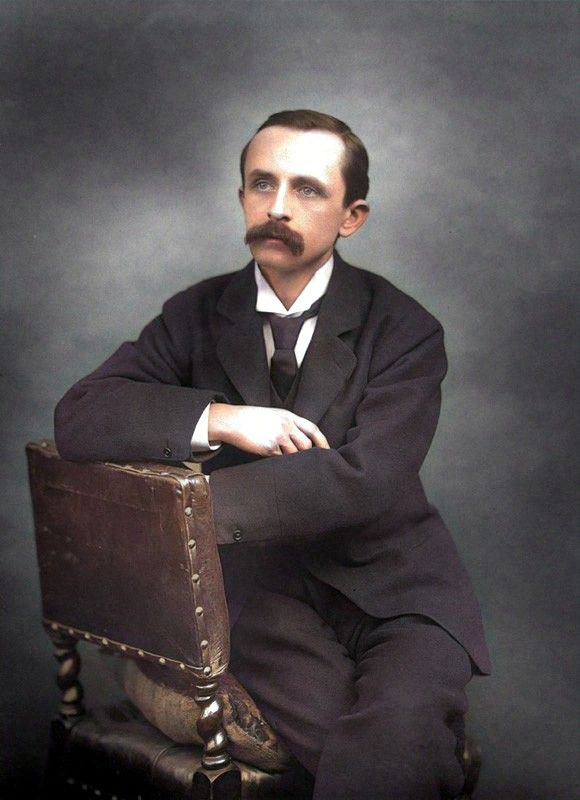
Attr: Herbert Rose Barraud, Public domain
| 8 Quotes | |
| Born as | James Matthew Barrie |
| Occup. | Novelist |
| From | Scotland |
| Spouse | Mary Ansell (1894-1909) |
| Born | May 9, 1860 Kirriemuir, Angus, Scotland |
| Died | June 19, 1937 London, England |
| Aged | 77 years |
| Cite | |
Citation Formats
APA Style (7th ed.)
J. m. barrie biography, facts and quotes. (2026, March 10). FixQuotes. https://fixquotes.com/authors/j-m-barrie/
Chicago Style
"J. M. Barrie biography, facts and quotes." FixQuotes. March 10, 2026. https://fixquotes.com/authors/j-m-barrie/.
MLA Style (9th ed.)
"J. M. Barrie biography, facts and quotes." FixQuotes, 10 Mar. 2026, https://fixquotes.com/authors/j-m-barrie/. Accessed 31 Mar. 2026.
Early Life and Background
James Matthew Barrie was born on 9 May 1860 in Kirriemuir, Angus, a small Scottish weaving town whose strict Calvinist atmosphere and close-knit gossip would remain in his imagination for life. He was the ninth of ten children born to David Barrie, a hand-loom weaver who later kept a modest shop, and Margaret Ogilvy Barrie, whose piety, storytelling gift, and emotional intensity shaped him more deeply than any schoolmaster. The family was poor but aspirational, rooted in the culture of hard work, Bible reading, and oral tale-telling that marked nineteenth-century Lowland Scotland. Barrie's childhood was divided between games, mimicry, and the inwardness of a boy who learned early to observe rather than dominate.
The defining wound of his youth came in 1867, when his adored older brother David died in a skating accident shortly before his fourteenth birthday. Their mother was shattered, and the young Barrie tried, consciously and unconsciously, to console her by occupying the dead son's place - wearing his clothes, learning his whistles, and cherishing the fact that David would remain forever young in memory. Out of that domestic tragedy grew some of the central tensions of Barrie's inner life: the idealization of boyhood, fear of adulthood, and the strange comfort of being loved as a substitute. He remained physically small, looked younger than his years, and developed a manner at once playful and evasive, turning pain into charm, fantasy, and theatrical control.
Education and Formative Influences
Barrie attended Glasgow Academy for a period, then Dumfries Academy, where he devoured adventure tales and tried his hand at amateur drama and journalism. He studied literature at the University of Edinburgh, graduating in 1882, and there absorbed both the prestige of Scottish letters and the practical disciplines of the press. He wrote reviews, sketches, and dramatic pieces while apprenticing himself to urban journalism in Nottingham and later London. The influence of his mother remained decisive: her recollections became the basis of Margaret Ogilvy (1896), one of his most revealing books, in which memory, idealization, and filial devotion blur into self-portrait. Equally formative was the Scottish "kailyard" tradition of sentimental village fiction, though Barrie would complicate it with irony, class observation, and a dreamlike melancholy uncommon in mere regional writing.
Career, Major Works, and Turning Points
Barrie first made his name with fiction drawn from Scottish life - Auld Licht Idylls (1888), A Window in Thrums (1889), and The Little Minister (1891) - works that turned provincial speech and chapel culture into literary property for a broad British readership. He moved increasingly toward the theater, where his instinct for dialogue, pauses, and emotional reversals found its true medium. After an unhappy marriage in 1894 to actress Mary Ansell, he formed an intimate bond with Sylvia and Arthur Llewelyn Davies and their sons, whose games and personalities fed directly into Peter Pan. The figure appeared in The Little White Bird (1902), then fully emerged in the play Peter Pan; or, The Boy Who Wouldn't Grow Up (1904), followed by Peter and Wendy (1911). Barrie also wrote major plays for adults, notably Quality Street (1901), The Admirable Crichton (1902), What Every Woman Knows (1908), and Dear Brutus (1917), balancing whimsy with social comedy and rueful knowledge. Knighted in 1913 and made a baronet in 1922, he was by then a national institution, yet personal losses - the deaths of Sylvia, several of the Llewelyn Davies boys, and friends from his youth - darkened his later years. He died in London on 19 June 1937.
Philosophy, Style, and Themes
Barrie's art circles obsessively around time, performance, and the bargains people make with loss. His fantasy is never escapism in a simple sense; it is a defensive enchantment raised against bereavement. Peter Pan promises eternal youth, but the promise is edged with loneliness, forgetfulness, and emotional arrest. Barrie understood how memory beautifies what it cannot restore, which is why his work often feels suspended between nursery and grave. “Every time a child says, I don't believe in fairies, there is a fairy somewhere that falls down dead”. The line is not just theatrical magic; it reveals his faith that imagination survives only through collective consent, as fragile as grief is durable. Equally characteristic is his paradoxical sense of regret: “You must have been warned against letting the golden hours slip by. Yes, but some of them are golden only because we let them slip”. For Barrie, value often appears retrospectively; what is lost acquires radiance precisely because it is beyond recall.
His style joins conversational lightness to metaphysical unease. He could write epigrammatically, but beneath the wit lies a man skeptical of triumph, worldly rank, and adult self-importance. “We are all failures at least, all the best of us are”. That sentence captures his psychology as much as his worldview: success never healed the original fracture, and public adoration coexisted with private insufficiency. In his comedies, social arrangements are exposed as performances; class, gender, and authority depend on tacit fictions everyone agrees to maintain. Yet he was no pure satirist. He treated human weakness tenderly, especially in women, children, and men who know too late what they have loved. The result is a body of work whose apparent delicacy conceals unusual emotional cunning.
Legacy and Influence
Barrie's legacy is inseparable from Peter Pan, one of the most durable modern myths, endlessly adapted for stage, film, illustration, psychology, and popular speech. "Peter Pan" entered the language as both compliment and diagnosis, a sign of Barrie's profound impact on how modern culture imagines childhood and arrested development. But his achievement is broader: he helped transform Edwardian theater by mixing fantasy with psychological insight, and his comedies remain sharp about class, marriage, and masculine vanity. He also assigned the Peter Pan rights to Great Ormond Street Hospital, linking his imagination to a continuing act of care. Critics have long debated the sentimentality of his work and the complexities of his relations with children, yet the debate itself testifies to his unnerving depth. Barrie endures because he grasped a permanent truth: childhood is not merely a stage of life but a lost country adults spend their lives translating.
Our collection contains 8 quotes written by M. Barrie, under the main topics: Wisdom - Sarcastic - Live in the Moment - Failure - Equality.
Other people related to M. Barrie: Radha Mitchell (Actress), Andrew Lang (Poet), Daphne du Maurier (Novelist), Maude Adams (Actress), Daisy Ashford (Writer)
J. M. Barrie Famous Works
- 1917 Dear Brutus (Play)
- 1911 Peter Pan (Novel)
- 1906 Peter Pan in Kensington Gardens (Novel)
- 1902 The Admirable Crichton (Play)
- 1901 Quality Street (Play)
- 1891 The Little Minister (Novel)
Source / external links