
King James I Biography Quotes 3 Report mistakes
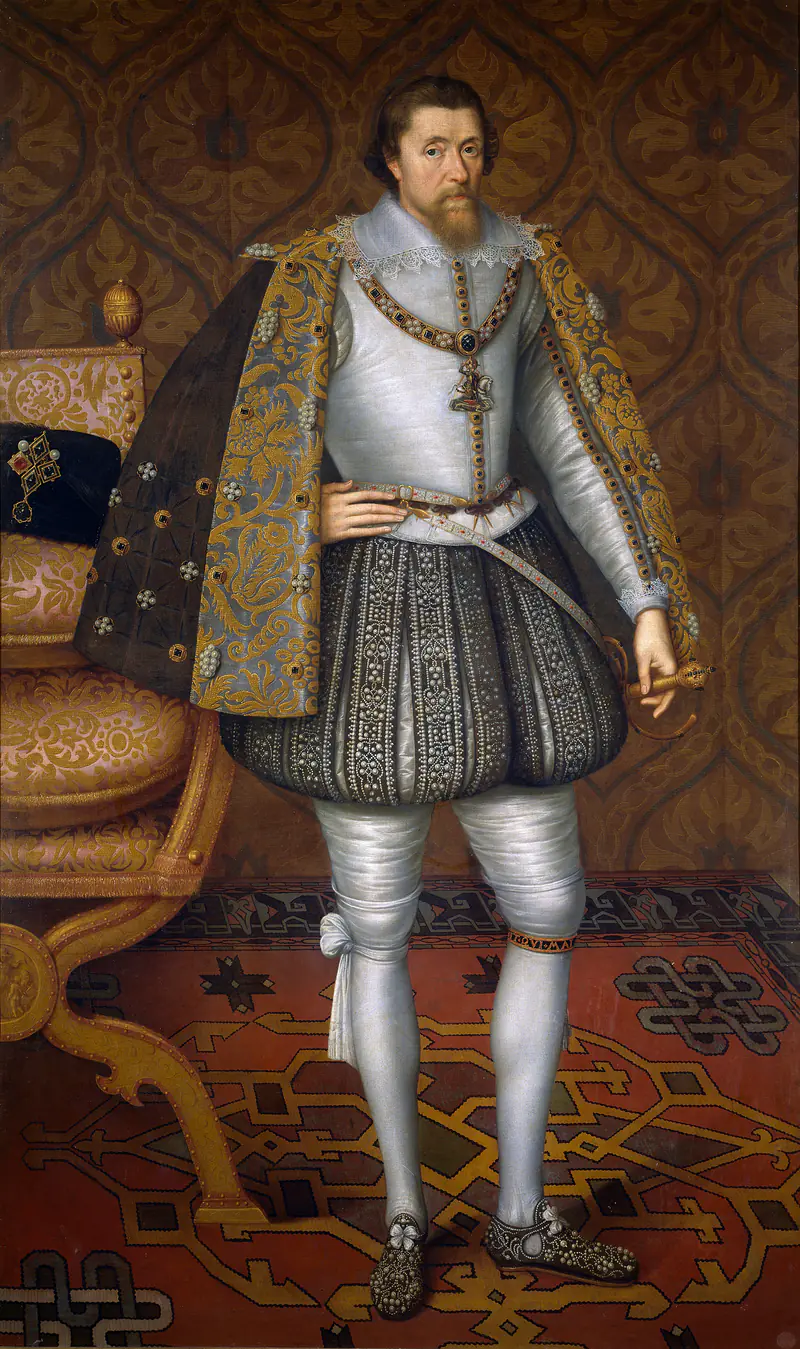
| 3 Quotes | |
| Born as | James VI of Scotland |
| Occup. | Royalty |
| From | Scotland |
| Born | June 19, 1566 Edinburgh, Scotland |
| Died | March 27, 1625 Theobalds, Hertfordshire, England |
| Cause | Natural Causes |
| Aged | 58 years |
James VI and I was born on 19 June 1566 at Edinburgh Castle, the only surviving son of Mary, Queen of Scots, and her husband Henry Stuart, Lord Darnley. His infancy unfolded amid violent crisis. Darnley was murdered in 1567, a crime that helped precipitate Marys forced abdication later that year. At just over a year old, James was crowned King of Scots at Stirling, swaddled in royal robes while nobles swore oaths on his behalf. Because he was a minor, Scotland was governed by a succession of regents, most notably James Stewart, Earl of Moray, who was assassinated in 1570; Matthew Stewart, Earl of Lennox, killed in 1571; John Erskine, Earl of Mar, who died in 1572; and James Douglas, Earl of Morton, deposed in 1578. These years were dominated by factional rivalry, the aftershocks of the Scottish Reformation, and the question of Marys detention in England under Elizabeth I.
Under the tutelage of the humanist scholar George Buchanan, assisted by Peter Young, James received a rigorous education in languages, scripture, rhetoric, and history. Buchanan pressed a stern Calvinist outlook and emphasized classical models of kingship, even composing texts that advanced limitations on royal power. The boy king absorbed these lessons while also cultivating a taste for debate and theology. From early on, he learned to balance ambitious magnates, the reformed Kirk, and foreign influences, skills that would define his political life.
Establishing Authority in Scotland
As James came of age, he navigated ruthless court politics. Esme Stewart, a cousin newly arrived from France and created Duke of Lennox, became an early favorite, provoking alarm among Protestant lords who feared Catholic resurgence. The Raid of Ruthven in 1582, when the young king was seized by William Ruthven, Earl of Gowrie, forced him into temporary captivity and removed Lennox from power. James regained freedom in 1583 and gradually asserted his authority, learning to shuttle between contending factions, including the assertive moves of James Stewart, Earl of Arran. He established a more stable regime by the late 1580s, bringing the fractious nobility to heel and strengthening the crown.
In 1589 he married Anne of Denmark, daughter of Frederick II. When storms thwarted her voyage to Scotland, James traveled to Norway and Denmark to meet her, an unusual and revealing gesture for a Renaissance monarch. Returning to Edinburgh in 1590, the couple established a court that mixed Scottish, Danish, and broader European influences. The climate of fear around witchcraft affected his early rule: the North Berwick witch trials were conducted after storms that disrupted the royal marriage journey, and James wrote Daemonologie in 1597, a tract that reflected his interest in theology and demonology.
Marriage and Family
James and Anne of Denmark had several children. Their eldest, Henry Frederick, Prince of Wales, won great popularity but died in 1612, a loss that deeply affected the court. Their daughter Elizabeth married Frederick V, Elector Palatine, in 1613, a dynastic match that later drew the Stuart monarchy into the maelstrom of continental war. Their younger son, Charles, born in 1600, eventually succeeded his father as Charles I. Other children died young, reinforcing the precariousness of dynastic succession.
Union of the Crowns
When Elizabeth I died childless in 1603, James, her closest legitimate Protestant heir, succeeded to the English throne as James I. The transition was managed smoothly, aided by careful consultation with Robert Cecil, principal minister to the late queen and later Earl of Salisbury. James traveled south to acclaim, styling himself King of Great Britain, a title that pointed to his ambition to unite Scotland and England more thoroughly. The crowns were joined in his person, though the kingdoms remained legally distinct.
The new king inherited a robust but demanding English polity, with a powerful House of Commons, an established Church with bishops, and a literate public engaged in religious debate. At the Hampton Court Conference in 1604, James presided over discussions with Puritan ministers and bishops. He rejected sweeping Presbyterian reforms but authorized a new English Bible translation to unify doctrine and worship. The King James Version, published in 1611, became a lasting monument of his reign and of the English language.
Religion, Toleration, and Fear
James favored order and episcopal governance and hoped for a broad church that included moderate Puritans while containing Catholic practice within the law. The Gunpowder Plot of 1605, led by Robert Catesby and foiled with the capture of Guy Fawkes, reinforced anti-Catholic sentiment. Parliament passed new penal measures, and James promoted an Oath of Allegiance in 1606 to distinguish loyalty to the crown from papal claims. He nevertheless maintained that persecution should be measured, not reckless, and continued to seek a degree of practical coexistence. In Scotland he gradually advanced royal oversight of the Kirk, culminating in the Five Articles of Perth in 1618, which introduced ceremonial practices that many Scottish Presbyterians resisted.
Finance and Parliament
The English crown under James faced chronic fiscal pressures. Peace brought relief but not solvency. With Robert Cecil, James pursued the Great Contract of 1608-1610, a proposed exchange of certain feudal dues for a stable income granted by Parliament. It failed in a welter of mistrust, and financial expedients multiplied, including the use of impositions and the sale of monopolies, practices that frustrated members of Parliament. The Parliament of 1614, known as the Addled Parliament, transacted no substantive business. After Cecil died in 1612, the king relied on new counselors and favorites, while the nervous system of crown finance became increasingly strained.
James was capable of firm political management but disliked confrontation. He saw himself as a peacemaker king, fond of scriptural aphorisms and the ideal of a well-ordered commonwealth. His writings, including The Trew Law of Free Monarchies and Basilikon Doron, articulated a vision of divinely sanctioned monarchy tempered by reason, law, and paternal duty. Yet his theoretical clarity did not always translate into fiscal discipline, and the culture of royal largesse at court complicated reforms.
Court, Culture, and Favorites
The Jacobean court became a center of arts and letters. William Shakespeares company received royal patronage as the Kings Men, performing for the court and publishing during the reign. Ben Jonson wrote and staged masques, often designed by Inigo Jones, blending architecture, costume, and allegory to project royal harmony and order. Intellectuals such as Francis Bacon rose to prominence; Bacon eventually became Lord Chancellor, only to be impeached by Parliament in 1621 for corruption in office.
James dependence on favorites shaped politics. Robert Carr, later Earl of Somerset, rose rapidly, then fell after the scandal following the death of Sir Thomas Overbury. George Villiers, rapidly elevated to Duke of Buckingham, emerged as the most powerful favorite of the later reign, guiding policy, shaping patronage, and provoking both admiration and resentment. These dependencies provided the king with trusted intermediaries but made him vulnerable to factional intrigue and public criticism.
Foreign Policy and the European Crisis
James sought peace. He ended the long Anglo-Spanish War with the Treaty of London in 1604, embracing commerce over conflict. He pursued marriage diplomacy to knit Protestant and Catholic powers, hoping to arbitrate rather than inflame confessional divisions. The marriage of Elizabeth to Frederick V tied the Stuarts to the Protestant cause in the Holy Roman Empire. When the Thirty Years War broke out in 1618 and Frederick briefly ruled Bohemia before defeat at the Battle of White Mountain, James faced intense pressure from English and Scottish subjects to defend his daughter and her husband and to restore the Palatinate.
Reluctant to plunge into a continental war, James tried negotiation and limited military support while seeking a Spanish marriage for Prince Charles. In 1623, Charles and Buckingham traveled incognito to Madrid in a dramatic but ill-judged bid to secure the match. The mission failed, soured relations with Spain, and inflamed English opinion. Parliament in 1624 urged war and pushed anti-Spanish policy. James, aging and ill, authorized measures toward conflict even as he remained wary of grand campaigns.
Scotland, Ireland, and the Wider Isles
James never forgot his Scottish origins and worked to align the two kingdoms. He promoted closer legal and commercial ties and maintained a Scottish presence at the English court. In Scottish governance he used bishops and loyal nobles to consolidate royal authority. In Ireland, where English and Scottish settlers were established under the crown, the Ulster Plantation took shape during his reign, reshaping property and demographics in ways that reverberated for centuries. His vision of a more integrated British archipelago contrasted with stubborn legal separations and local resistance.
Personality, Ideas, and Writings
James prided himself on learning and debate. He conversed with theologians such as Lancelot Andrewes, delighted in disputation, and wrote with a kings confidence about scripture, monarchy, and law. Basilikon Doron advised a prince on piety, justice, and prudence; The Trew Law defended the divine right of kings while insisting that good kingship obeys gods law and seeks the common good. He preferred compromise to coercion, negotiation to conquest, and often styled himself rex pacificus, the peacemaker king. Yet his love of theory and talk could frustrate practical men seeking swift decisions, and his generosity outpaced the treasurys means.
Later Years and Death
The final decade of the reign was clouded by personal grief and political strain. The death of Henry Frederick in 1612 dashed hopes invested in a charismatic heir. Charles matured under the shadow of Buckinghams influence. Disputes over monopolies, impositions, and foreign policy sharpened contests with Parliament, culminating in the sessions of 1621 and 1624, where impeachment and calls for war signaled a harder political climate. In the background, concerns about court morality, favoritism, and the power of Buckingham marked the public conversation.
James died on 27 March 1625 at Theobalds, passing the crowns to Charles I. He was buried in Westminster Abbey. His long reign across two kingdoms had ushered in the Union of the Crowns and produced the King James Bible, and it left unresolved tensions about finance, religion, and sovereignty that would later erupt under his son.
Legacy
James VI and I stands at a hinge in British and European history. He was the first monarch to rule England and Scotland together, articulating a British identity even as laws and institutions remained distinct. He moderated confessional conflict at home while trying to arbitrate it abroad, preferring treaties to battles. His court patronized a golden age of drama and masque, nurturing Shakespeare, Jonson, and Inigo Jones, and his authorized Bible translation shaped language and devotion for centuries. At the same time, his financial expedients, reliance on favorites like Robert Carr and George Villiers, and complicated parliaments seeded discontent. His dynastic diplomacy, especially the match of Elizabeth to Frederick V and the quest for a Spanish marriage for Charles, tied Britain to continental storms he could neither ignore nor master.
James was a thinker on the throne: a king who wrote about kingship, argued theology with bishops, and believed peace was the highest policy. The successes and contradictions of his reign framed the possibilities and perils inherited by Charles I, and through him, the course of the British kingdoms for generations.
Our collection contains 3 quotes who is written by King, under the main topics: Wisdom - Learning - Health.
Other people realated to King: George Herbert (Poet), John Still (Clergyman), Henry Wotton (Author), William Adams (Explorer), Barnabe Barnes (Poet), Lord Chandos (Writer)
Source / external links