
Robert Sheckley Biography Quotes 22 Report mistakes
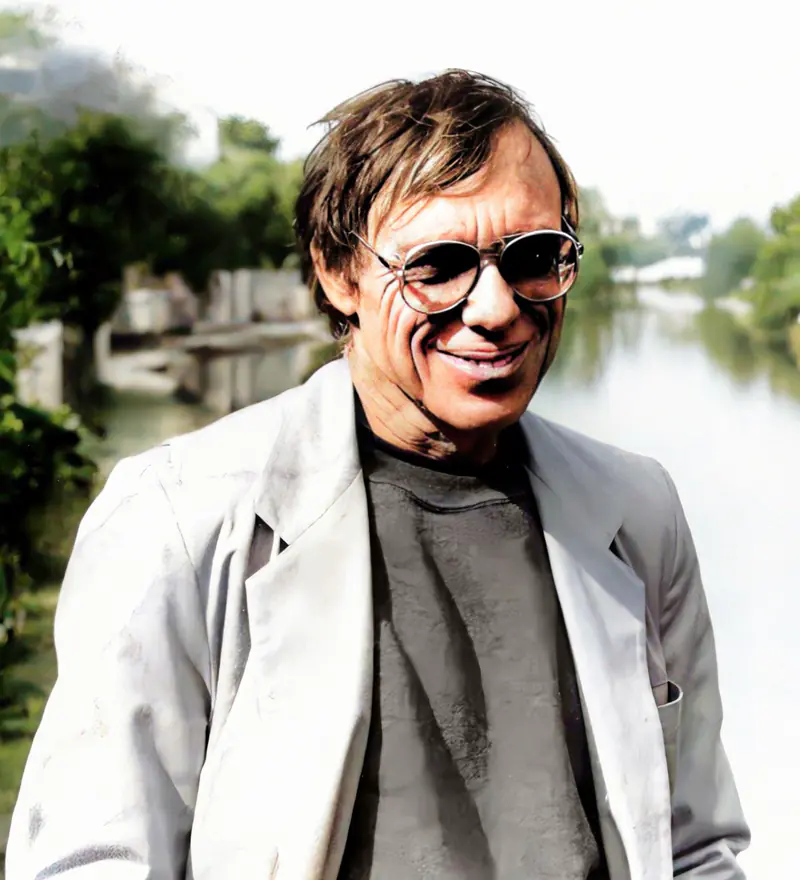
| 22 Quotes | |
| Occup. | Author |
| From | USA |
| Born | July 16, 1928 Brooklyn, New York, USA |
| Died | December 9, 2005 Poughkeepsie, New York, USA |
| Aged | 77 years |
Robert Sheckley was born July 16, 1928, in Brooklyn, New York, into a city that served as both machine and carnival - a place where mass advertising, Cold War anxiety, and immigrant energy collided. That early proximity to hustle and salesmanship would later reappear in his fiction as gleefully predatory bureaucracies, contracts with traps in the fine print, and protagonists trying to keep their dignity while being processed by systems. His comedy was never merely decorative; it was the laugh of someone who recognized how quickly modern life could turn human beings into paperwork.
He came of age during the Great Depression's long shadow and the mobilization of World War II, then entered adulthood at the opening of the atomic age. The postwar United States offered unprecedented prosperity alongside new pressures to conform, and Sheckley absorbed both the optimism and the coercion. The era's promises of technology and management - efficiency, progress, rational planning - became, in his hands, engines for absurdity and moral stress tests, a way to ask what happens when convenience becomes a philosophy and speed replaces judgment.
Education and Formative Influences
After service in the U.S. Army (including time in Korea), Sheckley returned to civilian life and studied at New York University, writing while supporting himself with assorted jobs. Like many mid-century science fiction writers, he learned his craft in the magazine ecosystem where deadlines, editors, and reader expectation rewarded clarity and punch. He read broadly across satire and social comedy as well as the then-dominant "idea story" tradition, and he turned the genre's gadgets into instruments for examining persuasion, identity, and the way a society teaches people what to want.
Career, Major Works, and Turning Points
Sheckley broke in during the 1950s, becoming one of the most distinctive voices of the magazine boom with stories that were compact, fast, and ferociously ironic; his collections circulated widely, and his name became shorthand for the kind of twist-ending parable that could be read in one sitting and remembered for years. He expanded into novels, including The Status Civilization and Mindswap, and returned repeatedly to a signature premise: ordinary people dropped into rule-bound worlds where the rules are insane but strictly enforced. One of his most enduring cultural afterlives arrived indirectly through cinema: his story "The Seventh Victim" helped inspire the 1965 film The 10th Victim, and decades later his satirical DNA can be felt in reality-TV dystopias and corporate-gamified futures. In later life he lived for extended periods outside the United States, continued publishing, and remained a touchstone for writers who wanted science fiction to be funny without surrendering its bite. He died December 9, 2005.
Philosophy, Style, and Themes
Sheckley's work is often described as comic, but the comedy is a method of moral inquiry. He distrusted single explanations and preferred to stage collisions between incompatible systems - legal codes, consumer desires, religious hopes, military logic - then watch characters improvise an ethics under pressure. "I like to think that I have no single view nor any single situation that I think things arrive from. I try to give examples of what I think are interesting questions for me". That stance made him an unusually nimble satirist: rather than preach, he built traps, let people walk into them, and then revealed the trap's blueprint.
His prose is lean and deadline-smart, but beneath the speed is an unmistakable inner weather: the anxiety of composition, the suspicion that language will fail at the crucial moment, and the stubborn willingness to ship work anyway. "I'm not too fond of the hard work and the constant battle with self-doubt that goes on when I write, but I figure that's part of the territory". The tension between control and chaos - between a writer's plan and a world's refusal to cooperate - mirrors his plots, where characters are invited to participate in grand designs only to discover that the design is indifferent or actively hostile. Even his reflections on craft carry a gambler's realism: "I do think that short story writing is often a matter of luck". Luck, in Sheckley, is not mere chance; it is the name we give to systems too complex or dishonest to admit their own arbitrariness.
Legacy and Influence
Sheckley endures as a master of satirical science fiction whose influence runs through later American and British genre comedy, from corporate dystopias to the bleakly playful logic of game worlds. His stories anticipated a culture where entertainment, surveillance, and marketing fuse, and where "choice" often means selecting among prewritten scripts. He also helped validate a mode of science fiction that stays intellectually serious while laughing at its own machinery - a tradition that shaped writers of the New Wave and beyond, and that continues to provide a vocabulary for describing modern life when it starts to feel, in the most Sheckleyan way, like an outrageous contract you accidentally signed.
Our collection contains 22 quotes who is written by Robert, under the main topics: Witty One-Liners - Ethics & Morality - Writing - Learning - Live in the Moment.
Other people realated to Robert: Roger Zelazny (Writer)
Robert Sheckley Famous Works
- 2012 Store of the Worlds: The Stories of Robert Sheckley (Collection)
- 1968 Dimension of Miracles (Novel)
- 1966 Mindswap (Novel)
- 1965 The Game of X (Novel)
- 1960 The Status Civilization (Novel)
- 1959 Untitled (Play)
- 1958 Immortality, Inc. (Novel)
Source / external links