
William Butler Yeats Biography Quotes 58 Report mistakes
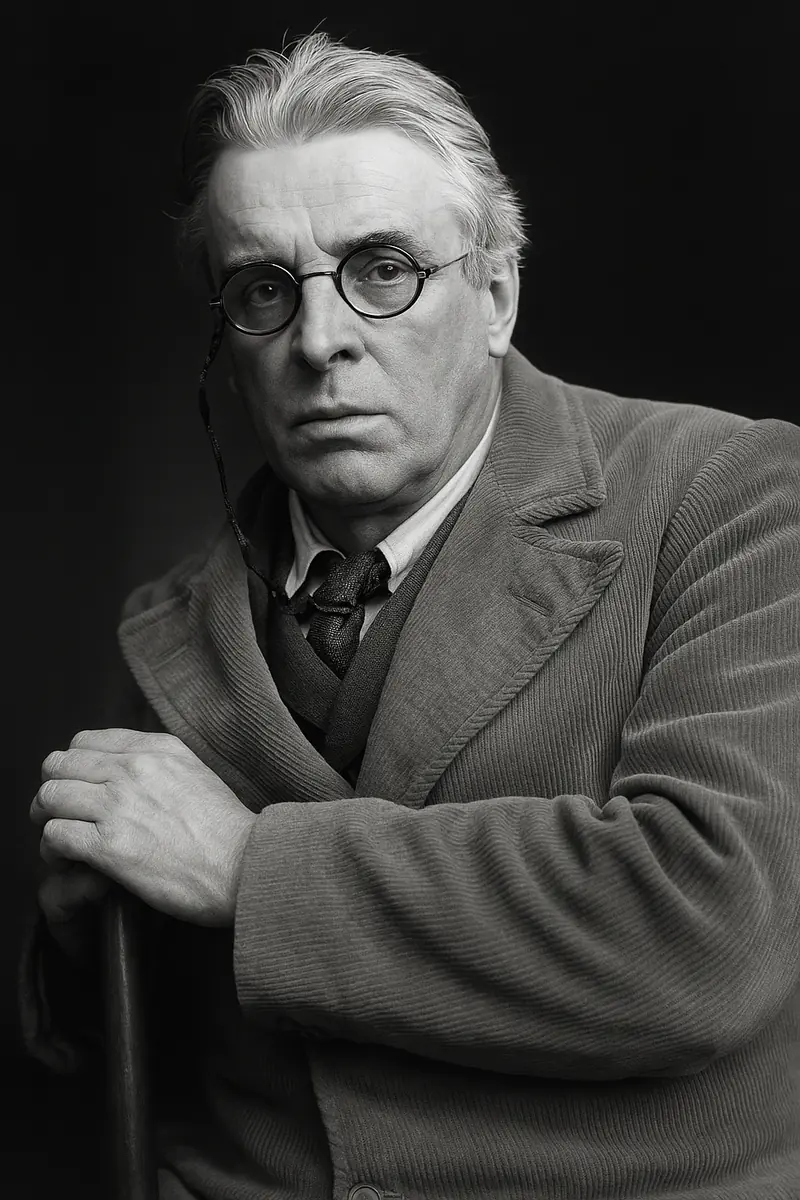
| 58 Quotes | |
| Known as | W. B. Yeats |
| Occup. | Poet |
| From | Ireland |
| Born | June 13, 1865 Sandymount, Dublin, Ireland |
| Died | January 28, 1939 Roquebrune-Cap-Martin, France |
| Aged | 73 years |
William Butler Yeats was born in Dublin in 1865 and grew up between the city and the coastal and rural landscapes around Sligo that would become central to his imagination. His father, John Butler Yeats, was a portrait painter whose talk of art and argument sharpened the young poet's ambitions; his mother, Susan Mary Pollexfen, rooted him in the lore, songs, and sea winds of Sligo. The children were part of a gifted household: his brother Jack B. Yeats became a celebrated painter, and his sisters, Susan (Lily) and Elizabeth (Lolly), later helped to create a distinctive Irish arts and crafts milieu. The family spent significant periods in London while John pursued work, but holidays in Sligo, with stories of fairies, heroes, and the Ben Bulben range, gave Yeats a mythic map he would never abandon.
Yeats attended school in Dublin and studied at the Metropolitan School of Art, where he met the visionary writer and mystic George (A. E.) Russell. As a student he read widely, from Irish saga literature to Shelley and the Pre-Raphaelites. He began as a poet with a taste for dreamlike images and archaic settings, writing chivalric and mythic narratives that sought to make Ireland's past into a living present.
Apprenticeship in Poetry and the Occult
From his earliest work, Yeats pursued a double apprenticeship in poetry and esoteric thought. He believed that symbol and ritual could reveal realities beyond ordinary speech. In London he moved in artistic circles, wrote reviews, and absorbed currents of thought that ranged from Theosophy to the occult. His membership in the Hermetic Order of the Golden Dawn, alongside figures such as S. L. MacGregor Mathers and A. E. Waite, gave him a formal framework for ritual and symbol. The language of talismans, gyres, and correspondences entered his poetry and never left it.
That blend of Irish myth and symbolist method shaped early volumes and his ambitious narrative poem The Wanderings of Oisin. His voice, initially described as Celtic twilight for its dreamlike and ornate textures, announced a poet intent on giving Ireland a spiritual literature equal to any in Europe. Even as he experimented, he was already planning a cultural revival that would extend beyond poetry into theater and the visual arts.
Irish Literary Revival and the Abbey Theatre
Yeats's public career unfolded with the Irish Literary Revival, a movement to create national literature in English that drew on Irish tradition without imitating English models. With Lady Augusta Gregory and Edward Martyn he helped found the Irish National Theatre Society, which grew into the Abbey Theatre. Lady Gregory's home at Coole Park became a workshop and refuge for writers and actors, and Yeats, Gregory, and their colleagues nurtured playwrights such as J. M. Synge, whose work they championed despite controversy.
As the Abbey's leading figure, Yeats recruited and encouraged talent, managed practical matters, and shaped repertory. Riots greeted Synge's The Playboy of the Western World, but Yeats defended the playwright's freedom, insisting that a mature national culture must tolerate unsettling truth. He collaborated with Lady Gregory on plays rooted in folklore and history and wrote his own dramas in verse, from The Countess Cathleen to Cathleen ni Houlihan. Through these works he fused mythic symbolism with contemporary questions of sacrifice, nationhood, and personal destiny.
Beyond the stage, the Revival had a press and craft dimension. Lily and Lolly Yeats, with Evelyn Gleeson, established the Dun Emer and later Cuala Press, which published Yeats's poems and plays in elegant editions that helped define the look of Irish literature. In this environment Yeats matured from a gifted lyric poet into a cultural architect.
Love, Marriage, and Intellectual Companions
Yeats's emotional life deeply marked his art. His long, complicated devotion to Maud Gonne, a nationalist activist and actor, is one of the abiding stories of modern literature. She inspired poems of desire, adoration, and disillusion; their relationship also fed his reflections on Ireland's fate. After she married John MacBride, Yeats's feelings turned toward elegy and political meditation, and the figure of the transformative, terrible beauty entered his poetry.
Earlier, in London, he had formed an important bond with the writer Olivia Shakespear, whose tact and intelligence steadied him. In 1917 he married Georgie (Georgiana) Hyde-Lees. Soon after the wedding, she began the automatic writing that Yeats came to regard as communications from an informing system. Out of these sessions he fashioned A Vision, a private philosophical schema of cycles and gyres that became a lifelong interpretive tool for his poems and plays. Their marriage, a durable partnership, brought two children, Anne and Michael, and a domestic base in the towerhouse at Thoor Ballylee, which he restored and celebrated as a symbol of rooted, aristocratic tradition.
Yeats also engaged with writers who helped move his style toward a striking modern idiom. Ezra Pound served as his secretary for several winters and introduced him to Japanese Noh drama and the papers of Ernest Fenollosa. From these encounters came spare, mask-driven plays like At the Hawk's Well and a new emphasis on hardness of image and rhythm.
Politics, Nation, and War
Yeats's politics were complex: sympathetic to Irish nationhood yet suspicious of puritanism and mob fervor, committed to an aristocratic ideal of culture yet alert to the energies of democratic change. He wrote with immediate feeling about Ireland's revolutionary era. Easter, 1916 memorialized both the heroism and the tragic cost of the Rising; other poems wrestled with the Irish War of Independence and the Civil War that followed. The poem An Irish Airman Foresees His Death became an elegy for Robert Gregory, Lady Gregory's son, and a meditation on the private motives behind public conflict.
After independence, Yeats served as a senator of the Irish Free State, where his speeches supported the arts, education, and civil liberties. He brought to legislative debate the same belief that a nation requires symbols, rituals, and a confident aesthetic. His public service coincided with some of his greatest poems, in which the turbulence of the era deepened his reflections on history. The Second Coming, written in the aftermath of World War I and amid Irish unrest, gave modern literature one of its most haunting images of historical breakdown and apocalyptic return.
Mature Style and Major Works
In his maturity Yeats transformed his art. The elaborate ornament of the 1890s gave way to a spare, sinewy diction. Poems grew more conversational yet more symbolically charged. He wrote sequences and books with architectural coherence: The Wild Swans at Coole distilled loss and renewal; The Tower and The Winding Stair explored age, power, and spiritual struggle with an unmatched blend of aphorism and dramatic argument.
Signature poems of this period include Sailing to Byzantium and Byzantium, which imagine escape from the flux of life into a perfected artifice; Leda and the Swan, with its violent myth of fate and empire; Among School Children, where philosophical speculation and a classroom visit end in the radiant question about dancer and dance. The Crazy Jane poems make bawdy wisdom a vehicle for metaphysical insight. Throughout, his A Vision supplied a pattern of interpenetrating cycles that ordered his understanding of personal and historical time, while the disciplines of the theater sharpened his sense of mask and voice.
Yeats's achievement won international recognition with the Nobel Prize in Literature, awarded not for a single book but for a sustained body of work that had renewed lyric and dramatic poetry. He accepted the honor as a vindication of Irish letters and used the public platform to further the cause of the Abbey and the broader cultural infrastructure he had helped build.
Later Years and Legacy
Old age did not silence Yeats; it intensified him. He wrote with startling candor about desire, decay, and the effort to make a soul. Health difficulties led him to undergo a rejuvenation procedure known as the Steinach operation, after which his sense of renewed energy produced a late burst of poems and plays. He continued to travel between Ireland and the Continent, to correspond with younger writers, and to revise earlier work with ever greater compression and bite.
He died in 1939 in France. In accordance with his wishes, his remains were later reinterred in Drumcliffe, County Sligo, beneath the mountain country he had mythologized from youth. The epitaph carved there, adapted from his poem Under Ben Bulben, reads: Cast a cold eye on life, on death. Horseman, pass by! In those lines, as in the career they close, a personal story becomes a public emblem. Yeats made from a divided life and a divided island a body of writing that unites myth and modernity, private obsession and civic purpose. Through friendships and collaborations with Lady Gregory, J. M. Synge, Edward Martyn, George Russell, Ezra Pound, Jack B. Yeats, and many others, he helped invent the modern Irish imagination. His poems and plays continue to shape how readers across the world think about identity, history, and the demanding freedom of art.
Our collection contains 58 quotes who is written by William, under the main topics: Witty One-Liners - Motivational - Ethics & Morality - Wisdom - Friendship.
Other people realated to William: Rabindranath Tagore (Poet), William Blake (Poet), W. H. Auden (Poet), James Joyce (Novelist), Edmund Wilson (Critic), T. S. Eliot (Poet), Sylvia Plath (Poet), Richard Le Gallienne (Poet), George A. Moore (Novelist), Paul Muldoon (Poet)
Frequently Asked Questions
- William Butler Yeats' most famous poem: The Second Coming.
- William Butler Yeats books: The Collected Poems; The Tower; The Winding Stair and Other Poems; The Wild Swans at Coole; Responsibilities; A Vision.
- William Butler Yeats works: Poems and plays; notable: The Wild Swans at Coole; Responsibilities; Michael Robartes and the Dancer; A Vision; The Countess Cathleen.
- William Butler Yeats famous works: The Second Coming; The Lake Isle of Innisfree; Easter, 1916; The Tower; The Winding Stair; Cathleen ni Houlihan.
- Poems of William Butler Yeats: The Second Coming; Sailing to Byzantium; The Lake Isle of Innisfree; Easter, 1916; Leda and the Swan.
- How old was William Butler Yeats? He became 73 years old
William Butler Yeats Famous Works
- 1938 Purgatory (Play)
- 1933 The Winding Stair and Other Poems (Collection)
- 1928 The Tower (Collection)
- 1927 Sailing to Byzantium (Poetry)
- 1925 A Vision (Non-fiction)
- 1923 Leda and the Swan (Poetry)
- 1919 The Second Coming (Poetry)
- 1919 An Irish Airman Foresees His Death (Poetry)
- 1917 The Wild Swans at Coole (Collection)
- 1917 At the Hawk's Well (Play)
- 1916 Easter 1916 (Poetry)
- 1914 Responsibilities (Collection)
- 1904 On Baile's Strand (Play)
- 1902 Cathleen Ní Houlihan (Play)
- 1899 The Wind Among the Reeds (Poetry)
- 1897 The Secret Rose (Collection)
- 1893 The Celtic Twilight (Non-fiction)
- 1892 The Countess Cathleen (Play)
- 1889 The Stolen Child (Poetry)
- 1888 The Lake Isle of Innisfree (Poetry)
Source / external links