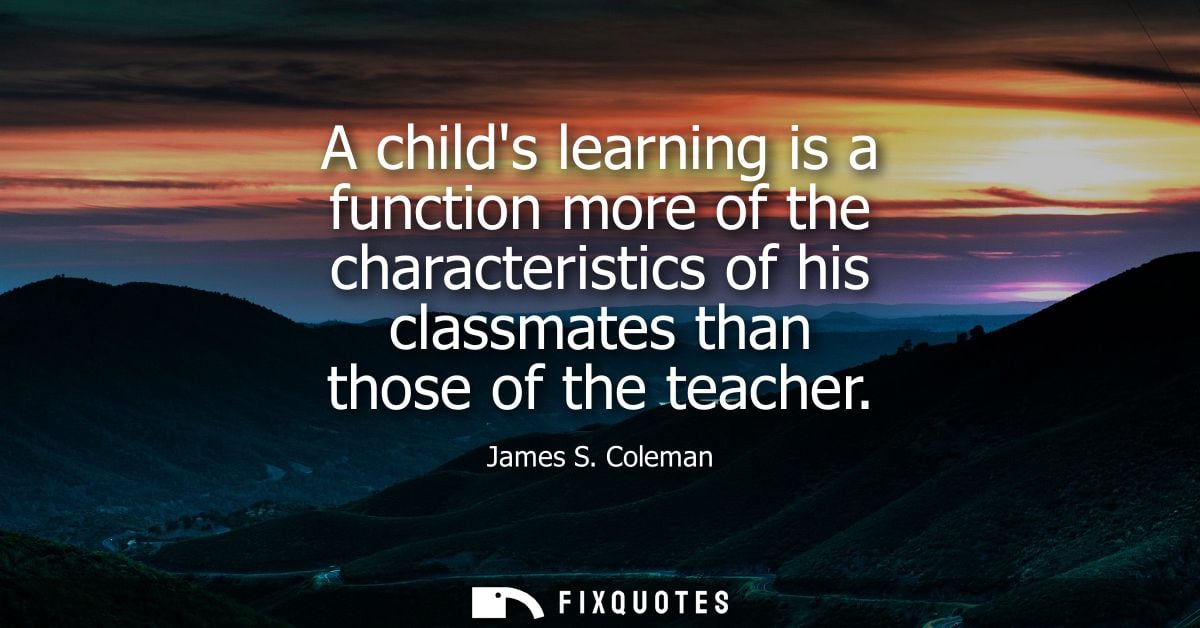
"A child's learning is a function more of the characteristics of his classmates than those of the teacher"
About this Quote
Coleman’s line lands like a polite grenade in the tidy story we tell about schools: that the teacher is the prime mover, the hero, the variable we can swap in and out to fix everything. Coming from a sociologist who helped redraw the map of American education, it’s less a hot take than a thesis statement about power - and where it actually sits.
The specific intent is to relocate causality. “Function” signals an almost clinical framing: learning isn’t just inspiration and effort; it’s an outcome shaped by a child’s social environment. Coleman is pointing to peer effects - the norms, expectations, competition, language, and behavioral codes that classmates transmit hour by hour. Teachers matter, but the classroom is a small society with its own gravity. Kids absorb not only algebra but what counts as “smart,” what gets mocked, what gets rewarded, what future feels plausible.
The subtext is uncomfortable for policymakers because it implies a hard limit to teacher-centric reforms. If peer composition drives outcomes, then inequity isn’t primarily a problem of individual instructional quality; it’s structural, tied to segregation by race and class, tracking, and the sorting mechanisms that cluster advantage. It also hints at why “good schools” are often shorthand for “good student bodies” - a taboo truth in real estate listings and district politics.
Context matters: Coleman’s research in the 1960s challenged assumptions that simply equalizing resources would equalize results. This sentence carries that era’s provocation forward, suggesting that integration, social mixing, and the ecology of a school may move the needle more than any single charismatic adult at the front of the room.
The specific intent is to relocate causality. “Function” signals an almost clinical framing: learning isn’t just inspiration and effort; it’s an outcome shaped by a child’s social environment. Coleman is pointing to peer effects - the norms, expectations, competition, language, and behavioral codes that classmates transmit hour by hour. Teachers matter, but the classroom is a small society with its own gravity. Kids absorb not only algebra but what counts as “smart,” what gets mocked, what gets rewarded, what future feels plausible.
The subtext is uncomfortable for policymakers because it implies a hard limit to teacher-centric reforms. If peer composition drives outcomes, then inequity isn’t primarily a problem of individual instructional quality; it’s structural, tied to segregation by race and class, tracking, and the sorting mechanisms that cluster advantage. It also hints at why “good schools” are often shorthand for “good student bodies” - a taboo truth in real estate listings and district politics.
Context matters: Coleman’s research in the 1960s challenged assumptions that simply equalizing resources would equalize results. This sentence carries that era’s provocation forward, suggesting that integration, social mixing, and the ecology of a school may move the needle more than any single charismatic adult at the front of the room.
Quote Details
| Topic | Learning |
|---|---|
| Source | James S. Coleman, Equality of Educational Opportunity (U.S. Dept. of Health, Education, and Welfare), 1966 (Coleman Report). Report emphasizes that classmates/peer characteristics strongly influence student achievement (often quoted/paraphrased from the executive summary). |
More Quotes by James
Add to List