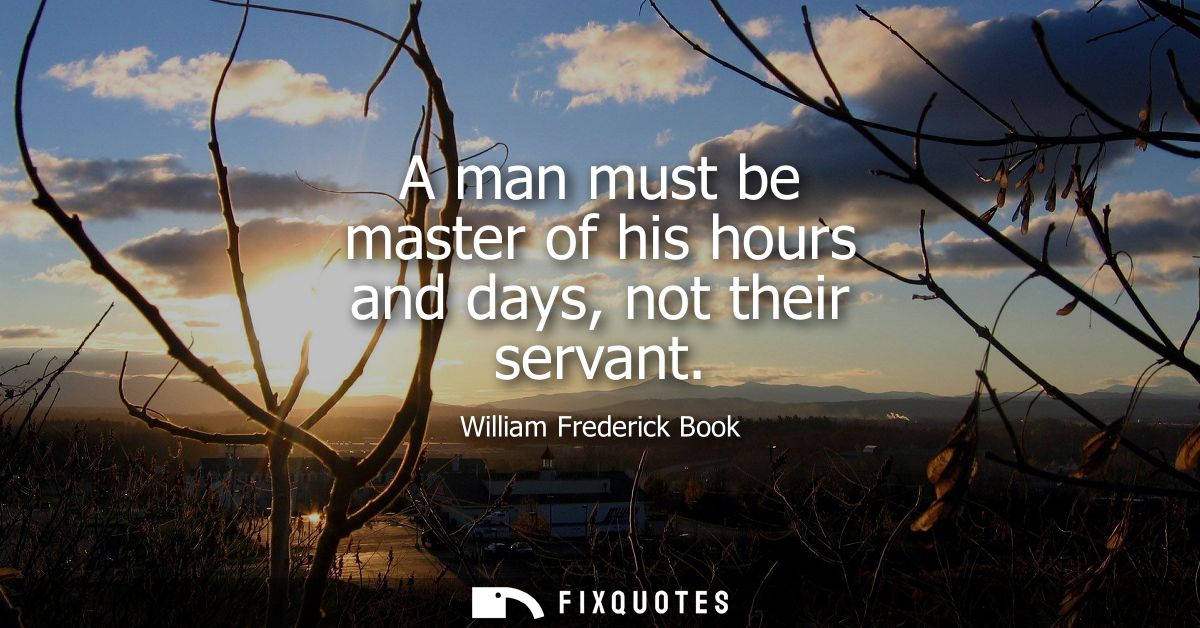
"A man must be master of his hours and days, not their servant"
About this Quote
Time, in Book's formulation, is a quiet tyrant: it never raises its voice, it just keeps winning. "Master of his hours and days" flips the usual moral vocabulary of self-control into the language of governance. Hours and days become territory to be ruled, not weather to be endured. The punch is in the second clause: "not their servant". Servanthood implies not only busyness but obedience - an entire life organized around other people's clocks, institutional schedules, and the low-grade panic of never being caught up.
As a writer associated with the early 20th century's faith in self-management and efficiency, Book is speaking from a culture newly obsessed with measurable productivity. Industrial time - shifts, timetables, factory discipline - had trained people to treat the clock as a boss. His line is a counterspell aimed at the emerging middle-class condition: being "free" while living like a subcontractor for your own calendar.
The subtext is less about squeezing more output from a day than about reclaiming agency. "Mastery" here isn't macho dominance; it's authorship. Decide what the day is for before the day decides what you're for. That framing matters because it shifts time management from a technocratic checklist to a moral stance: if you don't set priorities, someone else will, and your life will feel like an inbox.
The quote endures because it names a modern humiliation with surgical clarity: the sensation that the hours belong to everything except you.
As a writer associated with the early 20th century's faith in self-management and efficiency, Book is speaking from a culture newly obsessed with measurable productivity. Industrial time - shifts, timetables, factory discipline - had trained people to treat the clock as a boss. His line is a counterspell aimed at the emerging middle-class condition: being "free" while living like a subcontractor for your own calendar.
The subtext is less about squeezing more output from a day than about reclaiming agency. "Mastery" here isn't macho dominance; it's authorship. Decide what the day is for before the day decides what you're for. That framing matters because it shifts time management from a technocratic checklist to a moral stance: if you don't set priorities, someone else will, and your life will feel like an inbox.
The quote endures because it names a modern humiliation with surgical clarity: the sensation that the hours belong to everything except you.
Quote Details
| Topic | Time |
|---|---|
| Source | Help us find the source |
| Cite |
Citation Formats
APA Style (7th ed.)
Book, William Frederick. (2026, January 15). A man must be master of his hours and days, not their servant. FixQuotes. https://fixquotes.com/quotes/a-man-must-be-master-of-his-hours-and-days-not-170386/
Chicago Style
Book, William Frederick. "A man must be master of his hours and days, not their servant." FixQuotes. January 15, 2026. https://fixquotes.com/quotes/a-man-must-be-master-of-his-hours-and-days-not-170386/.
MLA Style (9th ed.)
"A man must be master of his hours and days, not their servant." FixQuotes, 15 Jan. 2026, https://fixquotes.com/quotes/a-man-must-be-master-of-his-hours-and-days-not-170386/. Accessed 12 Feb. 2026.
More Quotes by William
Add to List