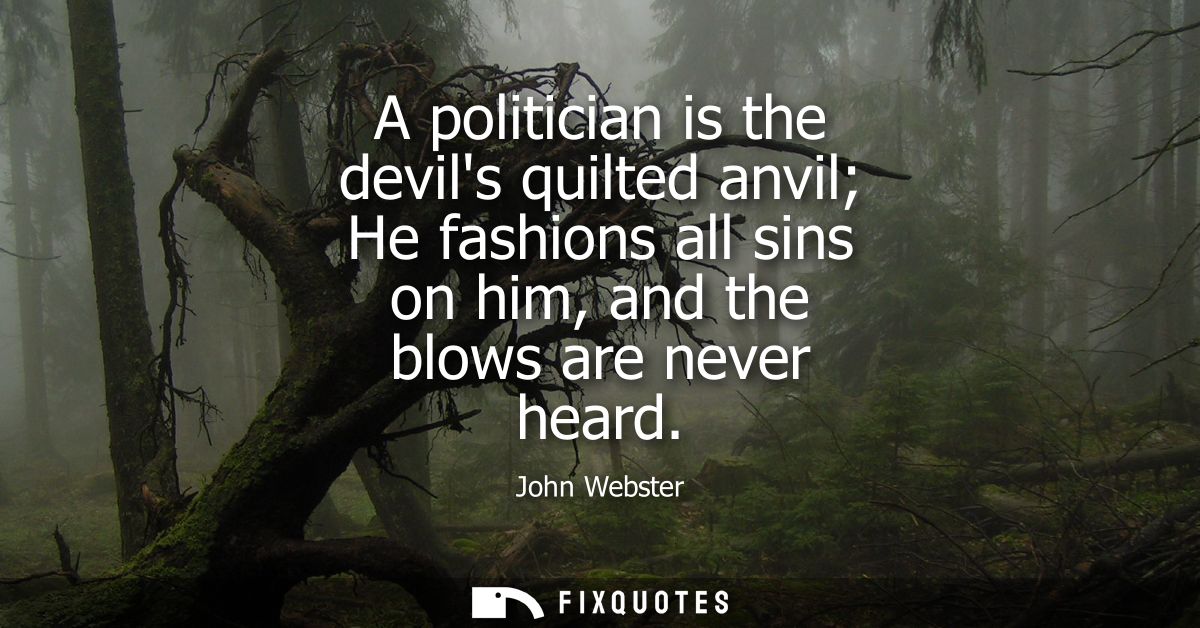
"A politician is the devil's quilted anvil; He fashions all sins on him, and the blows are never heard"
About this Quote
Webster reaches for a grotesque, tactile image because ordinary contempt won’t do. Calling a politician “the devil’s quilted anvil” turns governance into infernal craftsmanship: the anvil is where metal gets beaten into shape, and here what’s being forged is vice itself. “Quilted” is the telling adjective. An anvil shouldn’t be soft; padding implies insulation, protection, the ability to absorb impact without showing damage. In other words, the politician becomes both tool and shield, the surface on which corruption is hammered into policy while the noise - the public outcry, the moral consequence - is muffled.
The second line sharpens the accusation with stage-ready economy. “He fashions all sins on him” shifts agency in a slippery way. The politician is passive enough to be used (“on him”), yet implicated enough to be indispensable. Webster’s subtext is that power doesn’t merely attract sin; it enables sin to take durable form. The devil doesn’t need an original idea, just a reliable instrument.
“And the blows are never heard” is the most modern part: an early diagnosis of what we’d now call plausible deniability and reputational management. Damage happens, decisions land, people suffer, yet the system is designed to keep the hammering offstage. In Webster’s Jacobean world - a court culture thick with patronage, espionage, and public piety masking private rot - politics is not a civic calling but a soundproofed workshop. The line isn’t just anti-politician; it’s anti-theater of accountability, where the worst violence is the kind that leaves no audible trace.
The second line sharpens the accusation with stage-ready economy. “He fashions all sins on him” shifts agency in a slippery way. The politician is passive enough to be used (“on him”), yet implicated enough to be indispensable. Webster’s subtext is that power doesn’t merely attract sin; it enables sin to take durable form. The devil doesn’t need an original idea, just a reliable instrument.
“And the blows are never heard” is the most modern part: an early diagnosis of what we’d now call plausible deniability and reputational management. Damage happens, decisions land, people suffer, yet the system is designed to keep the hammering offstage. In Webster’s Jacobean world - a court culture thick with patronage, espionage, and public piety masking private rot - politics is not a civic calling but a soundproofed workshop. The line isn’t just anti-politician; it’s anti-theater of accountability, where the worst violence is the kind that leaves no audible trace.
Quote Details
| Topic | Justice |
|---|
More Quotes by John
Add to List