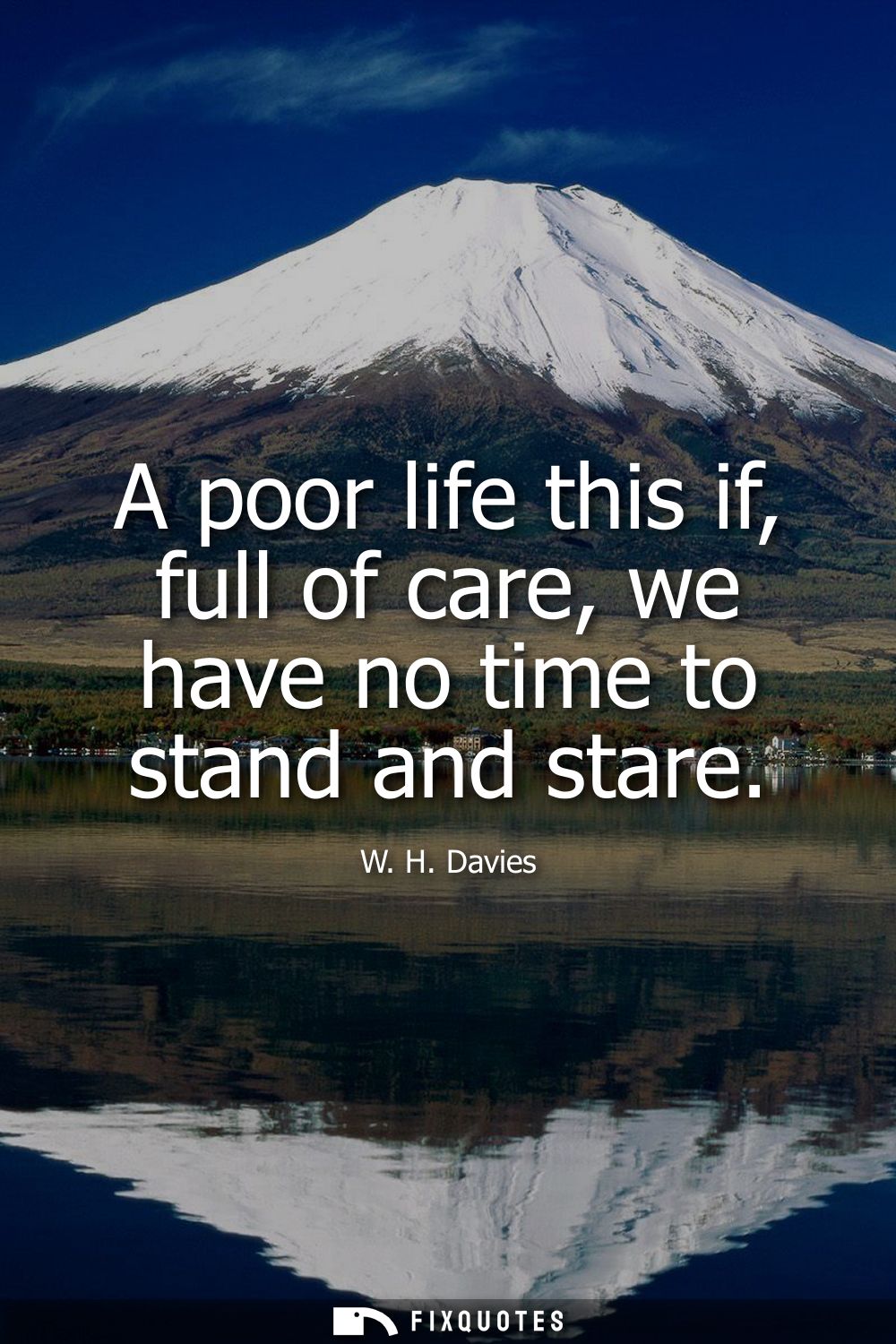
"A poor life this if, full of care, we have no time to stand and stare"
About this Quote
A jab disguised as a nursery-simple rhyme, Davies's line works because it makes modern busyness sound not just sad, but vaguely ridiculous. "Poor" lands first as moral diagnosis, not financial complaint: a life can be materially fine and still be impoverished in attention. Then he tightens the trap with the phrase "full of care" - care as worry, care as duty, care as the constant managerial hum of keeping things running. The twist is that "care" is usually treated as virtue; Davies treats it as a thief.
"Stand and stare" is deliberately plain, almost childlike, and that's the point. He isn't pitching a grand philosophy so much as pointing to an ordinary human capacity we've trained ourselves to feel guilty about. The line's music reinforces the argument: the soft internal echo of "care" and "stare" slows your mouth down, nudging you into the very pause he's prescribing. Even the simplicity is strategic. If contemplation required special education, the overworked reader could dodge it. Davies makes it accessible, then shames you a little for neglecting it.
Context matters: Davies came out of hard circumstances and wandered as a tramp before finding literary success. He wasn't romanticizing leisure from a comfortable remove; he knew what survival labor looks like. The poem "Leisure" (1911) arrives early in industrial modernity, when time became something you "spent" under clocks, shifts, and schedules. The subtext is quietly radical: attention is not a luxury item. It's the baseline of a life that isn't merely endured.
"Stand and stare" is deliberately plain, almost childlike, and that's the point. He isn't pitching a grand philosophy so much as pointing to an ordinary human capacity we've trained ourselves to feel guilty about. The line's music reinforces the argument: the soft internal echo of "care" and "stare" slows your mouth down, nudging you into the very pause he's prescribing. Even the simplicity is strategic. If contemplation required special education, the overworked reader could dodge it. Davies makes it accessible, then shames you a little for neglecting it.
Context matters: Davies came out of hard circumstances and wandered as a tramp before finding literary success. He wasn't romanticizing leisure from a comfortable remove; he knew what survival labor looks like. The poem "Leisure" (1911) arrives early in industrial modernity, when time became something you "spent" under clocks, shifts, and schedules. The subtext is quietly radical: attention is not a luxury item. It's the baseline of a life that isn't merely endured.
Quote Details
| Topic | Live in the Moment |
|---|---|
| Source | "Leisure" (poem) by W. H. Davies — contains the line "A poor life this if, full of care, we have no time to stand and stare". |
More Quotes by H. Davies
Add to List