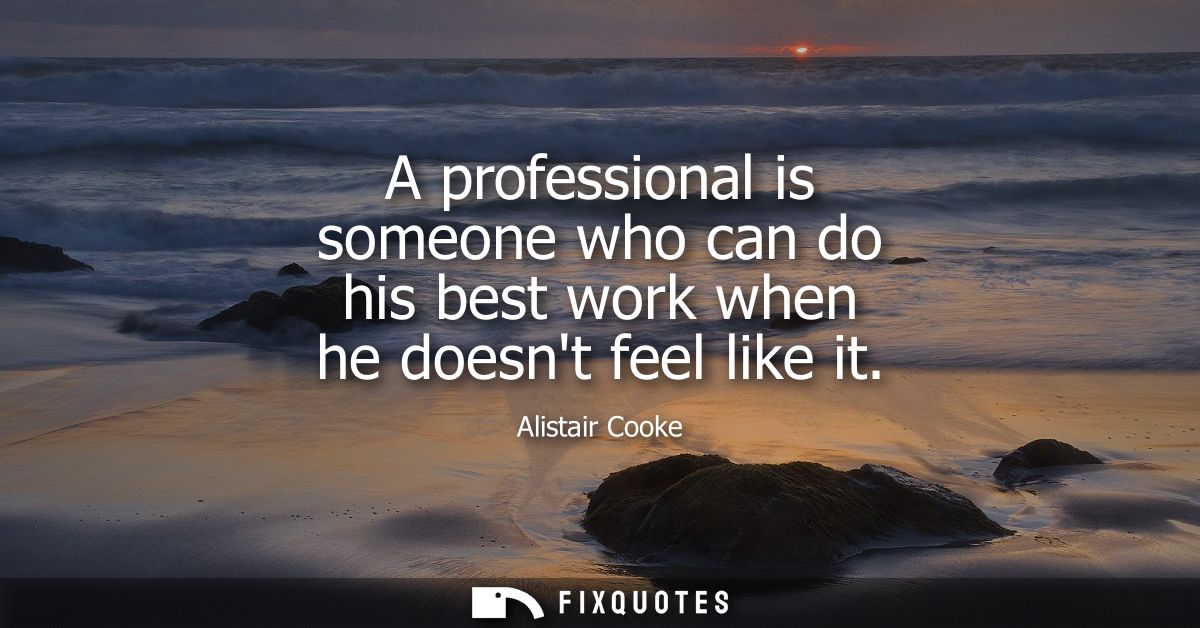
"A professional is someone who can do his best work when he doesn't feel like it"
About this Quote
Romance sells the myth that great work arrives on a gust of inspiration; Cooke, the journalist’s journalist, quietly tears that poster down. "A professional" here isn’t a title or a pay grade. It’s a behavioral standard: the ability to perform under conditions that are frankly ordinary - boredom, irritability, distraction, dread, the low-grade fatigue that makes sentences look like enemies. The line’s power comes from its refusal to flatter. Talent is assumed but demoted; temperament becomes the real battlefield.
Cooke’s phrasing is surgical. "Best work" raises the bar past mere competence: not just turning something in, but delivering the version you’d be proud to sign. Then he undercuts the cultural excuse machine with "when he doesn’t feel like it", a blunt clause that names the hidden obstacle most people treat as a veto. Feelings aren’t dismissed as unreal; they’re treated as unreliable managers.
The subtext is newsroom-clear: deadlines don’t negotiate. Journalism, especially in Cooke’s era of regular broadcasts and columns, trained writers to build a repeatable self rather than wait for a rare mood. The quote also doubles as a critique of performative creativity, the kind that publicly agonizes and privately postpones. Cooke implies that discipline is not the opposite of artistry but its delivery system - the scaffolding that lets craft show up on days when the muse is "out of office."
Cooke’s phrasing is surgical. "Best work" raises the bar past mere competence: not just turning something in, but delivering the version you’d be proud to sign. Then he undercuts the cultural excuse machine with "when he doesn’t feel like it", a blunt clause that names the hidden obstacle most people treat as a veto. Feelings aren’t dismissed as unreal; they’re treated as unreliable managers.
The subtext is newsroom-clear: deadlines don’t negotiate. Journalism, especially in Cooke’s era of regular broadcasts and columns, trained writers to build a repeatable self rather than wait for a rare mood. The quote also doubles as a critique of performative creativity, the kind that publicly agonizes and privately postpones. Cooke implies that discipline is not the opposite of artistry but its delivery system - the scaffolding that lets craft show up on days when the muse is "out of office."
Quote Details
| Topic | Work Ethic |
|---|
More Quotes by Alistair
Add to List