
Jean de La Fontaine Biography Quotes 39 Report mistakes
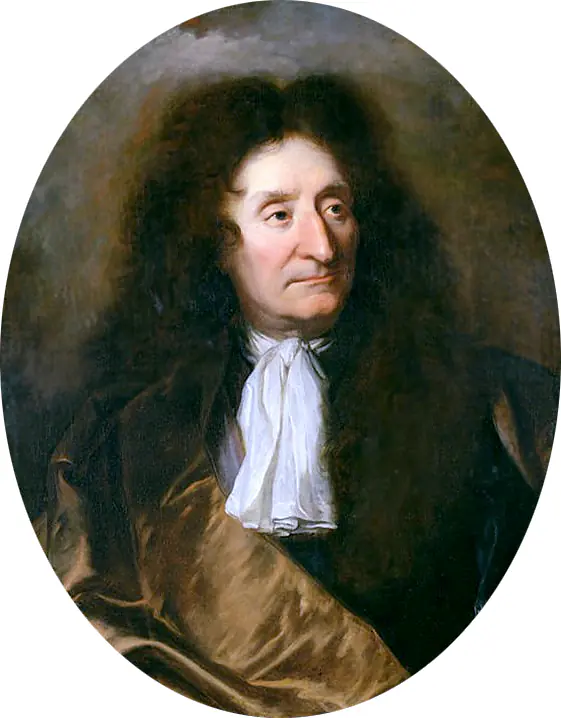
Attr: Hyacinthe Rigaud
| 39 Quotes | |
| Occup. | Poet |
| From | France |
| Born | July 8, 1621 Château-Thierry, Aisne, France |
| Died | April 13, 1695 Paris, France |
| Aged | 73 years |
Jean de La Fontaine was born on July 8, 1621, in Chateau-Thierry in Champagne, a provincial town where the Marne valley landscape and village speech remained close to the rhythms of oral tale and rural proverb. His father, Charles de La Fontaine, held the office of maitre des eaux et forets (master of waters and forests), a post that tied the family to the Crown's administration and to the practical governance of land, timber, and hunting rights. His mother, Francoise Pidoux, came from a legal and bourgeois milieu. The boy grew up between paperwork and woods, learning early how authority looks on paper and how it behaves in life.
Seventeenth-century France was tightening into the centralized monarchy of Louis XIII and then Louis XIV, and the countryside felt the pressure in taxes, patronage, and deference. La Fontaine's later genius for miniature dramas of power - the small crushing the smaller, the mighty flattering the mightier - was seeded in this world of hierarchy, where survival often depended on knowing who listened, who lied, and who could punish. He remained, by temperament, neither a courtier nor a rebel, but a watchful observer who preferred the sidelong glance to the direct sermon.
Education and Formative Influences
He studied at the College of Reims and spent time with the Oratorians, briefly testing a clerical path before returning to lay life; the experience left him with an ear for moral language without binding him to theology. He read widely - classical Latin poets and moralists, Renaissance storytellers, and above all the fabulists, from Aesop to Phaedrus - and absorbed the salon culture that prized wit, brevity, and indirection. In Paris he joined literary circles where the art of saying something sharp without sounding seditious was a survival skill, a craft that would become his signature.
Career, Major Works, and Turning Points
In 1647 he married Marie Hericart; the marriage was uneasy and often distant, and he drifted toward Parisian letters and patronage. Appointed to his father's office in 1652, he proved ill-suited to administrative routine, and his ambitions turned decisively toward literature. The decisive patron was Nicolas Fouquet, Louis XIV's powerful finance minister; La Fontaine attached himself to Fouquet's household and wrote in his defense after Fouquet's spectacular fall in 1661, a turning point that taught him how quickly brilliance could become liability. He found shelter later in the salons and in the household of Marguerite de La Sabliere, where he wrote much of the work that made him indispensable to French letters: the first collection of Fables (1668), followed by further books through the 1670s-1690s, and the licentious and artistically daring Contes et nouvelles. Elected to the Academie francaise in 1684 after resistance from moralists, he aged into a more public respectability, suffering ill health in the 1690s and dying in Paris on April 13, 1695.
Philosophy, Style, and Themes
La Fontaine's fables are not children's morals but adult social anatomy, composed in supple verse that can pivot from conversational ease to crystalline aphorism. He distrusted grand systems and preferred case studies: a wolf and lamb, a crow and fox, a powerful lion surrounded by frightened courtiers. His realism is psychological - the recognition that people rarely act from the reasons they give - and political, shaped by life under an absolutist court where survival depended on reading motives. "Every flatterer lives at the expense of him who listens to him". The line distills his sense of the court as an economy of vanity, where language itself can be predation.
His inner life, as it surfaces in the fables, is wary but not bitter: he accepts force as a fact yet refuses to glorify it. Again and again he praises flexibility over brittle pride, not as cowardice but as intelligent endurance. "I bend and do not break". That posture fits a writer who lived by patrons, navigated scandal over his tales, and still managed to tell hard truths in an age that punished direct confrontation. He also understood how choices meant to evade danger can lead straight into it, a theme of ironic fate threaded through many narratives of caution and overconfidence. "A person often meets his destiny on the road he took to avoid it". The sentence reads like autobiography in miniature: a provincial official's son who tried clerical discipline, administrative duty, and polite dependence, only to become the era's master diagnostician of power.
Legacy and Influence
La Fontaine fixed the fable at the center of French literature, giving it a musical, idiomatic French that became a national reference point and a schoolroom inheritance, yet his true audience has always been adults living among institutions. He influenced moralists and satirists from the Enlightenment onward, offered later poets a model of narrative verse that could be both light and lethal, and provided political thinkers with a repertoire of parables about legitimacy, manipulation, and the uses of weakness. His animals endure because they are never merely animals: they are recognizable people compressed into a few lines, speaking in a language that still clarifies how societies flatter, punish, and excuse themselves.
Our collection contains 39 quotes who is written by Jean, under the main topics: Witty One-Liners - Motivational - Ethics & Morality - Wisdom - Friendship.
Other people realated to Jean: Jean de La Bruyère (Philosopher), Ninon de L'Enclos (Author), Charles Perrault (Author)
Jean de La Fontaine Famous Works
Source / external links