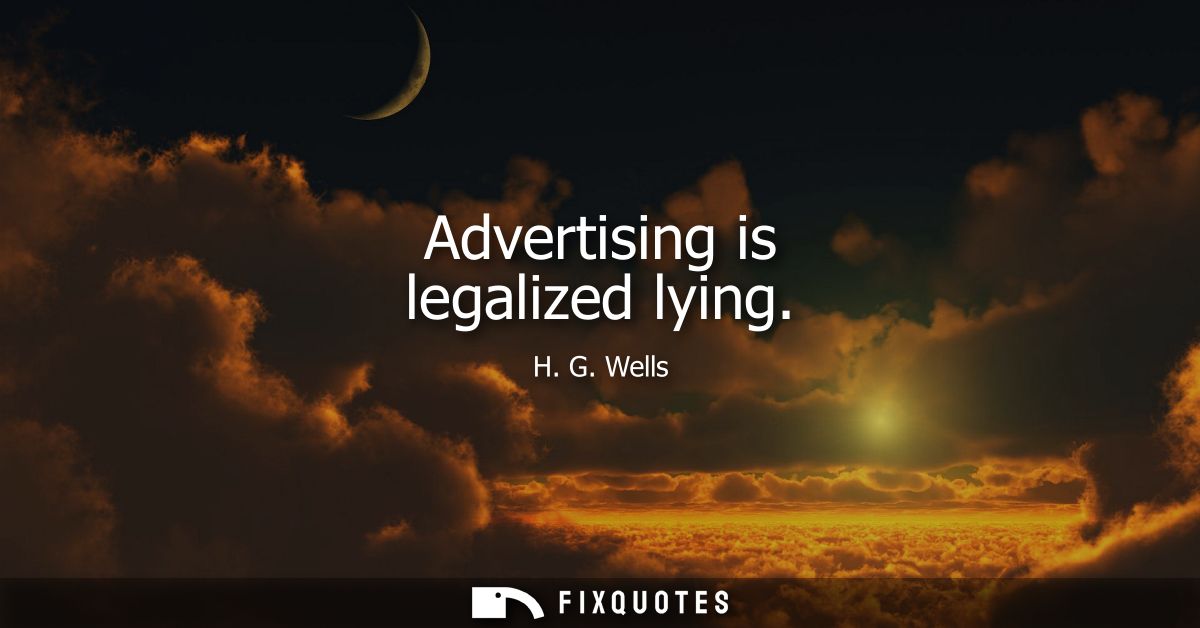
"Advertising is legalized lying"
About this Quote
Wells lands the punch with a bureaucrat's precision: not "lying", but "legalized lying". The phrase frames advertising less as a rogue moral failure than as a social contract we have quietly signed. It is a condemnation of a system that launders deception through paperwork, regulation, and custom until it passes as normal speech. By choosing "legalized", Wells implies complicity. The public may complain about ads, but it also depends on them, funds media through them, and accepts the bargain of being seduced in exchange for cheaper goods and a humming marketplace.
The line also carries Wells's modernist suspicion of the new machinery of persuasion. Writing in an era when mass newspapers, posters, and branded consumer culture were exploding, he watched language get repurposed from description to manipulation. Advertising doesn't merely exaggerate; it engineers desire, reroutes attention, and trains people to confuse aspiration with need. "Lying" here isn't only factual untruth. It's the strategic storytelling that makes products stand in for status, romance, health, even virtue.
The subtext is almost darker than the insult: the lie isn't a bug, it's the feature. A society that prizes growth will tolerate distortion as long as it remains profitable and plausibly deniable. Wells, the futurist who imagined worlds remade by technology and power, recognizes persuasion as infrastructure. Ads become a legal fiction that keeps the economic story coherent, even when the claims are not.
The line also carries Wells's modernist suspicion of the new machinery of persuasion. Writing in an era when mass newspapers, posters, and branded consumer culture were exploding, he watched language get repurposed from description to manipulation. Advertising doesn't merely exaggerate; it engineers desire, reroutes attention, and trains people to confuse aspiration with need. "Lying" here isn't only factual untruth. It's the strategic storytelling that makes products stand in for status, romance, health, even virtue.
The subtext is almost darker than the insult: the lie isn't a bug, it's the feature. A society that prizes growth will tolerate distortion as long as it remains profitable and plausibly deniable. Wells, the futurist who imagined worlds remade by technology and power, recognizes persuasion as infrastructure. Ads become a legal fiction that keeps the economic story coherent, even when the claims are not.
Quote Details
| Topic | Marketing |
|---|---|
| Source | Help us find the source |
| Cite |
Citation Formats
APA Style (7th ed.)
Wells, H.G. (2026, January 14). Advertising is legalized lying. FixQuotes. https://fixquotes.com/quotes/advertising-is-legalized-lying-23637/
Chicago Style
Wells, H.G. "Advertising is legalized lying." FixQuotes. January 14, 2026. https://fixquotes.com/quotes/advertising-is-legalized-lying-23637/.
MLA Style (9th ed.)
"Advertising is legalized lying." FixQuotes, 14 Jan. 2026, https://fixquotes.com/quotes/advertising-is-legalized-lying-23637/. Accessed 1 Apr. 2026.
More Quotes by Wells
Add to List