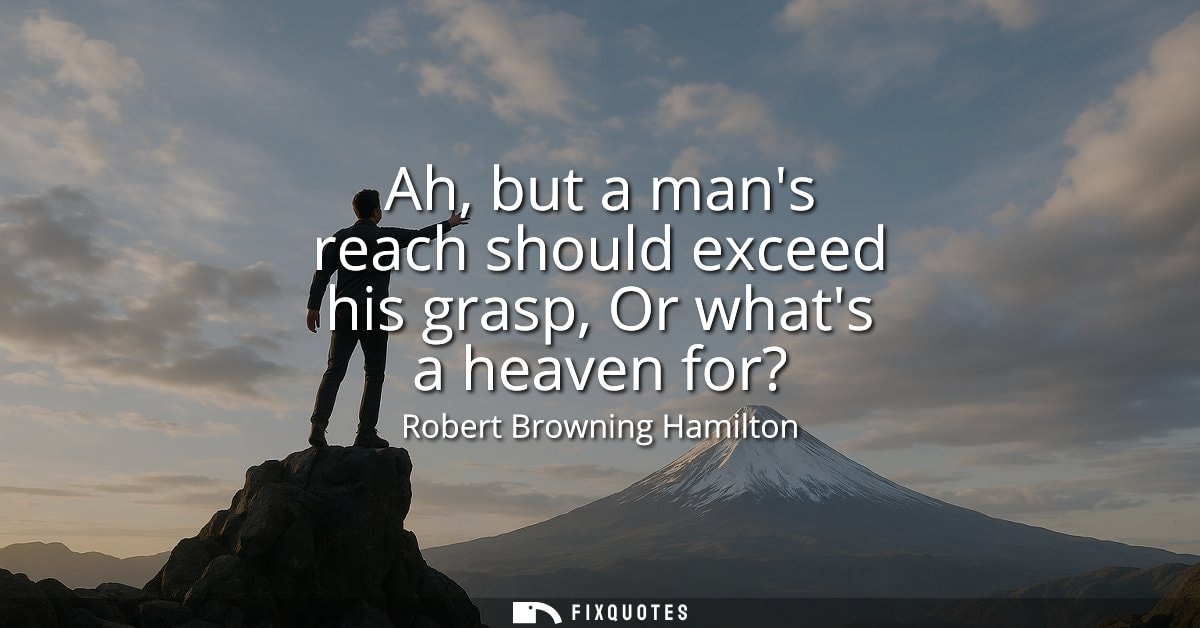
"Ah, but a man's reach should exceed his grasp, Or what's a heaven for?"
About this Quote
The pivot is the second clause, which smuggles theology into a practical ethic. “Or what’s a heaven for?” turns aspiration into evidence. Heaven, whether taken literally or as metaphor, becomes the horizon that justifies striving: the imagined ideal that keeps the human engine running. It’s slyly rhetorical, almost teasing. If you don’t attempt what you can’t guarantee, you’re treating the world like a closed system, as if there’s no “beyond” to aim at.
The context matters: a late-Victorian/early-20th-century writer living through industrial acceleration, imperial confidence, and then the brutal correction of world war. In that era, progress was both a creed and a gamble. The line captures the era’s optimism while quietly admitting its cost: you will fail to “grasp” plenty. The point is that the reaching is the measure of a life, and the unattained isn’t a verdict - it’s the proof you were aiming high enough.
Quote Details
| Topic | Meaning of Life |
|---|---|
| Source | Later attribution: Unbuilt Hamilton (Mark Osbaldeston, 2016) modern compilationISBN: 9781459733008 · ID: ma7XCgAAQBAJ
Evidence: ... Ah, but a man's reach should exceed his grasp Or what's a heaven for? — Robert Browning, Andrea del Sarto. I. n more earnest, less ironic times, Hamilton used to call itself the Ambitious City. As a tool of civic boosterism, it's a ... Other candidates (1) George Washington (Robert Browning Hamilton) compilation38.3% ich to place human gods i should place washington on that pedestal as the most fi |
| Featured | This quote was our Quote of the Day on August 13, 2025 |
| Cite |
Citation Formats
APA Style (7th ed.)
Hamilton, Robert Browning. (2026, January 13). Ah, but a man's reach should exceed his grasp, Or what's a heaven for? FixQuotes. https://fixquotes.com/quotes/ah-but-a-mans-reach-should-exceed-his-grasp-or-83285/
Chicago Style
Hamilton, Robert Browning. "Ah, but a man's reach should exceed his grasp, Or what's a heaven for?" FixQuotes. January 13, 2026. https://fixquotes.com/quotes/ah-but-a-mans-reach-should-exceed-his-grasp-or-83285/.
MLA Style (9th ed.)
"Ah, but a man's reach should exceed his grasp, Or what's a heaven for?" FixQuotes, 13 Jan. 2026, https://fixquotes.com/quotes/ah-but-a-mans-reach-should-exceed-his-grasp-or-83285/. Accessed 2 Apr. 2026.