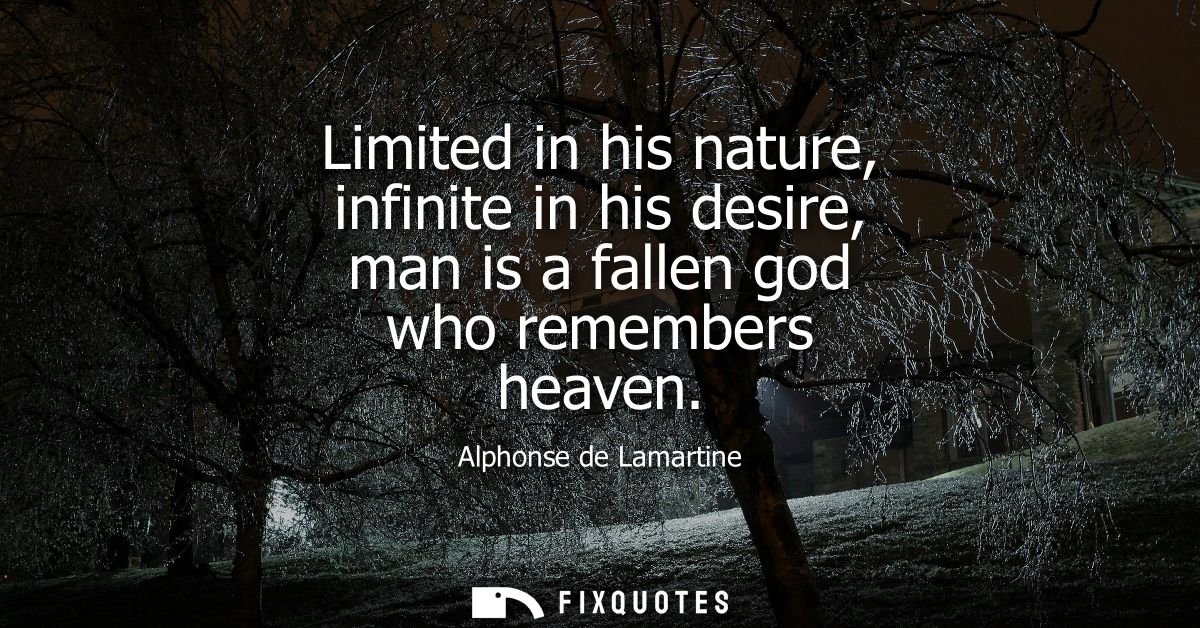
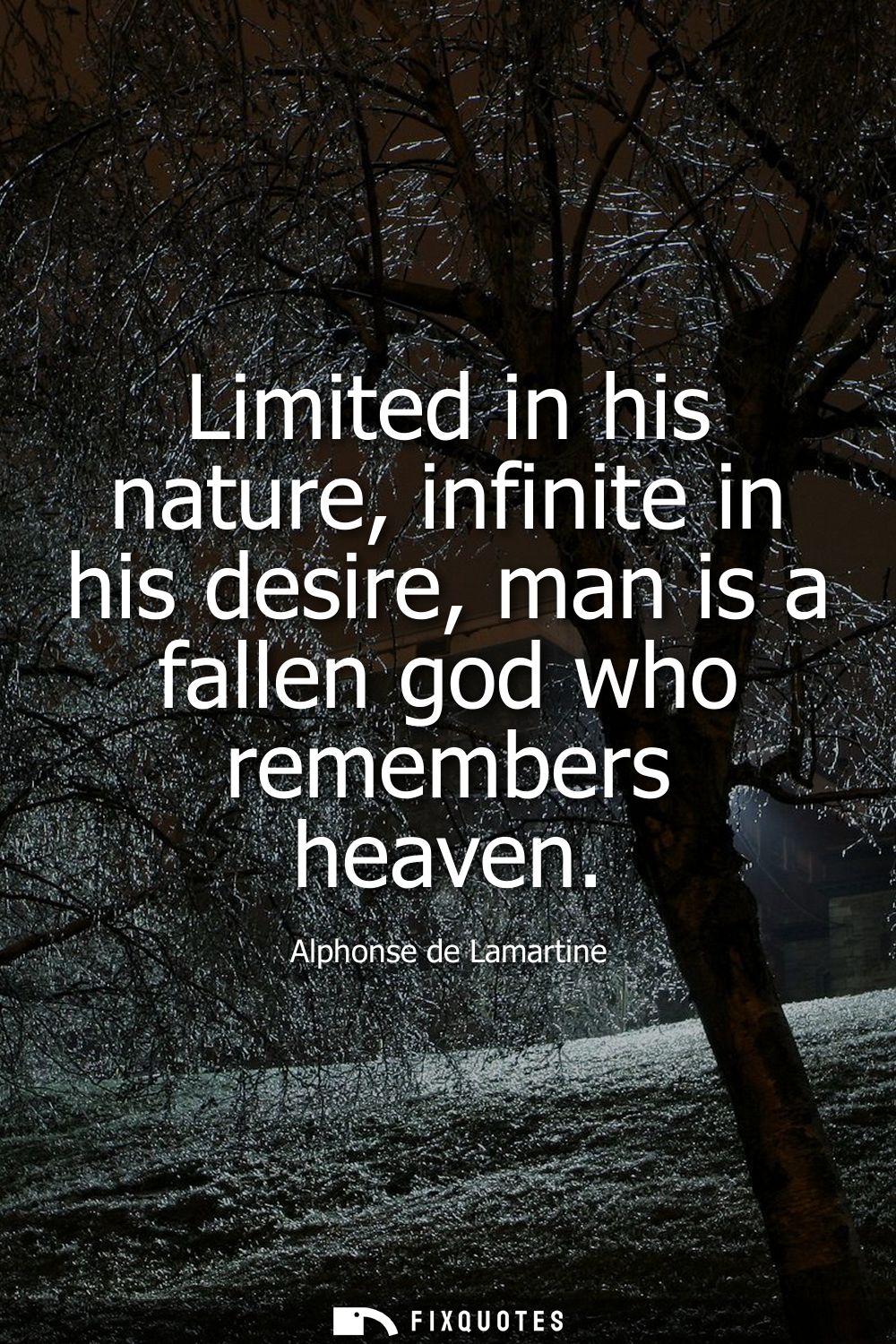
"Limited in his nature, infinite in his desire, man is a fallen god who remembers heaven"
About this Quote
The clincher, “a fallen god who remembers heaven,” borrows Christian myth without sounding like catechism. “Fallen” supplies guilt and gravity; it implies not just loss but a prior height, a dignity we can’t quite justify by our current performance. “Remembers” is the real weapon. If heaven were merely rumored, desire might be manageable. Memory makes it intimate, almost bodily. It frames longing as nostalgia for a place we can’t return to, which is why ambition so easily curdles into melancholy.
As a Romantic poet writing in post-Revolutionary France, Lamartine is working in an era allergic to cold rationalism and newly fascinated by interior life: the self as battlefield, faith as ache, politics as disillusionment. The intent isn’t to flatter humanity as “divine,” but to dramatize the specific torment of modern consciousness: we can imagine perfection, sense the shape of the absolute, and still have to negotiate with hunger, time, and compromise. The subtext is both consoling and accusing: your restlessness isn’t a personal failure; it’s your species’ inheritance.
Quote Details
| Topic | Wisdom |
|---|---|
| Source | Help us find the source |
| Cite |
Citation Formats
APA Style (7th ed.)
Lamartine, Alphonse de. (2026, January 17). Limited in his nature, infinite in his desire, man is a fallen god who remembers heaven. FixQuotes. https://fixquotes.com/quotes/limited-in-his-nature-infinite-in-his-desire-man-75390/
Chicago Style
Lamartine, Alphonse de. "Limited in his nature, infinite in his desire, man is a fallen god who remembers heaven." FixQuotes. January 17, 2026. https://fixquotes.com/quotes/limited-in-his-nature-infinite-in-his-desire-man-75390/.
MLA Style (9th ed.)
"Limited in his nature, infinite in his desire, man is a fallen god who remembers heaven." FixQuotes, 17 Jan. 2026, https://fixquotes.com/quotes/limited-in-his-nature-infinite-in-his-desire-man-75390/. Accessed 2 Apr. 2026.