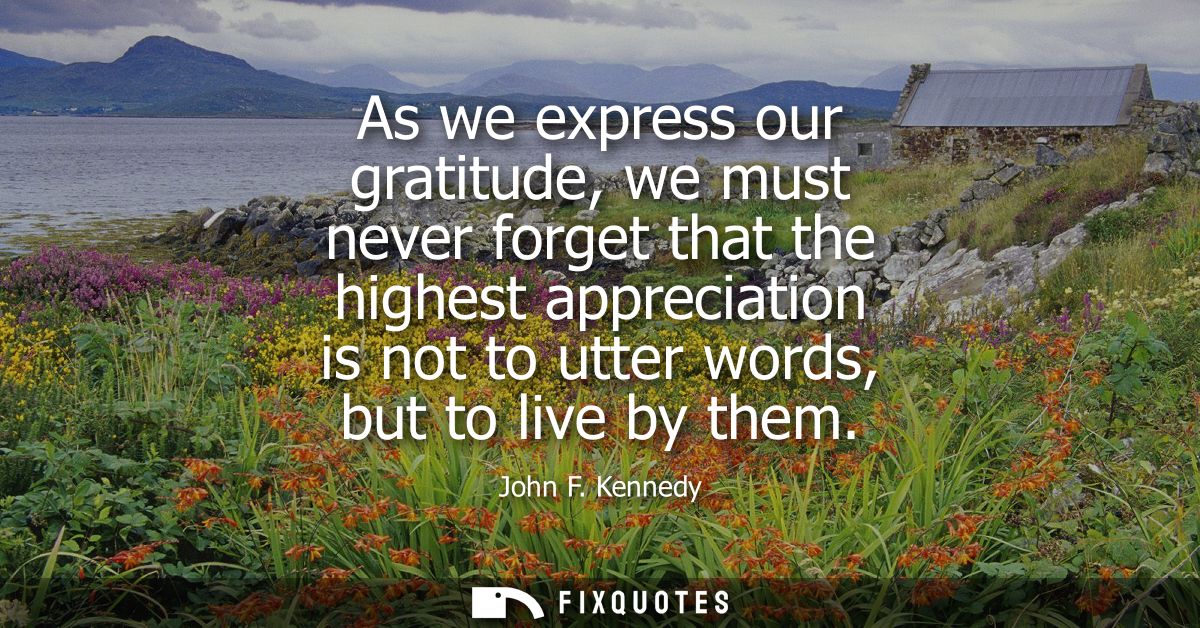
"As we express our gratitude, we must never forget that the highest appreciation is not to utter words, but to live by them"
About this Quote
Kennedy’s line hits with the clean authority of a president trying to turn sentiment into civic muscle. On its face, it’s an etiquette correction: stop mistaking polite language for real gratitude. Underneath, it’s a governing philosophy dressed as a moral reminder. Gratitude, in this framing, is not a private feeling or a ceremonial speech; it’s a public obligation that shows up as conduct, sacrifice, and follow-through.
The sentence is built like a quiet reprimand. “As we express our gratitude” grants the crowd its rituals - the applause, the commemorations, the patriotic phrasing - then the pivot lands: “we must never forget.” That “must” is doing heavy lifting. It turns appreciation into duty, and duty into something measurable. Kennedy doesn’t ask for warmer feelings; he demands alignment between words and life. The “highest appreciation” is a values hierarchy: talk is cheap, action is expensive.
Contextually, Kennedy’s presidency was saturated with performances of national unity and calls to service - Cold War anxieties, military valor, civil rights pressure, the emerging “ask not” ethos. In that atmosphere, gratitude could easily become a comforting script deployed at parades or podiums, a way to feel righteous without changing anything. Kennedy’s subtext pushes against that temptation. If you claim to honor sacrifice - of soldiers, citizens, predecessors - you’re implicitly agreeing to carry the burden forward. The quote works because it treats hypocrisy not as a personal flaw but as a national risk: a country that confuses ceremony for commitment eventually runs out of credibility.
The sentence is built like a quiet reprimand. “As we express our gratitude” grants the crowd its rituals - the applause, the commemorations, the patriotic phrasing - then the pivot lands: “we must never forget.” That “must” is doing heavy lifting. It turns appreciation into duty, and duty into something measurable. Kennedy doesn’t ask for warmer feelings; he demands alignment between words and life. The “highest appreciation” is a values hierarchy: talk is cheap, action is expensive.
Contextually, Kennedy’s presidency was saturated with performances of national unity and calls to service - Cold War anxieties, military valor, civil rights pressure, the emerging “ask not” ethos. In that atmosphere, gratitude could easily become a comforting script deployed at parades or podiums, a way to feel righteous without changing anything. Kennedy’s subtext pushes against that temptation. If you claim to honor sacrifice - of soldiers, citizens, predecessors - you’re implicitly agreeing to carry the burden forward. The quote works because it treats hypocrisy not as a personal flaw but as a national risk: a country that confuses ceremony for commitment eventually runs out of credibility.
Quote Details
| Topic | Gratitude |
|---|
More Quotes by John
Add to List