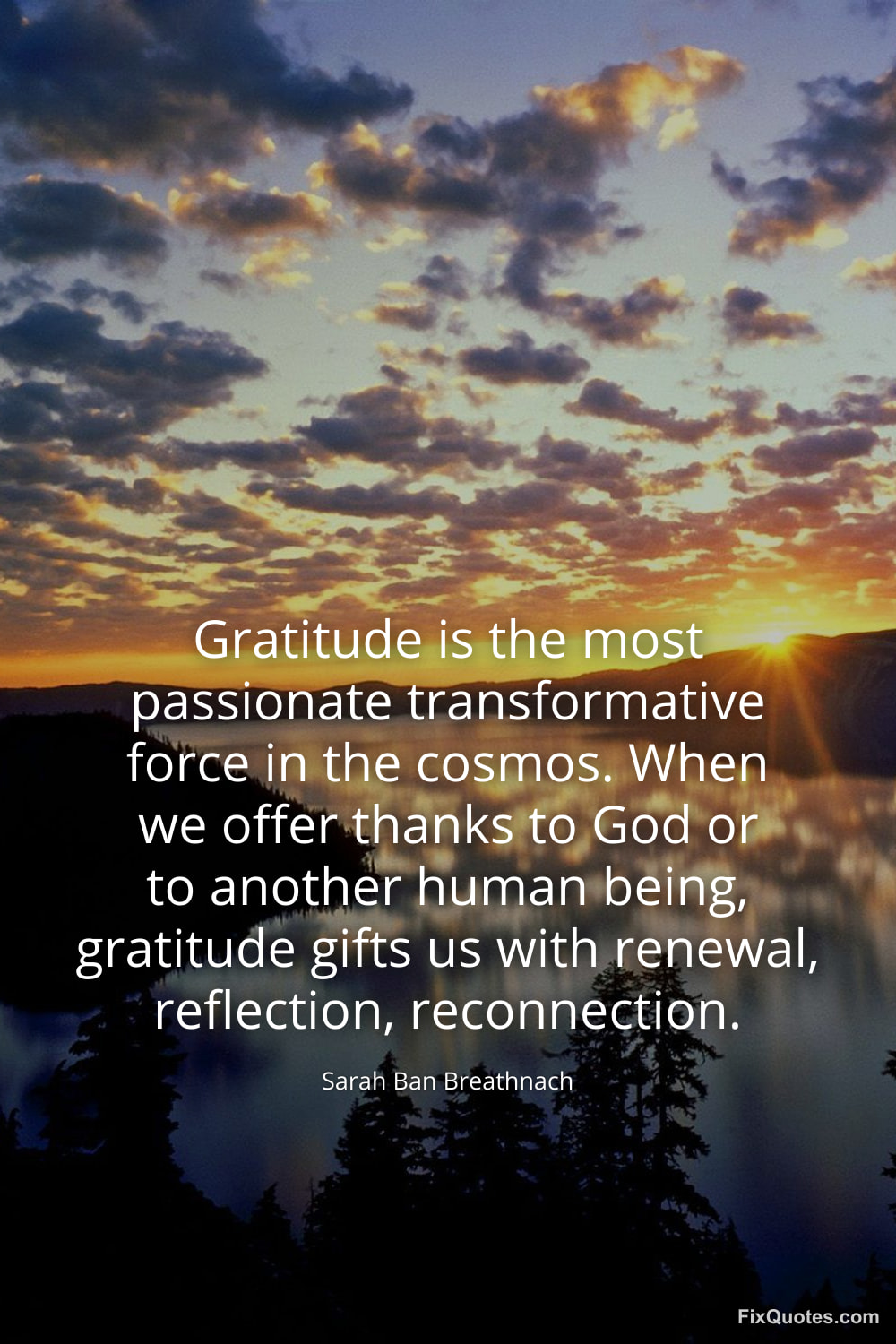
"Gratitude is the most passionate transformative force in the cosmos. When we offer thanks to God or to another human being, gratitude gifts us with renewal, reflection, reconnection"
About this Quote
Breathnach goes big on purpose: gratitude isn’t a nice habit, it’s a cosmic engine. That inflation is the point. As a self-help and spirituality writer, she’s competing with a culture that treats “thank you” like etiquette and wellness like a productivity hack. Calling gratitude “the most passionate transformative force in the cosmos” reframes it as raw energy rather than polite restraint. “Passionate” is a strategic adjective: it smuggles heat and desire into a practice that’s often marketed as calm, pastel, and compliant.
The construction “thanks to God or to another human being” quietly widens her tent. It nods to religious readers without alienating secular ones, suggesting gratitude works like a spiritual technology regardless of where you direct it. Subtext: you don’t need perfect beliefs, you need a practice. She also makes gratitude reciprocal: “gratitude gifts us.” That’s a sly inversion of moral duty. You’re not paying a social debt; you’re accepting a return.
Then come the three R’s - renewal, reflection, reconnection - a mini liturgy that maps a journey from the self to the world. Renewal promises personal repair, reflection adds meaning-making, reconnection restores social bonds in a time when alienation is practically a default setting. Contextually, Breathnach’s work lives in the late-90s/early-2000s boom of intimate, devotional self-improvement writing: spirituality translated into daily life. The intent isn’t to prove a metaphysics of gratitude; it’s to make the reader feel that a small act can carry the weight of change.
The construction “thanks to God or to another human being” quietly widens her tent. It nods to religious readers without alienating secular ones, suggesting gratitude works like a spiritual technology regardless of where you direct it. Subtext: you don’t need perfect beliefs, you need a practice. She also makes gratitude reciprocal: “gratitude gifts us.” That’s a sly inversion of moral duty. You’re not paying a social debt; you’re accepting a return.
Then come the three R’s - renewal, reflection, reconnection - a mini liturgy that maps a journey from the self to the world. Renewal promises personal repair, reflection adds meaning-making, reconnection restores social bonds in a time when alienation is practically a default setting. Contextually, Breathnach’s work lives in the late-90s/early-2000s boom of intimate, devotional self-improvement writing: spirituality translated into daily life. The intent isn’t to prove a metaphysics of gratitude; it’s to make the reader feel that a small act can carry the weight of change.
Quote Details
| Topic | Gratitude |
|---|
More Quotes by Sarah
Add to List