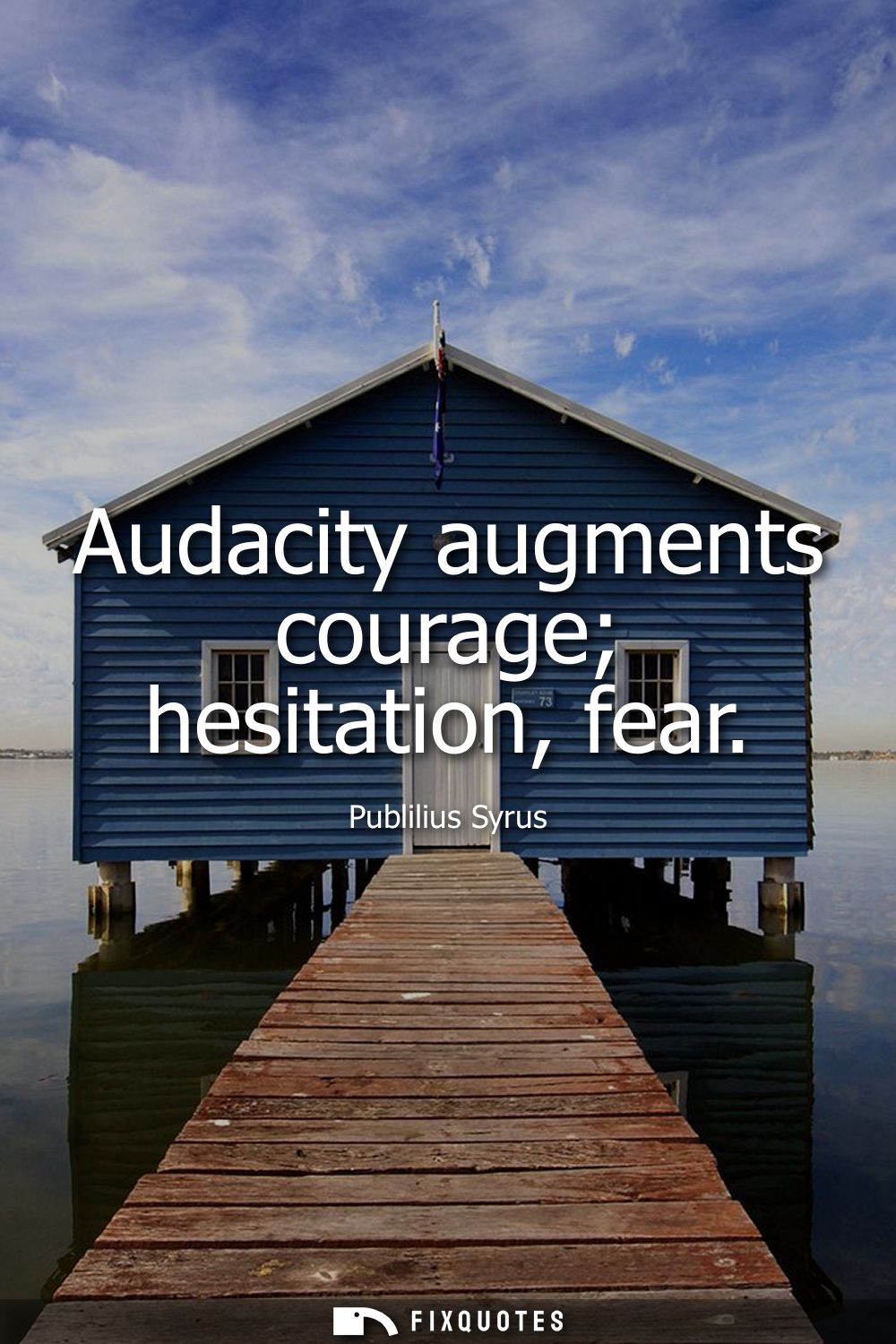
"Audacity augments courage; hesitation, fear"
About this Quote
“Audacity augments courage; hesitation, fear” reads like a clean line of moral arithmetic, the kind Roman audiences prized because it compresses a whole worldview into a single hinge. Publilius Syrus wasn’t writing philosophy in a vacuum; he was a former slave turned celebrated writer of mimes and sententiae, crafting portable wisdom for a culture that worshipped decisiveness in public life. In the late Republic’s competitive masculinity, you didn’t merely act bravely; you performed bravery. Audacity becomes both fuel and proof.
The trick in the line is its psychological insight disguised as instruction. Syrus isn’t claiming courage is a fixed trait you either possess or lack. He implies it’s self-reinforcing: push forward and the body catches up, the mind reinterprets risk as momentum. “Augments” is key: courage is something you can grow by behaving as if you already have it. The flip side is equally sharp. Hesitation doesn’t just signal fear; it manufactures it. Pause long enough and your imagination fills the gap with worst-case scenarios, turning caution into a narrative of impending defeat.
Subtextually, there’s a hard Roman edge here: deliberation is treated as weakness, even though Rome’s best political rhetoric often depended on careful timing and restraint. That tension is the point. Syrus is selling a usable myth for high-stakes environments - courts, politics, war, love - where the person who moves first often gets to define reality. The line flatters action not because action is always wise, but because action feels like sovereignty.
The trick in the line is its psychological insight disguised as instruction. Syrus isn’t claiming courage is a fixed trait you either possess or lack. He implies it’s self-reinforcing: push forward and the body catches up, the mind reinterprets risk as momentum. “Augments” is key: courage is something you can grow by behaving as if you already have it. The flip side is equally sharp. Hesitation doesn’t just signal fear; it manufactures it. Pause long enough and your imagination fills the gap with worst-case scenarios, turning caution into a narrative of impending defeat.
Subtextually, there’s a hard Roman edge here: deliberation is treated as weakness, even though Rome’s best political rhetoric often depended on careful timing and restraint. That tension is the point. Syrus is selling a usable myth for high-stakes environments - courts, politics, war, love - where the person who moves first often gets to define reality. The line flatters action not because action is always wise, but because action feels like sovereignty.
Quote Details
| Topic | Confidence |
|---|
More Quotes by Publilius
Add to List