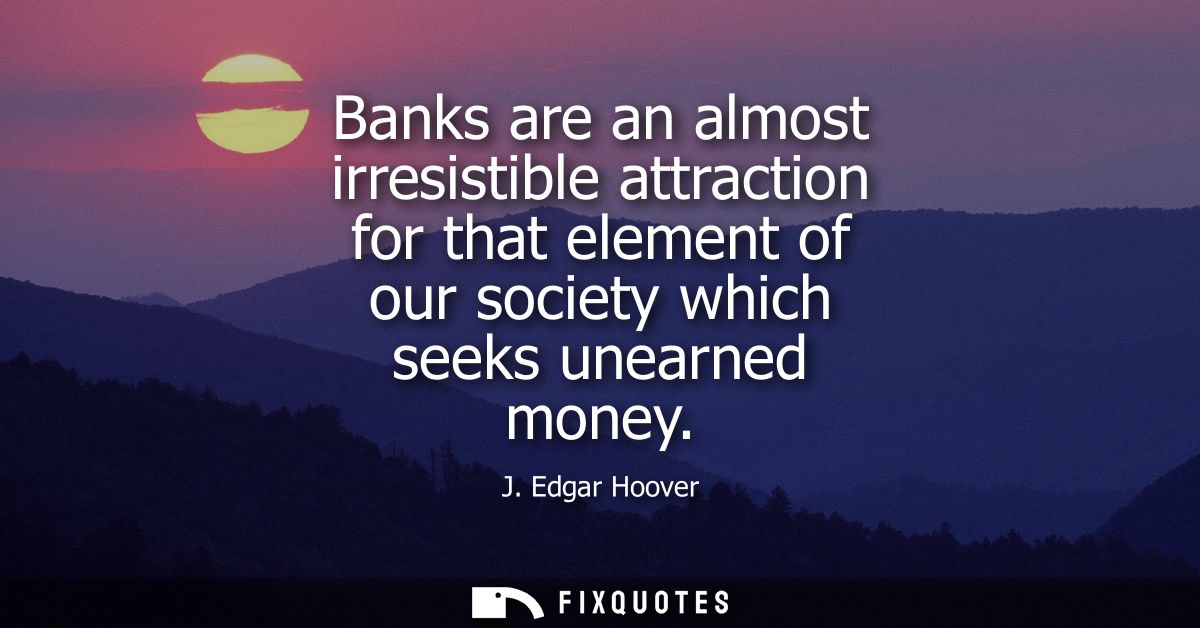
"Banks are an almost irresistible attraction for that element of our society which seeks unearned money"
About this Quote
Hoover’s line reads like a neat moral syllogism, but it’s really a warning label on modern capitalism: wherever money concentrates, the people who want it without the work will follow. The phrase “almost irresistible attraction” does sly double duty. It paints bank robbers as moths to a flame, driven less by ideology than by appetite, while letting banks themselves off the hook as passive “attractions” rather than institutions built to gather and guard other people’s cash. He’s condemning criminals, yes, but he’s also acknowledging that banks are designed as targets - temples of liquidity with predictable routines, centralized wealth, and public symbolism.
The subtext is classic Hoover: social order is fragile, and predation is an ever-present “element” within society, not an aberration. That word choice is telling. “Element” reduces criminals to a category, a contaminant you can isolate and neutralize, aligning with Hoover’s broader law-and-order worldview and the Bureau’s desire to present crime as a manageable threat requiring professional policing, not social reform.
Context matters. Hoover rose to prominence as the federal government expanded its reach, and the Great Depression era made banks both literal flashpoints (failures, runs) and cultural icons (the Dillinger myth, the folk-hero bandit). His sentence aims to puncture the romance: robbing a bank isn’t rebellion; it’s greed with a gun. Yet there’s an irony he leaves untouched: banks also attract another kind of “unearned money” - legal, institutional, and sanitized - and Hoover’s moral clarity depends on keeping that parallel offstage.
The subtext is classic Hoover: social order is fragile, and predation is an ever-present “element” within society, not an aberration. That word choice is telling. “Element” reduces criminals to a category, a contaminant you can isolate and neutralize, aligning with Hoover’s broader law-and-order worldview and the Bureau’s desire to present crime as a manageable threat requiring professional policing, not social reform.
Context matters. Hoover rose to prominence as the federal government expanded its reach, and the Great Depression era made banks both literal flashpoints (failures, runs) and cultural icons (the Dillinger myth, the folk-hero bandit). His sentence aims to puncture the romance: robbing a bank isn’t rebellion; it’s greed with a gun. Yet there’s an irony he leaves untouched: banks also attract another kind of “unearned money” - legal, institutional, and sanitized - and Hoover’s moral clarity depends on keeping that parallel offstage.
Quote Details
| Topic | Money |
|---|
More Quotes by Edgar Hoover
Add to List