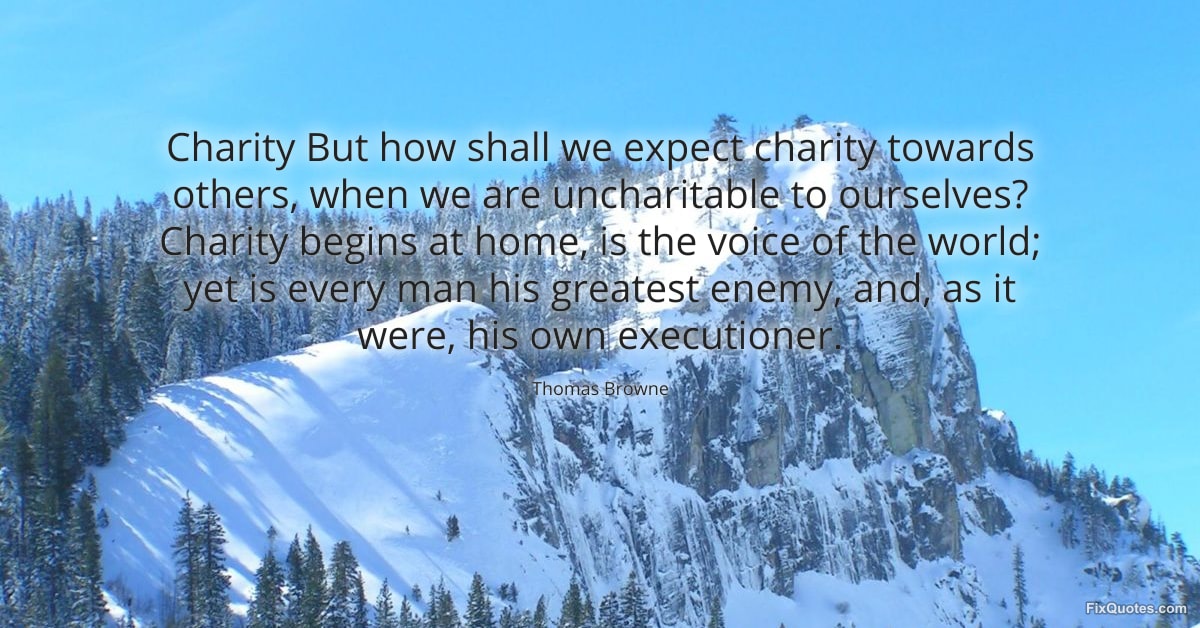
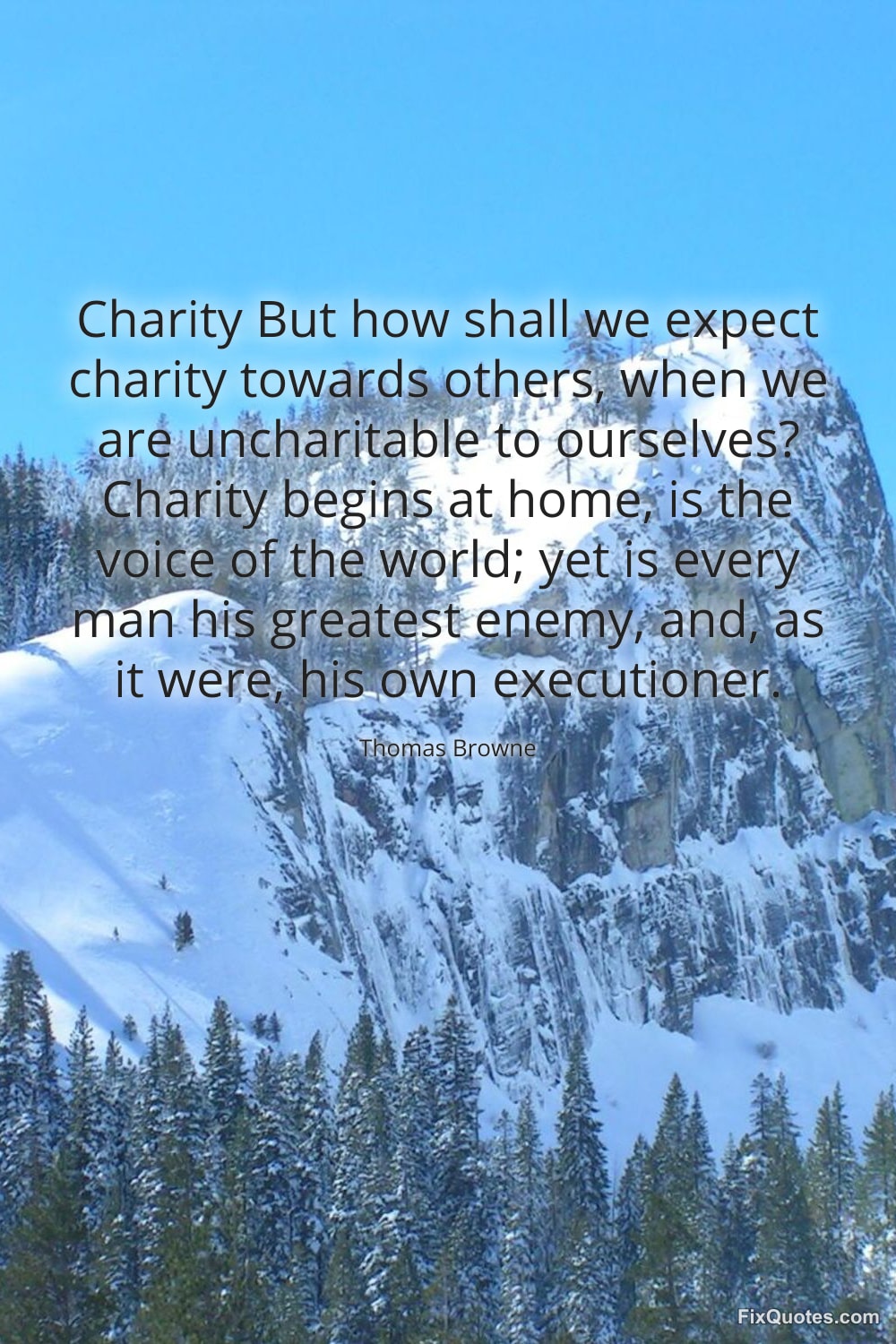
"Charity But how shall we expect charity towards others, when we are uncharitable to ourselves? Charity begins at home, is the voice of the world; yet is every man his greatest enemy, and, as it were, his own executioner"
About this Quote
Browne turns a pious platitude into a psychological indictment. "Charity begins at home" usually flatters the listener: take care of your own, be decent in private, and public virtue will follow. Browne keeps the proverb but flips its moral center. Home, for him, is not the household but the self, and the shock is that most people run their inner domestic economy like a cruel regime. If we practice self-contempt, self-sabotage, and punitive scrupulosity, he implies, our outward kindness is often performance, mood, or moral bookkeeping, not a stable habit.
The subtext is early modern and strikingly contemporary: the obstacle to compassion isn't ignorance of ethics but a failure of interior governance. Browne, a physician and natural philosopher writing in a century of religious conflict and plague, understood how easily "charity" becomes a public badge while private life curdles into anxiety and self-prosecution. His language leans on legal and carceral imagery - "enemy", "executioner" - to suggest that the harshest tribunal sits inside the skull. That metaphor does more than dramatize; it diagnoses. A person trained to condemn themselves will carry the same punitive reflex into the world, turning moral judgment outward as soon as it becomes unbearable inward.
"Is the voice of the world" adds a sly second edge: everyone praises charity; it's the default soundtrack of virtue. Browne's point is that the loudness of that chorus can hide how rarely charity is actually practiced where it counts first - in the quiet, unobserved relationship between a person and their own mind.
The subtext is early modern and strikingly contemporary: the obstacle to compassion isn't ignorance of ethics but a failure of interior governance. Browne, a physician and natural philosopher writing in a century of religious conflict and plague, understood how easily "charity" becomes a public badge while private life curdles into anxiety and self-prosecution. His language leans on legal and carceral imagery - "enemy", "executioner" - to suggest that the harshest tribunal sits inside the skull. That metaphor does more than dramatize; it diagnoses. A person trained to condemn themselves will carry the same punitive reflex into the world, turning moral judgment outward as soon as it becomes unbearable inward.
"Is the voice of the world" adds a sly second edge: everyone praises charity; it's the default soundtrack of virtue. Browne's point is that the loudness of that chorus can hide how rarely charity is actually practiced where it counts first - in the quiet, unobserved relationship between a person and their own mind.
Quote Details
| Topic | Self-Love |
|---|
More Quotes by Thomas
Add to List