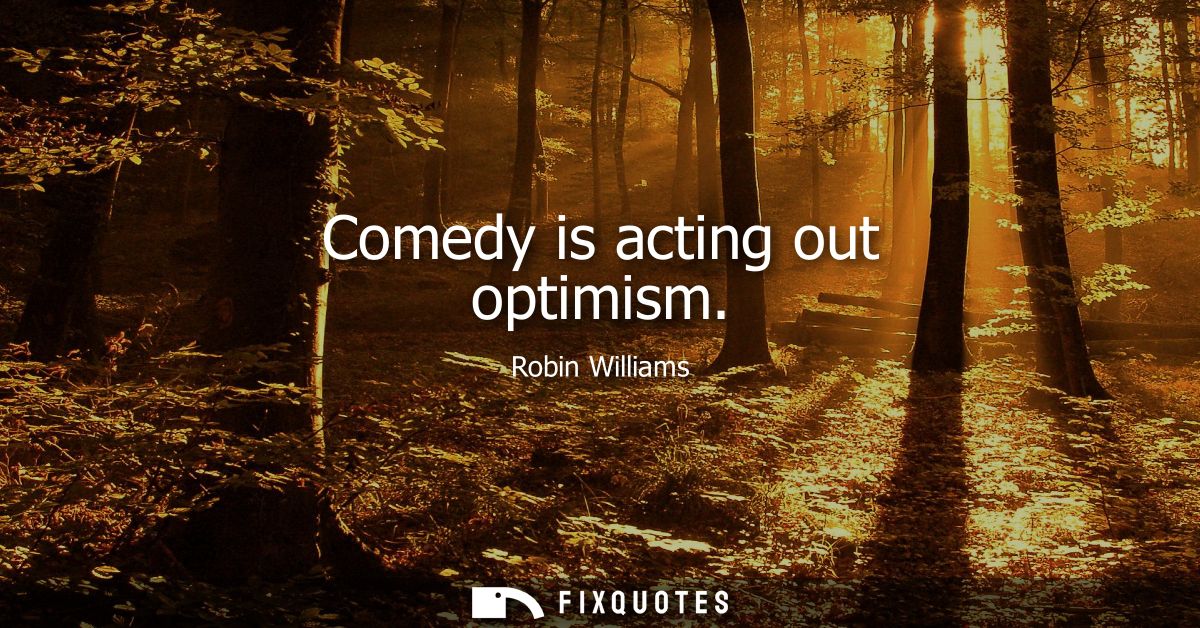
"Comedy is acting out optimism"
About this Quote
Comedy turns hope into a performance, a visible, audible act that insists life is worth the effort. Robin Williams understood that better than most. His stage energy, the hyperkinetic improvisations and voices, created a joyous storm that reminded audiences that possibility still exists, even when the world feels unmanageable. To say comedy is acting out optimism is to frame laughter as a stance, not a mood: a decision to embody hope and make it contagious.
The phrase carries a double resonance. To act out is to misbehave, to push boundaries; it is also to perform. Optimism, then, is not naive cheerfulness but a rebellious craft. A joke takes tension, confusion, or pain and flips it, releasing pressure through surprise. Setup and punchline rehearse a hopeful pattern: we can be wrong about how bad things are; the universe can deliver an unexpected turn that helps rather than harms. That pattern trains the nervous system to expect openings, to look for wiggle room in the stuck places.
Williams own roles often staged that belief. The Genie breaks rules to give a lonely kid agency. Mrs. Doubtfire invents a ridiculous persona to keep love alive. Patch Adams treats dignity as medicine. Even in Good Morning, Vietnam, where the backdrop is war, the jokes carve out human space amid chaos. The laughter never denies darkness; it insists darkness does not get the last line.
There is also a quiet honesty here about the performer. Optimism is not always felt; it can be practiced. By acting it out, the comedian creates a feedback loop where audience response warms the room and, sometimes, the self. The mask is not a lie; it is a tool that can summon the face beneath. Humor becomes civic work too, building solidarity out of shared recognition. When people laugh together, they momentarily believe together. That belief is the optimism being enacted: a collective wager that we can keep going, and find a way to make even the hard parts bearable.
The phrase carries a double resonance. To act out is to misbehave, to push boundaries; it is also to perform. Optimism, then, is not naive cheerfulness but a rebellious craft. A joke takes tension, confusion, or pain and flips it, releasing pressure through surprise. Setup and punchline rehearse a hopeful pattern: we can be wrong about how bad things are; the universe can deliver an unexpected turn that helps rather than harms. That pattern trains the nervous system to expect openings, to look for wiggle room in the stuck places.
Williams own roles often staged that belief. The Genie breaks rules to give a lonely kid agency. Mrs. Doubtfire invents a ridiculous persona to keep love alive. Patch Adams treats dignity as medicine. Even in Good Morning, Vietnam, where the backdrop is war, the jokes carve out human space amid chaos. The laughter never denies darkness; it insists darkness does not get the last line.
There is also a quiet honesty here about the performer. Optimism is not always felt; it can be practiced. By acting it out, the comedian creates a feedback loop where audience response warms the room and, sometimes, the self. The mask is not a lie; it is a tool that can summon the face beneath. Humor becomes civic work too, building solidarity out of shared recognition. When people laugh together, they momentarily believe together. That belief is the optimism being enacted: a collective wager that we can keep going, and find a way to make even the hard parts bearable.
Quote Details
| Topic | Optimism |
|---|
More Quotes by Robin
Add to List