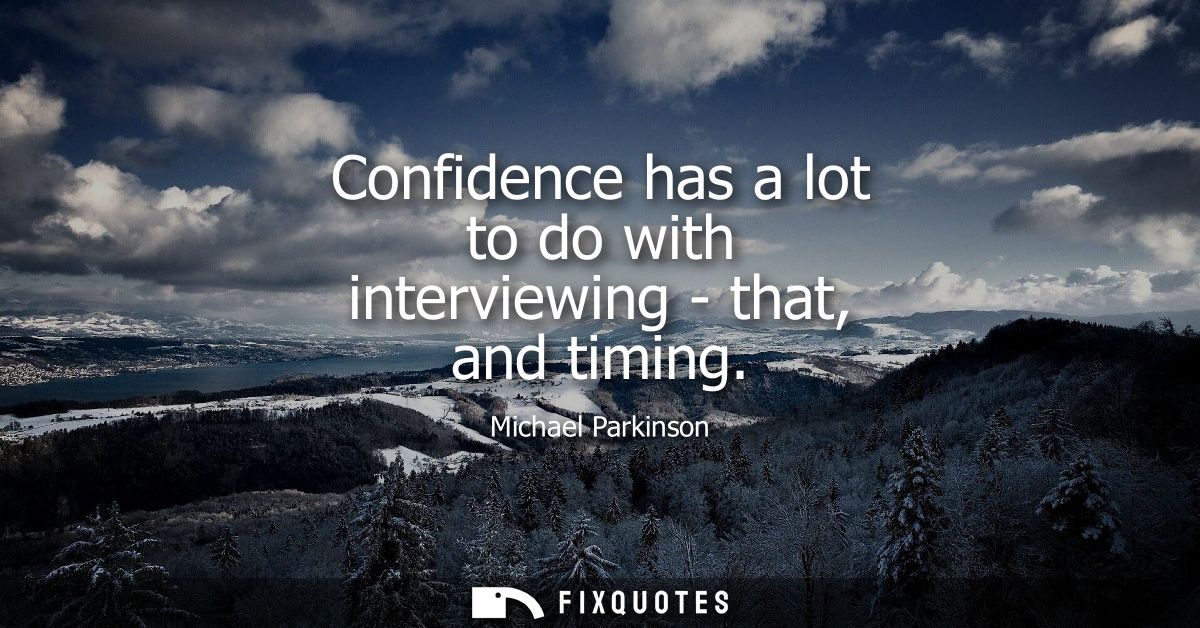
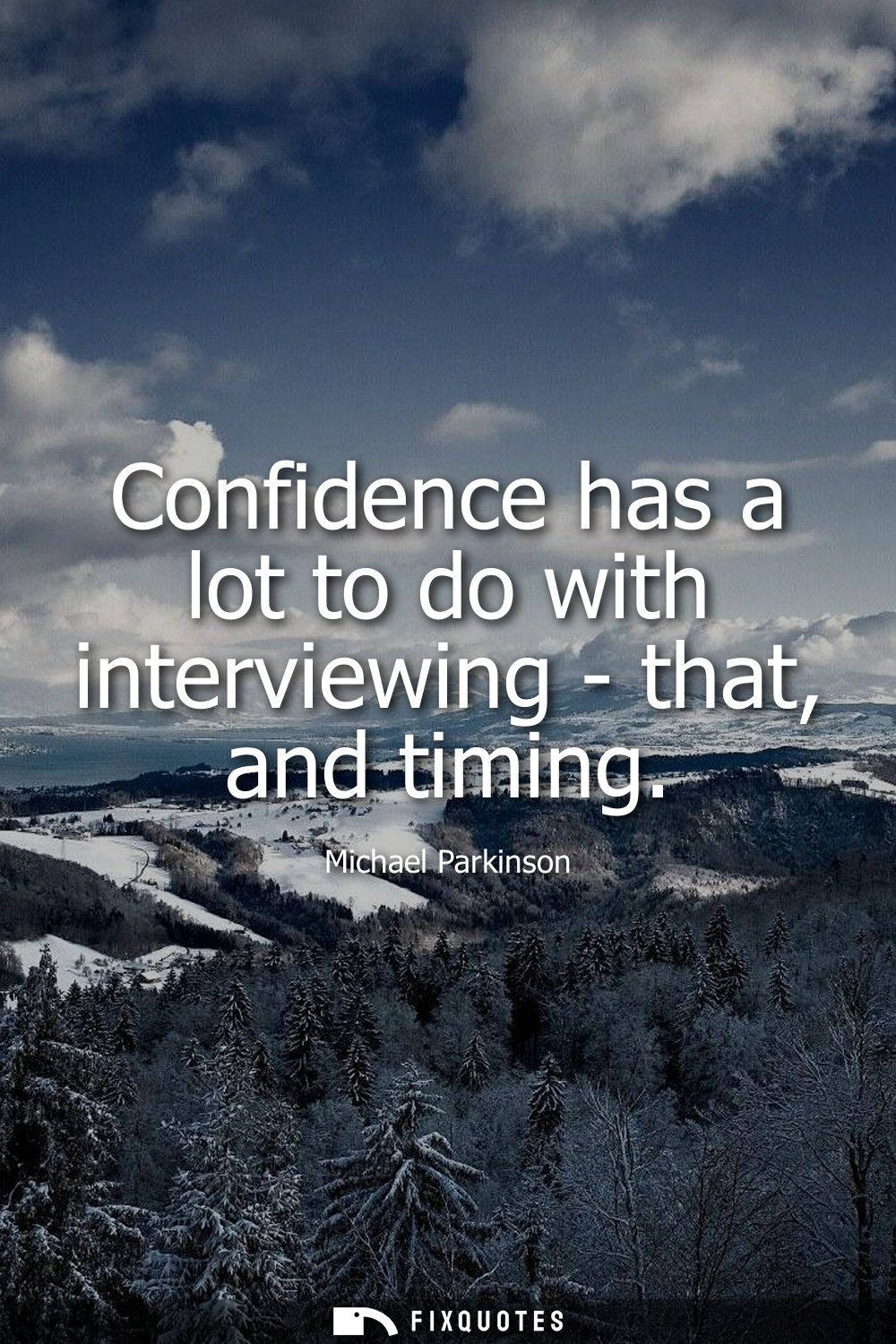
"Confidence has a lot to do with interviewing - that, and timing"
About this Quote
Parkinson’s line lands like an offhand tip, then reveals itself as a small theory of power. By pairing “confidence” with “timing,” he reduces the supposedly noble craft of interviewing to two forces that sit half inside the journalist and half inside the room. Confidence isn’t bravado here; it’s permission. It’s the calm authority that lets you interrupt a legend, hold a silence, ask the question that risks making everyone uncomfortable, and still keep the guest talking. Without it, an interview becomes a courtesy call.
Then he undercuts any myth of pure skill with “that, and timing” - a wry acknowledgement that great interviews are partly arranged by the calendar and the weather of a person’s life. Timing means catching a politician before the talking points harden, a star before the publicist’s grip tightens, an actor after a career wobble when honesty briefly becomes useful. It also means knowing when not to pounce: letting a story ripen, sensing the moment when a small pause will coax a confession more effectively than another clever prompt.
The context is Parkinson’s long reign on British television, where he mastered the deceptively hard art of making high-stakes conversation look effortless. His best interviews often hinged on that double competence: a relaxed assertiveness on-camera, and an almost predatory awareness of circumstance off-camera. The subtext is bracingly unsentimental: the “magic” viewers remember is rarely spontaneity. It’s preparation meeting opportunity, with the interviewer steady enough to recognize the opening and ruthless enough to take it.
Then he undercuts any myth of pure skill with “that, and timing” - a wry acknowledgement that great interviews are partly arranged by the calendar and the weather of a person’s life. Timing means catching a politician before the talking points harden, a star before the publicist’s grip tightens, an actor after a career wobble when honesty briefly becomes useful. It also means knowing when not to pounce: letting a story ripen, sensing the moment when a small pause will coax a confession more effectively than another clever prompt.
The context is Parkinson’s long reign on British television, where he mastered the deceptively hard art of making high-stakes conversation look effortless. His best interviews often hinged on that double competence: a relaxed assertiveness on-camera, and an almost predatory awareness of circumstance off-camera. The subtext is bracingly unsentimental: the “magic” viewers remember is rarely spontaneity. It’s preparation meeting opportunity, with the interviewer steady enough to recognize the opening and ruthless enough to take it.
Quote Details
| Topic | Career |
|---|
More Quotes by Michael
Add to List